

Quick overview
- Gold is currently priced at $4,346, facing a restricted outlook due to hawkish Federal Open Market Committee (FOMC) members.
- Chinese central bank buying and record ETF inflows are providing structural support for gold prices.
- The market anticipates a 90% probability of a rate hike at the December FOMC meeting, with gold defending the $4,334 support level.
- A close above $4,398 is necessary for gold to break out of its current downtrend and potentially rise further.
Gold is currently at $4,346 with a restricted outlook due to more hawkish members of the Federal Open Market Committee (FOMC). Meanwhile, Chinese central bank buying and global ETF inflows provide structural support. The market is pricing in over a 90% probability of a December Federal Open Market Committee (FOMC) meeting rate hike, and gold is defending the $4,334 support level. The near-term outlook is neutral with a slight decline risk, but the longer-term outlook is positive. The FOMC is the only major central bank that is not supporting gold, and record ETF buying is providing a floor. A close above $4,398 is needed for a further rise.
Fed Officials Broaden the Inflation Warning
More Fed officials are recognizing that inflation is broader-based than just in energy prices. Barkin indicated that while the SF region has shown “resilience” in the AI sector, other parts of the economy are showing “firming” conditions. Related to gold, Barkin noted that the cost drivers of inflation are broadening and no longer primarily driven by energy prices and tariffs. Collins said she believed inflation was “mean distributions” and noted support for the recent rate increase. For gold, Collins’s remarks reinforce the likelihood of a prolonged tight monetary policy.
Another Fed Hike Is Becoming the Base Case
On balance, we think recent Fed commentary confirms a higher probability of a third 2022 rate increase. Recently, Musalem said that the U.S. labor market was “somewhat” tight, and in his view, further rate increases were likely. Recently, financial markets have priced in a 90% probability of a 0.75% increase in the federal funds rate by year-end. From a historical perspective, we view the odds for a third 2022 rate hike as rather high.
China Is Providing a Powerful Structural Floor
China remains the most significant counterweight to the US. Gold purchases by the People’s Bank of China rose for the 22nd straight month in August, with the bank adding 20.2 metric tons. Prior to that, the last time the bank added that much gold in a single month was in October 2013. The addition took the country’s official gold holdings to around 2,387 metric tons, or about 9% of China’s FX reserve holdings. It is worth noting that with central bank gold purchases, there is generally no connection to changes in expected Fed policy. Rather, such purchases usually are reflections of dissatisfaction with the status quo and a desire to diversify reserve holdings. This last aspect, especially, provides a floor beneath the current price of gold.
ETF Demand Has Accelerated Sharply
ETF purchases are setting new monthly records, while institutional buying is at record highs. Strong ETF demand shows institutions are not deterred by high Treasury yields and the strong dollar to increase exposure. This also tones why the recent hawkish adjustments by the FED have not impacted gold negatively. The current environment brings a perfect storm for gold; strong physical demand, strong institutional demand and higher rates.
Chinese Investment Demand Extends Beyond the PBoC
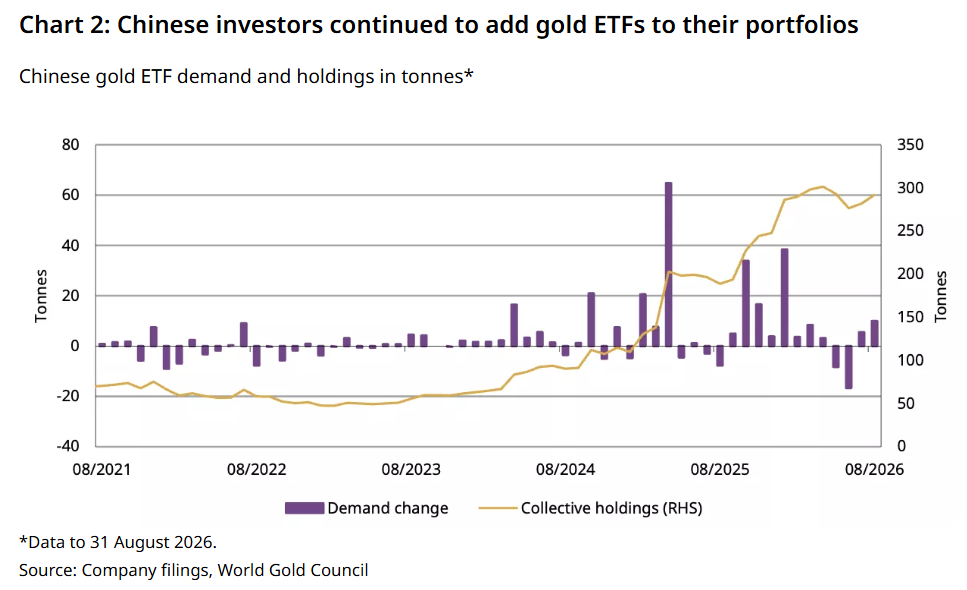
The central bank of China is not the only institution buying gold. August saw a 11 ton increase in Chinese gold ETFs, with inflows for September continuing. China is reported to have imported 1000 tons of gold in 2022. Institutional and private investors are buying gold in China. Weak domestic returns and geopolitical risk create an ideal environment for gold. Combined with higher U.S. interest rates, this environment should increase gold demand and prices.
Middle East Risk Remains a Two-Sided Driver
The geopolitical situation is causing trouble in a different way. Each time there is a flare up in the Middle East, investors increase safe-haven gold holdings. However, there are other two-sided risks from the situation. The disruption has a positive impact on inflation and gives the Fed. the justification it needs to raise rates. Geopolitical risks and U.S. policies towards Iran show the positive effect on rates and inflation but in an opposite way. If the policies enhance and increase diplomacy, gold prices may increase. The removal of sanctions will have the positive effect of lowering inflation and deflation expectations.
Gold Technical Analysis: $4,398 Is the Key Breakout Level
The spot price of gold is currently trading at around $4,346. In the last 4 hours of trading, gold has been trading in a somewhat sideways trend and currently is trading above the $4,334 support area. Multiple attempts at breaking down through the $4,334 support area have occurred but have not been successful and therefore demand has not been completely exhausted. The moving average has been trending higher and gold has been trading under it.
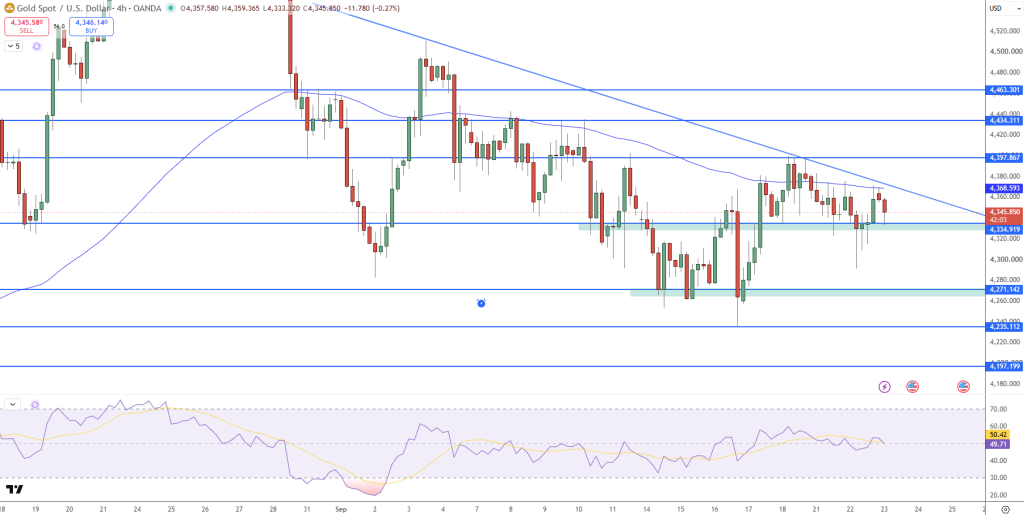
The overall trend of the market has been downtrending and until gold trades above the moving average and the overall downtrendline gold is expected to trade within the range it is currently in. The next resistance areas are expected at $4,369 and $4,398. If the price of gold breaks and trades above the $4,398 resistance area, the next expected resistance area is expected at $4,434, and then $4,463. If the price of gold breaks and trades below the $4,334 support area, the next expected support is expected at $4,271 and then $4,235. The RSI is currently at 50, indicating that that the gold market is expected to trend sideways for the short term.
Resistance: $4,369, $4,398, $4,434, $4,463
Support: $4,334, $4,271, $4,235
I am bearish with the trend line support and resistance in mind. I would need to see a close above $4,398 to change my bias. If $4,271 is broken, support would shift to $4,235.
Frequently Asked Questions
Why is gold holding up despite hawkish Fed policy?
There are a few central bank buying groups, along with record ETF buying, and geopolitical risks. All of this makes a floor for gold prices.
What is gold’s biggest short-term risk?
Any further forward movement with the Fed would definitely be negative. Higher rates and a higher USD strengthening bond rates would increase the opportunity cost of owning gold.
What is the key XAU/USD breakout level?
The most significant level is $4,398. Beyond that, levels are at $4,434 and $4,463.

Arslan Ali Butt
Lead Markets Analyst – Multi-Asset (FX, Commodities, Crypto)
Arslan Ali Butt serves as the Lead Commodities and Indices Analyst, bringing a wealth of expertise to the field. With an MBA in Behavioral Finance and active progress towards a Ph.D., Arslan possesses a deep understanding of market dynamics.
His professional journey includes a significant role as a senior analyst at a leading brokerage firm, complementing his extensive experience as a market analyst and day trader. Adept in educating others, Arslan has a commendable track record as an instructor and public speaker.
His incisive analyses, particularly within the realms of cryptocurrency and forex markets, are showcased across esteemed financial publications such as ForexCrunch, InsideBitcoins, and EconomyWatch, solidifying his reputation in the financial community.