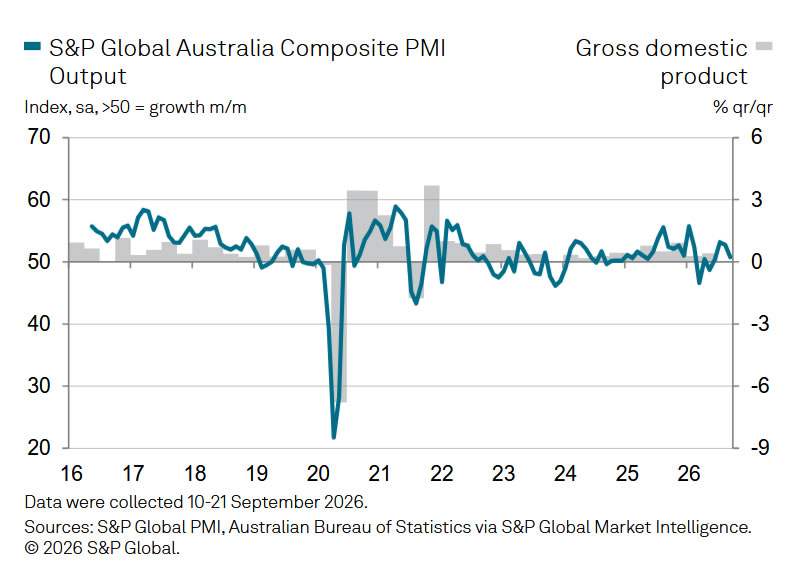
Australia’s private-sector expansion lost substantial momentum in September, with the S&P Global Flash Composite PMI falling to 50.8 from 52.7, its weakest reading of the third quarter. Services activity remained in expansion but slowed for a second straight month, with the index dropping to 51.4 from 53.2. Manufacturing deteriorated more sharply: the Manufacturing PMI fell to 49.3 from 52.0, while the Manufacturing Output Index dropped to 46.4 from 49.6, marking the steepest fall in factory output in 21 months.
The loss of momentum was driven by softer demand. Overall new business increased for a third consecutive month, but at the weakest pace over that period, while manufacturing new orders returned to contraction. Export orders fell for the fifth time in six months, again reflecting weakness in manufacturing. The slowdown also began to feed into employment, with private-sector headcounts falling for the first time in four months. Although the decline was modest, it was the largest reduction since October 2020 and was broad-based across sectors.
At the same time, weaker activity did not bring a corresponding easing in price pressures. Input cost inflation accelerated to a three-month high, while output charges also rose at a stronger rate than in August, although both remained below the elevated rates seen in the second quarter. S&P Global noted that businesses frequently linked higher costs to the Middle East conflict and rising energy and fuel prices. Business confidence also fell to a three-month low and further below its historical average, leaving September’s survey with an uncomfortable combination of slower growth, job losses and renewed cost pressure.
Data Summary
| Indicator | September | August |
|---|---|---|
| Composite PMI Output Index | 50.8 | 52.7 |
| Services PMI Business Activity Index | 51.4 | 53.2 |
| Manufacturing PMI | 49.3 | 52.0 |
| Manufacturing PMI Output Index | 46.4 | 49.6 |
The Composite reading marked the weakest growth of Q3, while manufacturing output recorded its steepest decline in 21 months.
Components
| Component | Trend |
|---|---|
| Overall new business | Growth slowed to three-month low |
| Manufacturing new orders | Returned to contraction |
| New export orders | Fell for fifth time in six months |
| Employment | Fell for first time in four months |
| Input prices | Inflation accelerated to three-month high |
| Output prices | Inflation accelerated from August |
| Business confidence | Fell to three-month low |
Employment losses were broad-based across sectors, while businesses cited energy and fuel costs linked to the Middle East conflict as an important source of renewed cost pressure.
Key Takeaways
- Australia’s Composite PMI fell sharply from 52.7 to 50.8, leaving private-sector activity only marginally above stagnation.
- Services remained the main growth engine, but its expansion slowed for a second consecutive month.
- Manufacturing returned to contraction, with output falling at the fastest pace in 21 months.
- Softer demand spread into the labor market, with employment falling for the first time in four months and by the most since October 2020.
- The growth slowdown was accompanied by stronger input and output price pressures, creating an uncomfortable combination of weaker momentum and renewed cost inflation.