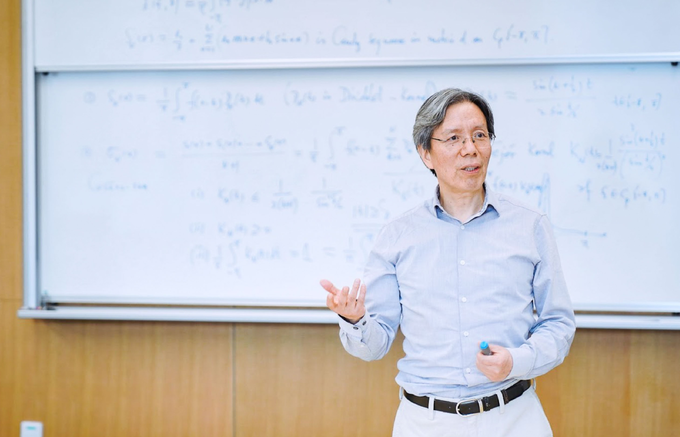
Lin, 67, took up a position as a Qiushi Chair Professor at Zhejiang University this month, according to information published by the university on Sept. 14.
He spent nearly four decades at New York University, where he rose to become a Silver Professor of Mathematics at the Courant Institute of Mathematical Sciences.
Zhejiang University describes Qiushi Chair Professors as leading scholars who have made major contributions to their fields and achieved broad international academic influence. Its 2026 recruitment information requires faculty in such positions to work full time at the university.
The appointment brings Lin back to the university where he earned his bachelor’s degree in mathematics in 1981 before leaving China for the U.S.
Born in Ningbo, eastern China’s Zhejiang Province, he worked carrying stones for seawall construction in his hometown before attending university, according to a 2024 profile published by NYU Shanghai University.
He entered Zhejiang University’s mathematics department in 1977. Despite his talent for mathematics and physics, he had a weak high school academic foundation and ranked near the bottom of his class in an assessment during his first year.
He responded by studying about 12 hours a day and eventually became one of the university’s outstanding mathematics students.
After graduating in 1981, he moved to the U.S. to continue his studies. He earned a doctorate in mathematics from the University of Minnesota in 1985 and joined New York University’s Courant Institute of Mathematical Sciences that year.
 |
|
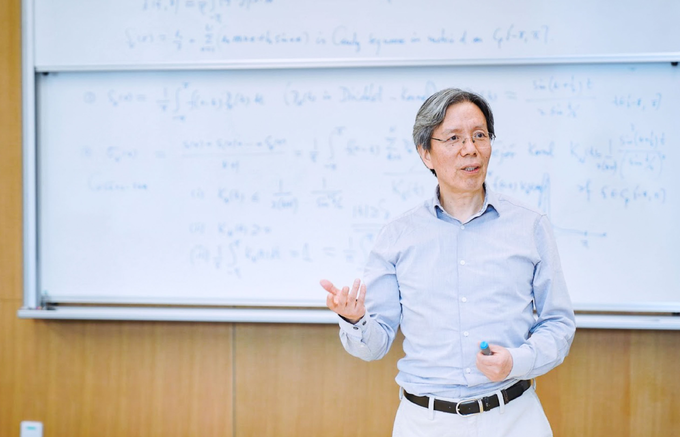
Fang-Hua Lin, Qiushi Chair Professor at Zhejiang University, China. Photo courtesy of NYU Shanghai |
His rise through academia was rapid.
In 1988, at 29, Lin was appointed a full professor of mathematics at the University of Chicago, skipping the associate professor rank. He returned to NYU the following year as a tenured professor and became one of the Courant Institute’s first Silver Professors in 2002.
Apart from periods of research, teaching and visiting scholarship at UC Berkeley, the University of Chicago and the Institute for Advanced Study in Princeton, he has spent most of his academic career at NYU. When he was elected to the U.S. National Academy of Sciences in 2025, he described the honor as particularly meaningful as he approached 40 years at the Courant Institute.
Lin’s research covers partial differential equations, geometric measure theory and geometric and applied analysis, including work on liquid crystals, homogenization and geometric variational problems.
He has published more than 200 research papers in leading mathematics journals, including “Annals of Mathematics,” “Acta Mathematica” and the “Journal of the American Mathematical Society.”
In 1990, he was an invited speaker at the International Congress of Mathematicians, a major global gathering where the Fields Medal, one of mathematics’ most prestigious honors, is awarded.
He was elected to the American Academy of Arts and Sciences in 2004 and the U.S. National Academy of Sciences in 2025. His other honors include the American Mathematical Society’s Bocher Memorial Prize in 2002 and the S.S. Chern Prize at the International Congress of Chinese Mathematicians in 2004.
Despite spending much of his career in the U.S., Lin maintained close academic ties with China.
He first returned in 1989, eight years after leaving Zhejiang University, and later made frequent trips for teaching, lectures, research collaborations, summer programs and academic conferences. He also helped establish the mathematics program at NYU Shanghai, a joint venture between NYU and East China Normal University that opened in 2012.
He previously served as associate provost and founding co-director of the NYU-ECNU Institute of Mathematical Sciences and helped design the university’s undergraduate mathematics curriculum and launch its honors mathematics program.
NYU’s current faculty directory continues to list Lin as a Silver Professor of Mathematics, while NYU Shanghai lists him as an affiliated professor.

