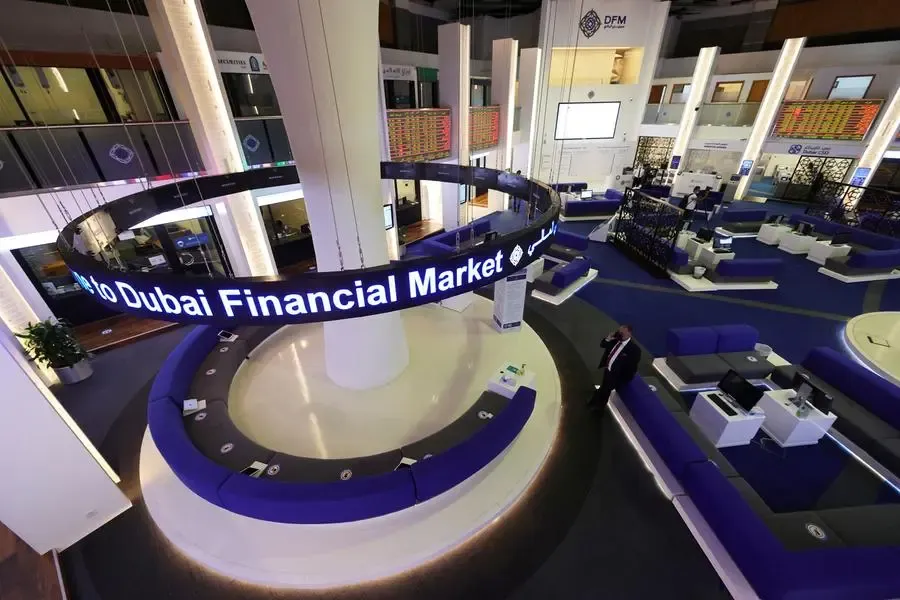
FILE PHOTO: A general view shows the Dubai Financial Market after Joe Biden wins U.S. presidency, in Dubai, United Arab Emirates November 8, 2020. REUTERS/Christopher Pike.
A total of 779 companies were listed on GCC stock markets
,
WAM (Emirates News Agency)
MUSCAT, 13th September, 2026 (WAM) — GCC stock markets recorded trading in approximately 401.7 billion shares during 2025, an increase of 19.5% compared with the previous year, with the value of shares traded reaching approximately US$618 billion.
This is according to the latest data released by the Statistical Centre for the Cooperation Council for the Arab Countries of the Gulf (GCC-Stat).
The general composite index measuring GCC stock market performance stood at approximately 165.2 points at the end of 2025, down 3.8% compared with the end of 2024.
The total market capitalisation of GCC stock markets reached approximately US$3.9 trillion in 2025, a decline of 6.2% compared with the previous year.
A total of 779 companies were listed on GCC stock markets. Of these, the shares of 756 companies were eligible for trading by citizens of Gulf Cooperation Council (GCC) countries on GCC markets, representing 97% of all listed companies. The proportion reached 100% on Bahrain Bourse (BHB), Muscat Stock Exchange (MSX), Qatar Stock Exchange (QSE) and Boursa Kuwait.
In 2025, GCC stock markets witnessed extensive regulatory and legislative developments encompassing the regulation of capital markets and investment funds, the development of offering and listing rules, stronger corporate governance, the regulation of trading conduct and the development of market-making mechanisms, alongside the expansion of digital platforms and financial technologies.
The year also saw stronger risk-based supervision and oversight, the development of financial market infrastructure and updated capital adequacy frameworks, alongside expanded sustainability disclosures and the development of regulations governing the electronic issuance of securities.
As part of efforts to strengthen GCC integration, the investment fund passporting regulations came into force as the first unified regulatory framework for a financial product across GCC countries. Work also continued on initiatives to support the listing and trading of bonds and sukuk, promote dual listings and electronic connectivity between stock exchanges, and unify investor identification numbers for GCC citizens.
Disclaimer: The content of this article is syndicated or provided to this website from an external third party provider. We are not responsible for, and do not control, such external websites, entities, applications or media publishers. The body of the text is provided on an “as is” and “as available” basis and has not been edited in any way. Neither we nor our affiliates guarantee the accuracy of or endorse the views or opinions expressed in this article. Read our full disclaimer policy here.