 1—joint inspection automated channels and one-stop joint services lanes add three new inspection arrangements
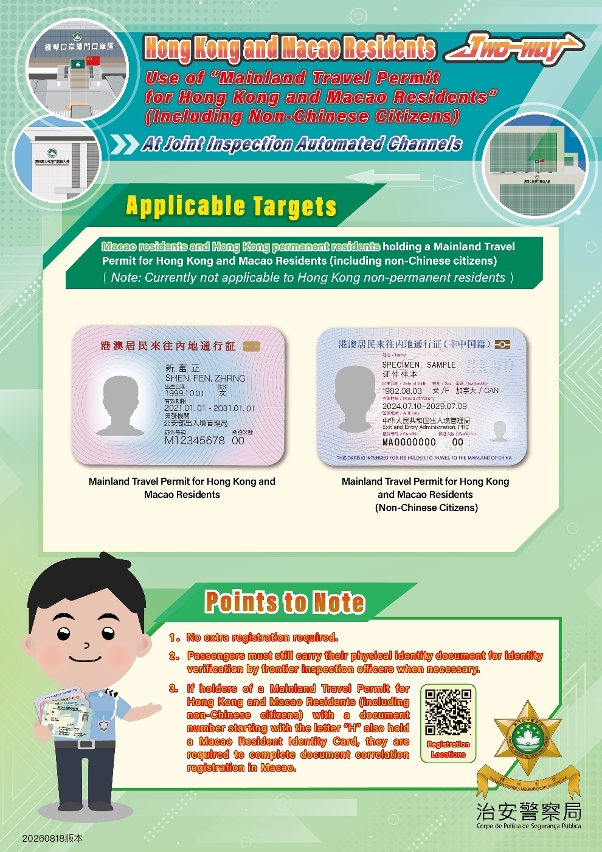
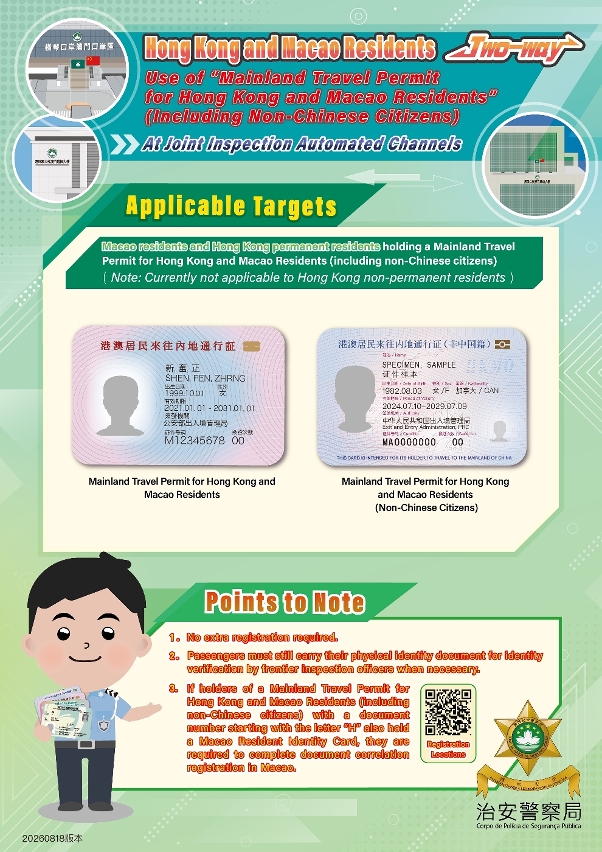
I. Macao residents and Hong Kong permanent residents can use the Mainland Travel Permit for Hong Kong and Macao Residents (including non-Chinese Citizens) in both directions, for departure and arrival, at the Joint Inspection Automated Channels and One-stop Joint Services Lane.
To enhance the convenience of cross-border travel for Hong Kong and Macao residents, the Public Security Police Force, the Public Security Forces Affairs Bureau of Macao, and the Zhuhai General Station of Exit and Entry Frontier Inspection have been rolling out system upgrades. Beginning August 18, 2026, Macao residents and Hong Kong permanent residents will be able to use their Mainland Travel Permit for Hong Kong and Macao Residents (including non-Chinese citizens) to complete automated immigration clearance, for both departure and arrival. This applies to passengers traveling between Macao and Zhuhai, or between Macao and Hengqin, via the automated channels at the Zhuhai-Macao Passenger Clearance Hall of Hong Kong-Zhuhai-Macao Bridge Port; Hengqin Port (including the One-stop Joint Services Lanes); and the Qingmao Port.
The Zhuhai-Macao Hall at the Hong Kong-Zhuhai-Macao Bridge Port, Hengqin Port, and Qingmao Port are Macao’s three land checkpoints operating under the “Joint Inspection, One-Time Release” immigration clearance mode. As key connection points linking Macao, Zhuhai, and Hengqin, they support Macao’s integration into the Greater Bay Area and its key involvement in developing the Guangdong-Macao In-Depth Cooperation Zone in Hengqin. Central to this clearance mode is the Joint Inspection Automated Channels debuted in 2018 at the Hong Kong–Zhuhai–Macao Bridge Port, the first of such clearance arrangement in China. They represent a novel model for immigration clearance under the “One Country, Two Systems” framework. Through the arrangement of “queue once, verify document once, biometric check once”, passengers can complete the immigration clearance procedures between Guangdong and Macao in one go. Previously, the Joint Inspection Automated Channels at the three aforementioned ports and the One-stop Joint Services Lanes at Hengqin Port have on multiple occasions widened the groups of eligible passengers. Behind this expansion was a full upgrade of the “face scan” smart clearance function. Not only did it let more passengers pass through immigration with greater speed and ease, it also lifted port throughput. Safe and reliable by design, this convenient, efficient clearance mode keeps massive cross-border passenger flows moving in orderly fashion. The first half of 2026 saw 42 million immigration clearances at the three mentioned ports that operate under the joint inspection mode, averaging 235,000 crossings a day and a year-on-year increase of 12.8% over the same period of 2025. Macao residents accounted for 43.8% of these crossings, up 12.4% year-on-year, while Hong Kong residents made up 2.2%, an increase of 12.2% over the same period.
Before the current measure takes effect, Macao and Hong Kong residents holding a Mainland Travel Permit for Hong Kong and Macao Residents (including non-Chinese citizens) who used the Joint Inspection Automated Channels were required to present different documents depending on direction of their travel. When travelling from Macao to the Mainland, they had to present their Mainland Travel Permit for Hong Kong and Macao Residents (including non-Chinese citizen). When returning to Macao from the Mainland, they were required to present either a Macao Resident Identity Card or a Hong Kong Permanent Identity Card. After the new measure takes effect, Macao residents and Hong Kong permanent residents can go through the automated channels—including the One-stop Joint Services Lanes—at the three aforementioned ports simply by presenting their Mainland Travel Permit for Hong Kong and Macao Residents (including non-Chinese citizens). This Permit alone will allow passengers to complete automated immigration clearance in either direction, whether travelling between Macao and Zhuhai or between Macao and Hengqin. The current facilitation measure does not affect Hong Kong and Macao residents who use the Joint Inspection Automated Channels to enter Macao, as they may continue using their Macao Resident Identity Card or Hong Kong Permanent Resident Identity Card. Regardless of whether identity card or the Mainland Travel Permit for Hong Kong and Macau Residents (including non-Chinese citizens) is used, the Public Security Police Force will continue to follow the existing practice, using the information from the Macao Resident Identity Card or Hong Kong Permanent Resident Identity Card for the Macao entry and exit records. On a related note, passengers are reminded that they must still carry a valid physical identity document with them, as it may be needed for identity checks by police officers.
Details of the new measure are as follow:
Eligible groups and identity document
Macao permanent/non-permanent residents: Hold a valid Mainland Travel Permit for Hong Kong and Macau Residents (including non-Chinese citizens), and have registered for the automated immigration clearance of Mainland.
Hong Kong Permanent Residents: Hold a valid Mainland Travel Permit for Hong Kong and Macau Residents (including non-Chinese citizens), and have registered for the automated immigration clearance of Mainland and Macao.
※Note1: Currently unavailable to non-permanent Hong Kong residents.
2: Holders of the Mainland Travel Permit for Hong Kong and Macao Residents (including non-Chinese citizens) with a document number starting with “H” are required to complete the document correlation registration in Macao if they also hold a Macao Resident Identity Card.
Applicable inspection channels
Joint Inspection Automated Channels at the Zhuhai-Macao Passenger Clearance Hall of Hong Kong-Zhuhai-Macao Bridge Port, at the Passenger Clearance Hall and Immigration Clearance Hall for On-board Passengers of Hengqin Port, at the Qingmao Port and other ports; as well as the One-stop Joint Services Lane at Hengqin Port.
※Note: These measures do not yet apply to the manual channels at the ports mentioned above, or to any other ports in Macao.
Different ways to verify identity document
|
Macao ➔ Mainland China (Departure from Macao) automated channels |
|
Presenting the Mainland Travel Permit for Hong Kong and Macao Residents (including non-Chinese citizens) |
|
Mainland China ➔ Macao (Arrival at Macao) automated channels |
|
Passengers may choose to present: 1)Macao Resident Identity Card/Hong Kong Permanent Resident Identity Card; or 2)Mainland Travel Permit for Hong Kong and Macao Residents (including non-Chinese citizens) [current enhancement measure]. |
II. Expanding the range of eligible passengers for the Joint Inspection Automated Channels and One-stop Joint Services Lanes at Hengqin Port
To let more passengers access the Joint Inspection Automated Channels or the One-stop Joint Services Lane, two additional facilitation measures will take effect on August 18. These will drive more cross-border travel, while freeing up inspection capacity at the ports and lifting overall clearance efficiency.
1. Expanding the range of passengers eligible to use the Joint Inspection Automated Channels.
Mainland residents who hold a People’s Republic of China Exit and Entry Permit valid for one year with multiple entries may use the Joint Inspection Automated Channels at the Hong Kong-Zhuhai-Macao Bridge Port and Hengqin Port (Mainland immigration clearance is restricted to designated ports).
2. Expanding the range of passengers eligible to use the automated One-stop Joint Services Lane at the Hengqin Port to the following groups:
‧Foreign nationals holding a foreign passport and a PRC Foreign Permanent Resident ID Card, who are visa-exempt and exempt from Prior Authorization to Enter for entry into Macao;
‧Foreign nationals holding a foreign e-passport and a PRC Foreigner’s Residence Permit valid for over 6 months, who are visa-exempt and exempt from Prior Authorization to Enter for entry into Macao;
‧Foreign nationals holding a foreign e-passport with a multiple-entry Chinese visa valid for over 6 months, who are visa-exempt and exempt from Prior Authorization to Enter for entry into Macao;
‧Taiwan residents holding a 5-Year Mainland Travel Permit for Taiwan Residents.
※Note: These two measures require eligible passengers to complete registration for automated immigration clearance in respect of both Macao and Mainland China.
For the locations to register for the automated immigration clearance and the document correlation registration.
https://www.fsm.gov.mo/psp/eng/psp_top7_sm_1_5.html
For automated clearance registration points under the Mainland border inspection.
https://mp.weixin.qq.com/s/ZEK6OrJHAvNltNbBdKpzwA
III. The way forward
The three new clearance facilitation measures introduced this time are designed to streamline entry and exit procedures and enhance cross-border travel convenience. Going forward, the Public Security Police Force, the Public Security Police Force Affairs Bureau of Macao, and the Zhuhai Exit-Entry Frontier Inspection General Station will continue to undertake initiatives to make immigration clearance more convenient. Future efforts will particularly draw on the established practice under which Hong Kong and Macao residents use the Mainland Travel Permit for Hong Kong and Macao Residents (including non-Chinese citizens) bi-directionally, to travel between Macao and the Mainland. Building on this experience, the key focus is the bi-directional verification of identity cards for Hong Kong and Macao residents at the automated channels and automated lanes of the aforementioned ports operating under joint inspection mode. This more convenient clearance process will promote the two-way flow of people and resources, which in turn supports Macao’s push for appropriately diversified economic development and facilitates high-quality growth across the Greater Bay Area as well as the development of the Guangdong–Macao Intensive Cooperation Zone in Hengqin.