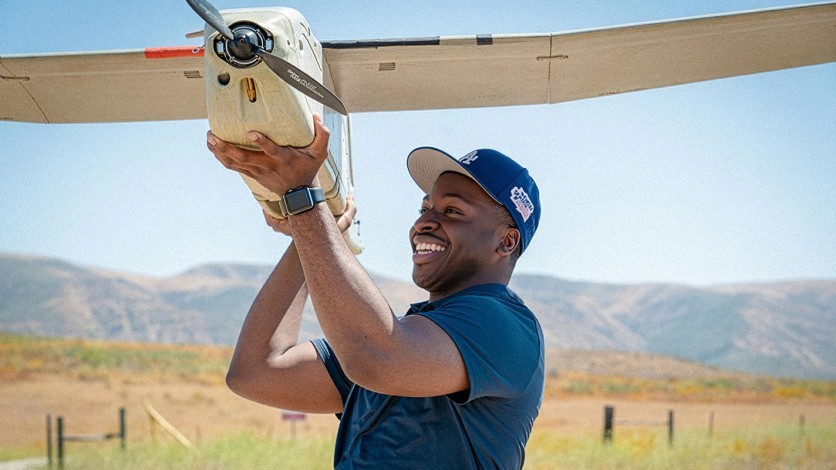

Shares of US drone component maker Unusual Machines surged as much as 22% on Friday after President Trump signed a proclamation imposing tariffs of up to 100% on imported drones and their parts — but the engineering constraint the tariff was designed to escape is not going away: the permanent magnets that spin the motors inside every domestically made drone are still roughly 90% manufactured in China, and the lithium-ion battery cells that power those drones are roughly 99% China-produced, according to NextWeb’s drone supply chain analysis. Wall Street is betting on an American drone renaissance; the materials science says the timeline will be longer than the stocks are pricing in.
The proclamation, signed Thursday under Section 232 of the Trade Expansion Act of 1962 — the same national security authority previously used for steel and aluminum tariffs — imposes a 100% ad valorem tariff on drones exceeding 25 kilograms (approximately 55 pounds) at maximum takeoff weight, drones equipped with thermal imaging capabilities, their docking stations, and certain critical components, per the White House drone tariff fact sheet. A 25% tariff applies to smaller consumer and commercial drones lacking those capabilities, plus other drone components. The tariffs are scheduled to take effect September 3, 2026 — 19 days after the proclamation was signed. Non-sensitive components face a 180-day runway, effective February 9, 2027.
Unlike the International Emergency Economic Powers Act tariffs the Supreme Court struck down in February 2026 in Learning Resources, Inc. v. Trump, Section 232 authority has withstood legal challenge and is not currently facing a comparable constitutional threat, as prior TechTimes tariff coverage has documented. The drone tariffs are legally durable in a way the administration’s earlier tariff architecture was not.
Wall Street’s Bet: Domestic Drone Stocks Surge
Unusual Machines (UMAC) climbed more than 22% to approximately $33 in midday Friday trading, approaching the company’s 52-week high, per 247 Wall St.’s tariff rally report. Red Cat Holdings (RCAT) gained approximately 8% to $11.02. AgEagle Aerial Systems (UAVS) climbed about 5%, and Ondas Holdings (ONDS) rose roughly 4%. Defense contractors with drone exposure also moved higher: Kratos Defense & Security Solutions (KTOS) gained nearly 3%, and AeroVironment (AVAV) rose approximately 2%.
The logic investors applied is simple: a 100% tariff prices Chinese-made drones out of the large-platform and thermal-imaging markets, and a 25% tariff adds friction to the consumer segment. Every dollar of cost advantage DJI’s hardware formerly held over US-made alternatives shrinks. With DJI holding roughly 70% of the US commercial drone market according to the Commerce Department’s own Section 232 investigation finding — and with DJI already barred from receiving new equipment authorizations by the FCC’s December 2025 Covered List expansion — the tariff stacks an economic barrier on top of a regulatory one already in place.
UMAC had already surged approximately 114% year to date before Friday’s gain, which raises the valuation bar for investors chasing the tariff-driven rally. The company posted a Q2 loss of 16 cents per share in early August 2026, in line with analyst estimates.
The Engineering Wall: Magnets and Batteries
The tariff changes who makes the finished drone. It does not change where the core functional components come from.
Every brushless DC motor inside a commercial or military drone depends on a neodymium-iron-boron (NdFeB) permanent magnet — a rare earth alloy capable of producing the highest magnetic energy density of any material in commercial production. The stator of each motor generates a rotating magnetic field via timed three-phase current; the rotor, bearing the NdFeB magnet array, chases that rotating field to spin the propeller. Without rare earth magnets of sufficient grade, brushless motor performance collapses. Each small drone motor contains roughly 5 to 15 grams of neodymium-iron-boron material inside drone motors.
China manufactures approximately 90% of the world’s NdFeB permanent magnets, according to the Select Committee on China, as Dronelife’s reporting on the Magnets Value Chain Support Act has documented. Goldman Sachs has estimated China’s share of the broader rare earth magnet manufacturing market at approximately 98%, as TechTimes’ Army depot coverage noted. China also produces roughly 99% of the lithium-ion battery cells used in commercial and military drones. Motors and batteries — the two components most critical to whether a drone lifts off and keeps flying — originate overwhelmingly in Chinese factories, regardless of where the airframe is assembled.
The Army demonstrated this structural constraint when it activated a domestic brushless motor assembly line at Tobyhanna Army Depot in Pennsylvania on June 30, 2026 — a milestone the Pentagon described as a breakthrough in supply chain independence, as TechTimes reported on Tobyhanna’s motor line. The magnets inside those motors still come from China.
US domestic magnet production is growing. MP Materials’ Independence facility in Fort Worth, Texas has commenced production of neodymium-iron-boron magnets, targeting approximately 1,000 tonnes per year as a starting point. Vulcan Elements, a North Carolina startup backed by a $620 million Pentagon loan announced in November 2025, is targeting 10,000 tonnes per year at full capacity. Even at Vulcan’s target, the combined US domestic output would represent a fraction of the tens of thousands of tonnes of NdFeB magnets the global drone and defense industry consumes annually.
The Conflict-of-Interest Loop
Unusual Machines — the company whose stock surged furthest on Friday — has a formal relationship with Donald Trump Jr. that predates the tariff by nearly two years. Trump Jr. joined Unusual Machines’ advisory board in November 2024, weeks after the presidential election, receiving 200,000 shares as compensation for the role and having earlier purchased 66,000 shares and 66,000 warrants in a private placement, according to Forbes reporting. The advisory board did not exist before his appointment; CEO Allan Evans created it for the occasion, according to Forbes.
Following the appointment, UMAC’s stock nearly doubled in a single day. The company subsequently landed its largest Pentagon contract to date — a deal to supply 3,500 drone motors and other components to the US Army, with the Army indicating a plan to order an additional 20,000 pieces of equipment in the following year. Multiple outlets, including Forbes and the Citizens for Responsibility and Ethics in Washington (CREW), have documented that Unusual Machines appears to be among the companies that created or expanded advisory roles specifically to bring Trump family members onto their boards, subsequently receiving government business, as CREW’s January 2026 report documented.
Trump Jr. denied any involvement with Unusual Machines in communications with federal officials. A spokesperson for him stated: “Don has never communicated with anyone in the administration on behalf of Unusual Machines or about the contract in question.”
The conflict-of-interest loop extends further. Trump Jr.’s venture capital firm, 1789 Capital, invested in Vulcan Elements — a rare earth magnet startup positioning itself as the domestic alternative to China’s NdFeB supply chain — in August 2025. Three months after that investment, the Pentagon’s Office of Strategic Capital announced a $620 million conditional loan commitment to Vulcan, a company of 30 employees at the time, to expand magnet production capacity to 10,000 tonnes per year. ProPublica reported in May 2026, as republished by WUNC/NPR, that White House staff learned of a request to route the loan to Vulcan “around September or October” — shortly after 1789 Capital’s investment. Peter Navarro, a White House adviser and a friend of Trump Jr.’s, worked on the Vulcan deal, according to Manufacturing Dive.
Trump Jr. denied involvement in the Vulcan loan as well. Manufacturing Dive reported his denial in its August 14 coverage. Democratic lawmakers have demanded answers about the Vulcan deal; House Republicans blocked Trump Jr.’s subpoena at a Natural Resources subcommittee hearing on critical minerals.
The financial logic is circular: the Section 232 drone tariff increases demand for domestically made drone components (benefiting Unusual Machines, in which Trump Jr. holds a stake); and the supply chain gap the tariff cannot resolve — the absence of domestic rare earth magnet capacity at scale — creates the commercial rationale for Vulcan Elements to expand (the rare earth company in which Trump Jr.’s fund holds a stake, backed by $620 million in Pentagon loans). Neither connection proves a causal relationship between the tariff decision and Trump Jr.’s financial interests. Both connections are documented. The Cato Institute’s blog noted in May 2026 that “it can be argued that the administration’s true motivation for its ad hoc equity stake collection was to build a pseudo-investment fund for Trump, with the stated justifications serving as little more than window dressing” — while also acknowledging that “the fact that Trump Jr.’s fund invested in Vulcan does not prove that the administration’s deal was awarded because of it.”
What the Tariff Actually Does: A Tiered Structure
The proclamation establishes four tariff tiers calibrated to perceived national security sensitivity:
The 100% rate applies to the category the White House deems most sensitive: drones exceeding 25 kilograms (approximately 55 pounds) at maximum takeoff weight, drones equipped with thermal imaging, their docking stations, and certain critical components. This tier covers the industrial and defense drone categories — platforms used for power line inspection, precision agricultural spraying, search and rescue thermal operations, and infrastructure mapping. For operators currently relying on large-format Chinese hardware in these applications, the tariff is designed to make that hardware economically unviable and redirect procurement toward domestically made or Blue UAS-approved alternatives.
The 25% rate applies to smaller consumer and commercial drones lacking the national-security-sensitive capabilities, as well as other drone components. This tier covers the vast majority of hobbyist and small commercial platforms. Twenty-five percent adds meaningful cost friction, particularly as it stacks on top of other existing import duties, but does not replicate the economic force of the 100% tier.
Allied nations received preferential rates: 15% for the European Union, Japan, Liechtenstein, South Korea, Switzerland, and Taiwan — contingent on substantially all hardware, software, and technology originating from those countries — and 10% for the United Kingdom under the same origin condition, as Quartz’s allied tariff breakdown confirmed. These rates are meaningfully lower than what Chinese competitors face, but they still represent a new cost burden in markets where those manufacturers previously operated without drone-specific levies.
Commerce Secretary Howard Lutnick has been authorized under the proclamation to establish a formal domestic drone-manufacturing onshoring incentive program and to add further UAS components to the tariff program if their imports are later found to contribute to the identified national security concerns. An update to the president is required within 120 days.
China’s Countermove
China had already moved eight days before the tariff proclamation. On August 5, China’s Ministry of Commerce announced a retaliatory package that included requiring strict case-by-case approval for every drone shipment to the United States, blacklisting six American companies — including Applied DNA Sciences, Stratum Reservoir, Altana Technologies, the Responsible Business Alliance, Verite Group, and Human Rights in China — and launching additional trade-related investigations, as NBC News reported on China’s retaliation. The ministry cited the FCC’s Covered List expansion and the Department of Homeland Security’s addition of 43 Chinese companies to the Uyghur Forced Labor Prevention Act entity list as the provocation.
China’s commerce ministry spokesperson stated that US actions “seriously harm China’s legitimate rights and interests” and that China could “only take necessary countermeasures in response, including strengthening export controls on drones and their key components and technology to the US.” The case-by-case approval requirement adds administrative friction to existing shipment pathways that drone manufacturers and distributors currently rely on to move product.
Who Pays More and When
For industrial and defense drone operators — the tier facing the full 100% duty — the effective cost of Chinese-made hardware will double once the tariff takes effect on September 3, per the White House tariff proclamation details. Power line inspection companies, agricultural spray drone operators, and search and rescue agencies whose procurement plans anticipated Chinese large-format hardware must now either shift to Blue UAS-approved domestically manufactured or allied-nation alternatives, pay the doubled price, or defer purchasing decisions until domestic supply scales.
That scaling is not a given. Domestic manufacturers the tariff is designed to benefit still source their core inputs — brushless motor magnets, battery cells — from the same Chinese supply chains the policy is trying to escape. Unusual Machines has been building a manufacturing facility in Orlando, Florida, with drone motor production scheduled to begin this year; the magnets for those motors remain largely imported.
Consumer and small commercial operators facing the 25% rate will absorb higher prices in the near term, with those costs stacking on top of existing import duties. DJI’s technological lead in the consumer segment — its obstacle-avoidance systems, camera quality, and flight software — remains so pronounced that some analysts question whether even significant price increases will push buyers toward domestic alternatives that currently lack comparable performance at equivalent price points.
European, Japanese, South Korean, and Taiwanese drone manufacturers face their own recalibration. The 15% preferential rate is substantially lower than the rates facing Chinese competitors, but it still represents new cost pressure in a market where these manufacturers had previously operated without drone-specific duties.
The proclamation also builds on a regulatory foundation already in place. The FCC’s December 2025 Covered List expansion blocked all new foreign drone models from receiving equipment authorization — preventing new DJI and Autel products from entering the US market. The January 2026 Blue UAS exemption framework allowed approved domestic and certain allied-nation manufacturers, including Parrot, Teledyne FLIR, AeroVironment, and Auterion, to continue operating. Thursday’s tariffs stack an economic barrier on top of a regulatory architecture that had been tightening for months, as TechTimes’ FCC LiDAR ban coverage documented.
Eight Years of Escalation
Thursday’s proclamation is the culmination of a US-China drone policy conflict that began in 2018, when the Pentagon first banned DJI systems from military use over data security concerns. The Commerce Department added DJI to its Entity List in 2020. A December 2024 rule barred Chinese manufacturers from obtaining authorization to sell new drone models or key components in the United States. A June 2025 executive order, described as “Unleashing American Drone Dominance,” directed the FAA to accelerate rulemaking and directed the Defense Department to prioritize US-made drones in procurement. The FCC’s December 2025 Covered List action then blocked all new foreign drone authorizations. The tariff proclamation of August 13 represents the economic instrument following the regulatory scaffolding.
DJI disputes the underlying data security rationale. A five-month independent security audit by US cybersecurity firm OnDefend, published in May 2026, found no backdoors, no data transmissions outside the United States, no viable pathways for hijacking or weaponization, and confirmed that flight logs have not been automatically uploaded to DJI servers since June 2024. DJI’s argument — that its hardware is technically clean — does not resolve the structural legal reality: China’s National Intelligence Law (2017) Article 7 legally requires all Chinese organizations to cooperate with national intelligence efforts, an obligation that applies to DJI regardless of the results of any corporate-commissioned audit. The Department of Defense submitted a classified annex to Congress in April 2026 setting out its security rationale; that annex has not been made public.
The global drone market reached an estimated $96.4 billion in 2026, up from $83.8 billion in 2025, according to Grand View Research’s analysis of commercial and military hardware revenue. With Beijing now requiring case-by-case approval for every drone shipment to the United States and Washington imposing duties that effectively price Chinese hardware out of critical commercial sectors, drones have become the most recent flashpoint in a US-China technology trade conflict that has already passed through semiconductors, telecommunications equipment, electric vehicles, and humanoid robots.
Frequently Asked Questions
Why did Unusual Machines stock surge more than any other drone company on the tariff news?
Unusual Machines manufactures drone components domestically in the United States — specifically motors, electronic speed controllers, flight controllers, and video equipment — and sells to both commercial and defense customers. Because the tariff is designed to price Chinese-made components out of the US market, domestic component suppliers like Unusual Machines are the most direct financial beneficiaries: the companies that were previously competing against cheaper Chinese imports now face competitors paying 25–100% more. The company also has a formal advisory board relationship with Donald Trump Jr., who holds a stake in the company; the connection between the Trump family and the primary domestic drone tariff beneficiary has drawn scrutiny from ethics organizations, ProPublica, Forbes, and others since the advisory board was created in November 2024. CREW’s January 2026 ethics report documents this pattern in detail.
What drones are subject to the 100% tariff, and which face the lower 25% rate?
The 100% tariff covers drones exceeding 25 kilograms (approximately 55 pounds) at maximum takeoff weight, drones equipped with thermal imaging capabilities, docking stations for those drones, and certain critical components. This category covers large commercial platforms used in agriculture, infrastructure inspection, and industrial surveying, as well as thermal-equipped drones used by fire departments and search and rescue teams. The 25% rate applies to smaller drones below the 25 kg threshold that lack thermal imaging — the consumer and small commercial category. Allied-nation products from the EU, Japan, South Korea, Switzerland, Taiwan, and Liechtenstein face a 15% rate instead, and the UK faces 10%, contingent on origin certification. The tariffs are scheduled to take effect September 3, 2026; certain component tariffs are delayed until February 9, 2027. Full details are in the White House drone tariff fact sheet.
If US drone manufacturers are the winners, why can’t they simply ramp up to meet demand?
The challenge is not assembly capacity — it is inputs. Every brushless DC motor inside a drone requires neodymium-iron-boron permanent magnets, which China manufactures at roughly 90% of global capacity, as Dronelife’s magnet supply chain report documented. The battery cells that power those drones are roughly 99% produced in China. A US company can assemble drone motors domestically, but the magnets inside those motors and the battery cells that run the finished product still come from Chinese supply chains. The Army demonstrated this constraint at Tobyhanna Army Depot, where it opened a domestic motor assembly line in June 2026 — but the magnets for those motors remain China-sourced, as TechTimes’ Tobyhanna motor line coverage documented. Domestic rare earth magnet producers like MP Materials and Vulcan Elements are scaling up, but combined output remains a fraction of what the drone industry requires. The tariff creates the demand signal for domestic scaling; the physical infrastructure to respond to that signal does not exist yet at the necessary scale.
What did China do in response, and does that affect drone buyers before September 3?
China announced retaliatory measures on August 5 — eight days before the tariff proclamation was signed — that require case-by-case approval for every drone shipment to the United States, in addition to blacklisting six US companies. NBC News confirmed China’s export controls are already in effect and adds administrative friction to existing import supply chains. US distributors and importers that were counting on shipments of DJI or other Chinese drone hardware may face delays and uncertainty even before the September 3 tariff effective date, as shipments now require individual Chinese government approval. The timing of China’s August 5 action — predating the proclamation — suggests Beijing was responding to the FCC’s Covered List action and the forced-labor enforcement measures rather than to the Section 232 tariff specifically; regardless of the trigger, the practical consequence for buyers who need hardware is that the supply is becoming more constrained from both ends simultaneously.
