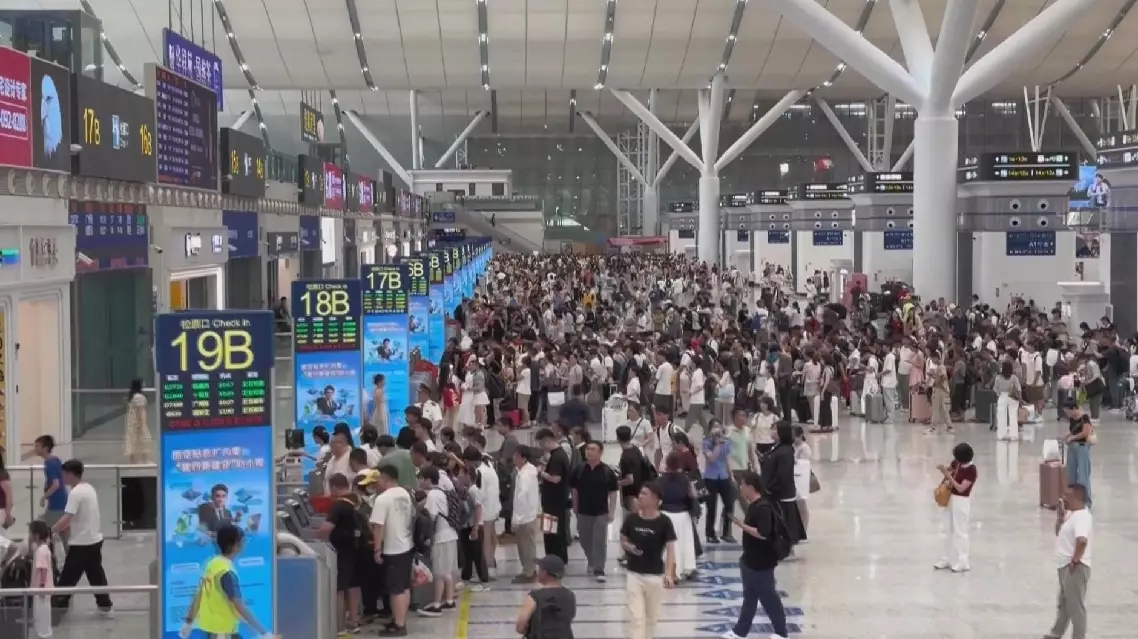
As of Monday, the Guangzhou-Shenzhen-Hong Kong Express Rail Link had transported a cumulative total of 20.054 million cross-border passengers this year, reaching the 20-million-passenger milestone 11 days earlier than last year, according to the latest statistics from Shenzhen railway department.
Breakdown figures showed that the number of passengers traveling from the Chinese mainland to the Hong Kong Special Administrative Region (HKSAR) came in at 10.327 million, and the number of passengers traveling from the HKSAR to the Chinese mainland stood at 9.727 million, with a vigorous two-way flow of passengers.
“We’re planning to take the kid to Disneyland during the summer vacation, and also visit Victoria Harbour — the one the kid has read about in her schoolbooks,” said Ms Wang, a tourist from southwest China’s Sichuan Province.
“Since we’re coming by the high-speed rail, it’s quick and convenient,” said Wang’s daughter.
“We are going back to my hometown Xiamen for a trip of about six days. We will visit Gulangyu Island and some other places, as my children have never been there,” said Mr. Che from the HKSAR.
Data showed that the cross-border passenger flow reaches peak at weekends. This year, the peak number of days with daily passenger flow exceeding 100,000 has reached 63, four days more than the same period of last year.
“Since the start of the summer travel season, the passenger flow on the Guangzhou-Shenzhen-Hong Kong High-Speed Express Rail Link has continued to rise, with a total of 3.817 million passenger trips transported, averaging 93,000 per day. On August 8, in particular, the number of passenger trips reached 136,000, setting a new record for the highest single-day passenger flow during the period,” said Wei Liangyi, duty chief of the Shenzhen North Railway Station. According to statistics from the Shenzhen General Station of Exit and Entry Frontier Inspection, as of 18:00 on Thursday, the number of people entering and leaving the country through Shenzhen ports this year had reached 182 million, including 5.2025 million foreign people.
“We are going [to travel in] China in Guangzhou, Guilin, Dali, Lijiang, Shangri-La. It’s easy to take high-speed railway,” said a tourist from France.
“Since the beginning of this year, the West Kowloon Border Inspection Station has handled over 1.07 million foreign passenger trips, an increase of 34.7 percent compared to the same period last year. In particular, nearly 300,000 foreign tourists have entered the country under visa-free policies, an increase of about 78 percent compared to the same period last year,” said Wu Yanwen, a staff member with West Kowloon Border Inspection Station.
Cross-border passenger trips on Guangzhou-Shenzhen-Hong Kong high-speed rail top 20 million this year
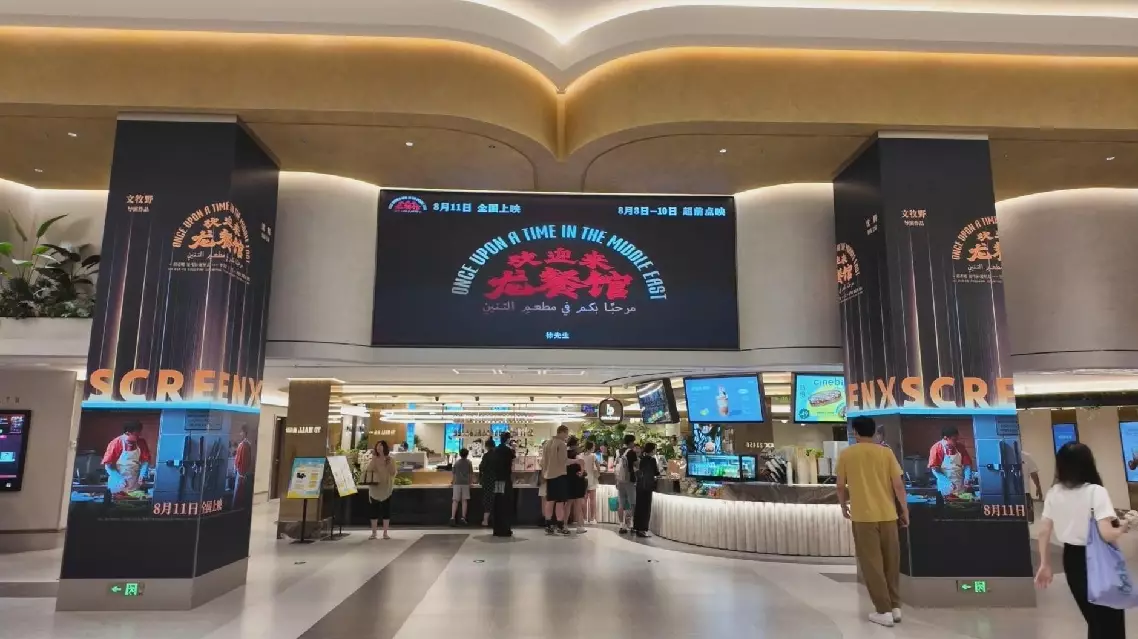
Breaking long-standing Western heroic narrative conventions in filmmaking, the trending Chinese anti-war film “Once Upon a Time in the Middle East”, is reshaping global cinematic discourse on war and peace.
The summer blockbuster was released on Tuesday nationwide and had earned box office revenue of more than 536 million yuan (around 79.5 million U.S. dollars) as of 22:00 Friday.
The story centers on Xu Fu, a down-on-his-luck Chinese chef portrayed by celebrated comedian Shen Teng, who travels to the Middle East to settle his debts. There, he joins forces with a local restaurant manager to operate a bustling restaurant, bringing authentic Chinese culinary traditions to a war-torn foreign land.
As a distinct Chinese anti-war feature, “Once Upon a Time in the Middle East” abandons timeworn Western heroic storytelling. The film adopts the humble viewpoint of Xu Fu, an ordinary cook. Through his eyes as a neutral bystander, it portrays the struggles and sufferings of ordinary people trapped in conflict and uses food and everyday life to explore survival, compassion and the value of peace, rather than focusing on the battlefield.
Such a narrative perspective is quite pioneering among global anti-war film productions.
“It realistically reflects the turmoil of war. Therefore, we desire peace and oppose the suffering that wars of aggression inflict upon the people,” a moviegoer praised.
Meanwhile, the blockbuster has garnered massive overseas anticipation prior to its international debut. Many global film enthusiasts agree that the production epitomizes a transformative shift in Chinese film industry, which is overhauling Hollywood’s established narrative paradigms and reinterpreting the global narrative of war and peace at a higher level.
“Just imagine how this story would unfold if Hollywood were to film it. It would almost certainly follow the standard formula of superheroes, super-soldiers, or elite operatives swooping in, resolving the crisis in a flash, and then disappearing. What does the ‘Once Upon a Time in the Middle East’ offer? The idea that the best days are those spent sharing a meal together. Conversely, what drives people to fight instead of dining together? Anyone who has seen the film knows the answer. That is why some netizens have said that if this movie were to compete for a U.S. Oscar award, it would be a voice representing the Global South,” said Zuo Heng, a researcher at the China Film Archive.
Many scholars also hold the view that war narratives on international screens have long revolved around contests of victory and military conquest, but “Once Upon a Time in the Middle East” does not stoke hatred nor glorify victory by force. Instead, it hides the key to peace amid the mundane routines of daily meals.
This vision of peace, rooted in the moderation and inclusiveness of Chinese civilization, blazes a new trail of expression for global anti-war films.
It constitutes an innovation in film creation and enables the world to see perceptions of peace different from those of the West.
“The film delivers an anti-war perspective that diverges from the Hollywood paradigm. It abandons Hollywood-style individualism, and quietly challenges the ‘America First’ mindset. ‘Once Upon a Time in the Middle East’ keeps exploring innovative approaches to shape contemporary Chinese discourse and narrative systems,” said Sun Jiashan, a researcher with the Department of Chinese Culture Education and Research under the Central Institute of Socialism.
Chinese anti-war film offers new cinematic narrative on war and peace