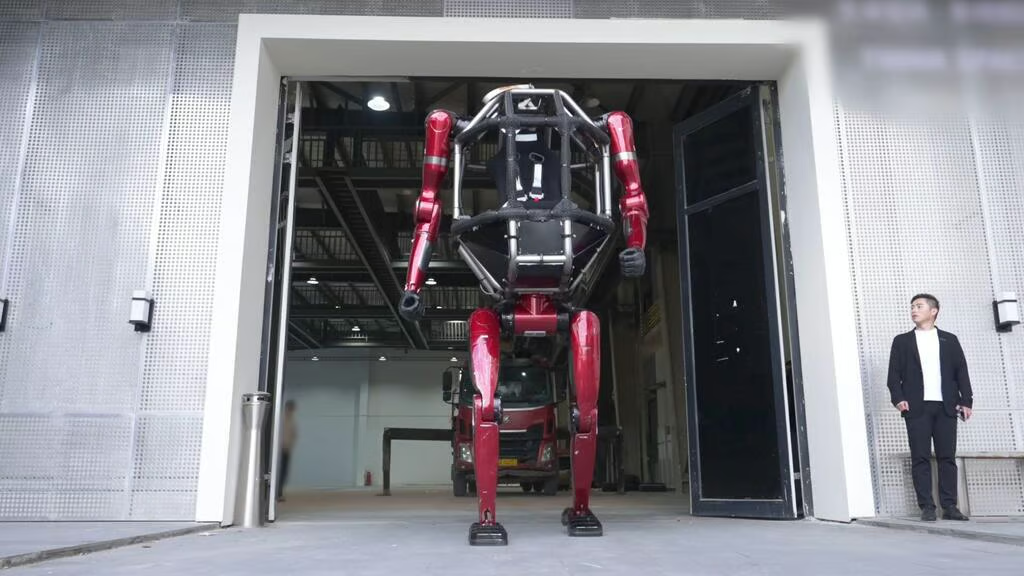
But it turns out that while American companies are drawing much of the attention, the Chinese are already producing on an entirely different scale.
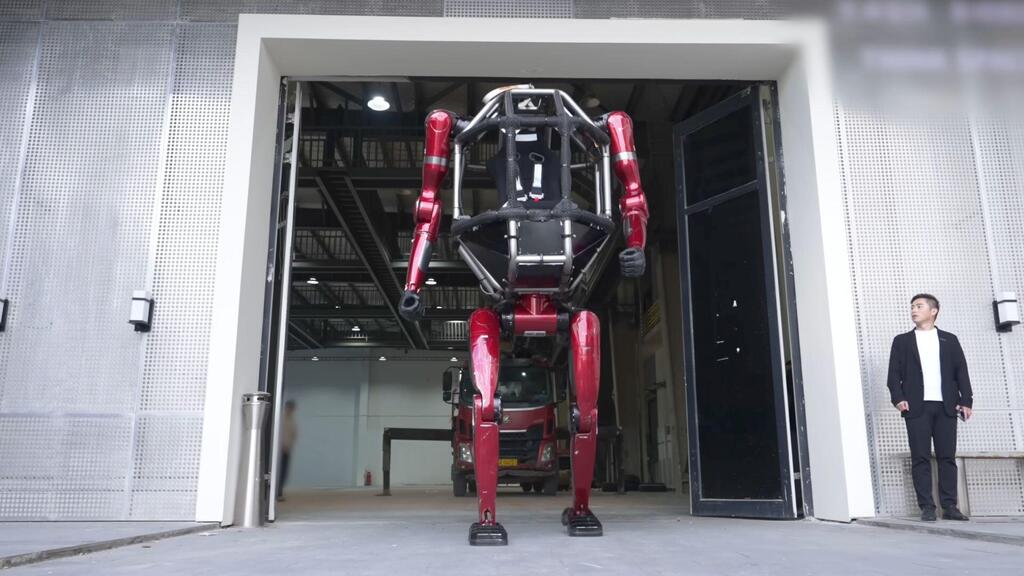
Unitree’s GD01 robot
(Photo: Unitree)
Data published by the technology website The Next Web reveals just how wide the gap is: Chinese manufacturers are currently responsible for about 97% of global shipments of humanoid robots. In other words, almost every humanlike robot shipped this year to a customer, research institution or other organization came from China.
An important caveat: A “shipment” does not necessarily mean the robot is already working in a factory or replacing human beings. Some machines are sent to laboratories, universities and companies that purchase them for research and development. Still, the figure illustrates how large a gap has emerged in the ability to actually manufacture these machines.
That figure joins an estimate published last year by the American investment bank Morgan Stanley, which finds that of about 13,000 to 16,000 humanoid robots shipped during 2025, about 90% were made by Chinese companies. The U.S., Japan and other competitors, by contrast, are operating on a much smaller scale.
Unitree’s Gabi robot becomes a Buddhist monk
(Video: Reuters)


One of the clearest examples of the gap is China’s Zhiyuan Robotics, which, according to the data, shipped about 5,100 robots last year, close to 40% of the entire global market. Unitree, which has already become one of the leading names in China’s robotics industry, is not far behind.
Across the ocean, by contrast, the picture looks very different. Companies such as Figure, Tesla and Agility Robotics in the U.S. are indeed developing advanced robots and carrying out trials and initial deployments, but in terms of the number of units actually reaching the market, each is still limited to a few hundred.
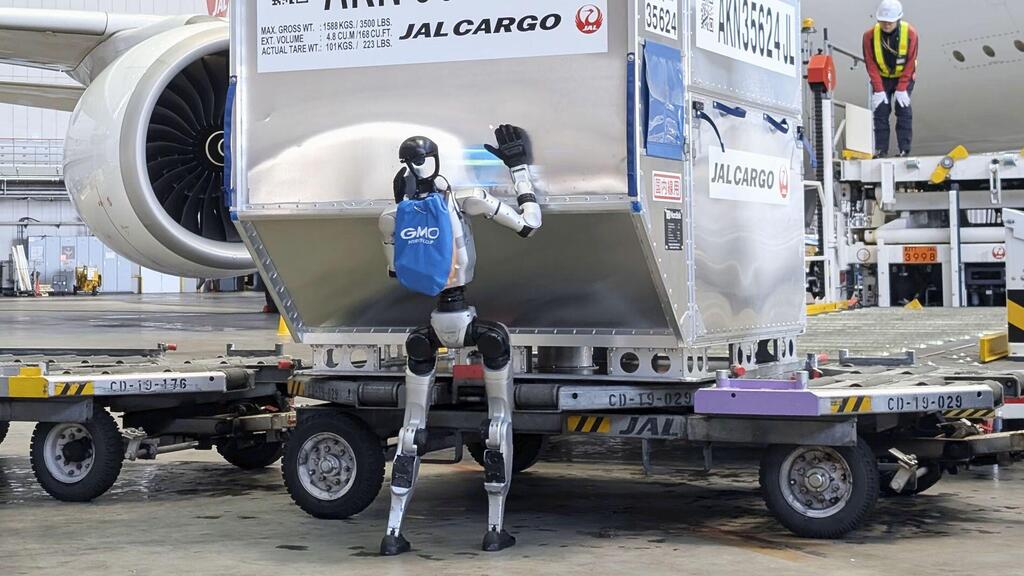
A Unitree robot works at an airport
(Photo: Getty Images)
According to Morgan Stanley’s calculations, Zhiyuan Robotics shipped roughly 36 times more robots than its American competitors. That is a gap that is difficult to explain by the success of one company alone, and it points to a broader advantage China currently holds: the ability to take a technology still in its early stages and move it quickly into large-scale production.
Developing an impressive AI model is not enough to produce a humanoid robot. These machines require a large array of components: motors, sensors, cameras, drive systems, joints, reducers, 3D vision sensors, electronics and control systems.
Here, China has a significant advantage. More than half of the world’s 100 main suppliers of essential robotics components are Chinese. That means local manufacturers can obtain a large share of the parts they need within the domestic supply chain, while competitors in other countries often have to import them.
The result is not only a shorter supply chain, but also an ability to scale up production and lower prices more quickly. In the current robotics industry, where price remains one of the main barriers to broad adoption, this is an advantage whose importance is hard to overstate.
At the same time, surveys among Chinese companies indicate that mass adoption of robots will begin only when prices fall below a certain threshold. Accordingly, manufacturers in the country are trying to cut costs and produce more units, hoping to gradually turn an expensive experimental product into a machine that makes economic sense to operate in a factory, business and perhaps eventually at home.
Behind the production lines are growing sums of money. By early 2026, China had already attracted nearly half of global venture capital investment in humanoid robotics, while the country’s leading companies are also beginning to turn to capital markets. Unitree, for example, recently received a green light to advance toward an initial public offering, against the backdrop of growing investor interest in the field.
All of this is joined by support from the Chinese government, which has made robotics and physical AI — artificial intelligence that operates in the physical world and not only inside a computer — a top priority. Accordingly, forecasts for China’s industry continue to rise, and Morgan Stanley has already doubled its shipment forecast for China.
At the same time, the first uses are beginning to move beyond the laboratories. Chinese automakers are among the early adopters of the technology, and BYD, for example, plans to place a humanoid robot in its showrooms in the coming months.
That may be less impressive than a video of a robot doing a flip, dancing or boxing with another robot, but it is precisely the relatively boring uses that will likely determine in the end whether this is a real industry or just another niche technology gimmick.
Here lies the major asterisk behind that impressive figure: A significant share of the robots now coming off production lines in China are still better at demonstrations than at real work in the field. Walking, running, dancing and complex movements look excellent in videos, but the distance between a controlled demonstration and a robot capable of performing useful tasks for hours, independently and reliably, remains large.
The fact that a robot was shipped to a customer also does not necessarily indicate commercial use. Since some machines serve as research and development platforms, a 97% market share does not mean that 97% of the world’s useful robots are Chinese, and certainly does not mean the outcome of this technological race has already been decided.
But production scale matters even when the technology is not yet mature. The more robots a company produces, the more information it can gather from operating them in the real world, the faster it can identify faults, improve production lines and reduce component costs.
At the same time, production scale strengthens local suppliers and allows them to invest in the next generation of sensors, motors and components. In other words, an advantage in quantity today can become a technological advantage tomorrow.
The U.S., however, has a major card of its own: artificial intelligence. Ultimately, even the most mechanically advanced robot is limited if the software that operates it cannot understand its surroundings, plan actions and cope with situations for which it was not programmed in advance.
And here, some of the world’s strongest companies are in the U.S. If advanced AI models become the “brain” that powers the next generation of robots, the American advantage in software could narrow at least part of the industrial gap with China.