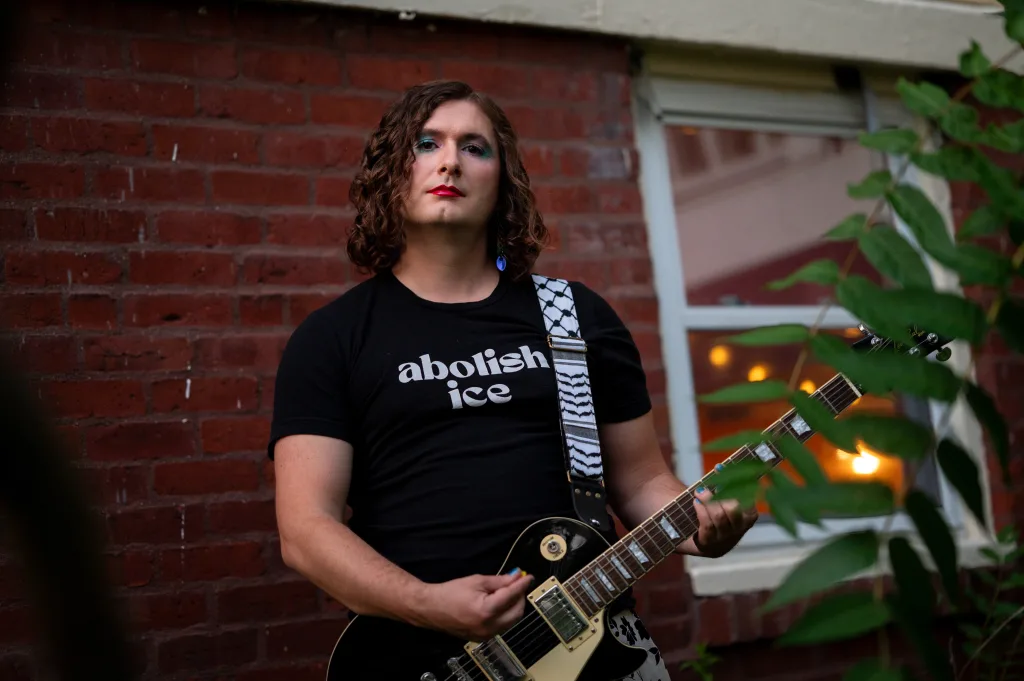

Evan Greer – Photo Credit Michelle Schapiro
The revelation that Madison Square Garden maintained an internal database identifying LGBTQ celebrities while also tracking activists and critics has intensified concerns about the growing reach of corporate surveillance. Digital rights advocates say the database—which included Fight for the Future Director Evan Greer, a transgender activist who uses she/they pronouns—illustrates how private companies are increasingly deploying facial recognition and other surveillance technologies with few legal safeguards or public oversight.
The controversy emerged after WIRED reported that Madison Square Garden Entertainment maintained an extensive internal database containing information about celebrities, including their political affiliations, demographic characteristics and personal relationships with company executives. According to the report, the database also included notes about activists and critics of the company, raising new questions about how private corporations are using surveillance technologies once associated primarily with governments.
Fight for the Future subsequently revealed that Greer appeared in the database, where company personnel identified her as a facial recognition activist. For Greer, the revelation is less about one corporation than a broader shift toward private entities building surveillance capabilities that increasingly rival those of governments.
“That is a great question,” Greer said when asked why Madison Square Garden would keep records on LGBTQ celebrities. “And I think what’s useful for (people) to think about with stuff like this is there may not be a overarching nefarious purpose why a corporation like Madison Square Garden would be keeping a database like this.”
Greer acknowledged that Madison Square Garden has suggested the database may have functioned as a customer relationship management tool.
“It might be on its face what they say it is, which is sort of their own CRM where they’re keeping track of celebrities and want to invite them to queer events,” Greer said.
But Greer argued that focusing solely on Madison Square Garden’s explanation misses the larger issue.
“I think what it illuminates for folks is that we think of surveillance as something that the government does,” Greer said. “And increasingly we’re heading into a future where in fact, private companies and even wealthy individuals are building surveillance capabilities that rival some nation states.”
According to Greer, those expanding capabilities are subject to far fewer legal restrictions than government surveillance.
“There are actually far fewer regulations and rules in place that govern how those private companies and individuals can use surveillance technologies,” Greer said. “And so the answer is we don’t really know why James Dolan is keeping a database of gay celebrities.”
Greer said the more pressing concern is what the database represents about the growing power of wealthy corporations.
“It may be for no terrible reason,” Greer said. “But I think the bigger question here is what are we going to do as a society to put some rules in place so that wealthy and powerful individuals and companies can’t leverage their surveillance capabilities to suppress dissent, to discriminate against marginalized communities, or to otherwise consolidate their power and undermine our democratic institutions that are supposed to hold the powerful to account?”
Greer said the political climate makes private surveillance particularly concerning for marginalized communities.
“Of course,” Greer said when asked whether the current political environment makes people more uneasy about surveillance. “I mean, we already have the Trump administration making lists of trans people for purposes that are not about protecting trans people.”
Greer added, “Anyone who has studied history for any amount of time can get a little anxious and itchy when authoritarian governments start making lists of marginalized communities.”
While governments often receive the greatest scrutiny over surveillance, Greer argued that private companies increasingly provide the infrastructure that governments later rely upon.
“The reality is that government surveillance, at least for the last 50 years, has been largely built on top of corporate surveillance,” Greer said, citing disclosures by former National Security Agency contractor Edward Snowden about government access to data held by telecommunications companies and internet providers.
Greer warned that private companies may deploy technologies for commercial reasons while governments later gain access to those same systems.
“We’re just heading further and further down that path as we allow private companies, even like a music venue like Madison Square Garden to start using technologies like facial recognition or other AI surveillance tools that they may be using for their own private purposes, but that governments can and will access for law enforcement purposes, for suppressing dissent or to otherwise, again, consolidate their power and undermine our ability to hold them to account.”
Greer challenged the common argument that people who obey the law have little to fear from surveillance.
“I think this is, I wrote this in the piece that I wrote recently for MS Now, formerly MSNBC, but I think this is the thing that comes up a lot,” Greer said. “And the thing that I want people to understand is that you personally never have to be targeted by corporate surveillance for it to profoundly impact your life.”
Instead, Greer said, surveillance changes the balance of power between corporations and the public.
“What corporate surveillance does, especially at scale and with the kind of enhancement of artificial intelligence, which makes it cheaper, faster, and easier for private companies and individuals to use, is not just target people that have broken the rules,” Greer said. “It allows companies to break the rules and get away with it because it makes it easier for them to, for example, surveil activists, regulators, the people that are supposed to be holding them accountable and make it harder for us to organize.”
Greer said the Madison Square Garden database itself illustrated that concern.
“This Madison Square Garden story, one of the kind of nuggets embedded there was that they were actually keeping a dossier on me, Evan Greer, as a facial recognition activist for the purpose of keeping tabs on the critics and activists that are trying to hold them to account,” Greer said.
Greer argued that the consequences of surveillance ripple far beyond those directly monitored.
“So even if you yourself are the most law-abiding, squeaky, clean citizen in the world, surveillance can make your life worse and it can make the world less free and less vibrant for your kids and your kids’ kids,” Greer said.
Greer compared unchecked surveillance to other collective societal challenges.
“We have to think of this more like a collective problem like climate change or world hunger,” Greer said. “This is something that affects all of us.”
Greer warned that artificial intelligence is accelerating the expansion of surveillance technologies.
“If we don’t make decisions as a human society about what rules are going to govern technologies like artificial intelligence, we will lose the last vestiges of democratic control that we have in the few standing democracies on the planet, frankly.”
Civil rights organizations have pointed to numerous documented cases in which facial recognition systems have falsely identified innocent people, resulting in wrongful arrests. Researchers have also found that many facial recognition algorithms perform less accurately on people with darker skin, leading to concerns about racial bias in policing and private security.
Greer cited several examples where private companies have already deployed the technology in ways that affected innocent individuals.
“Macy’s, for example, is facing litigation after their facial recognition system, which is purportedly to catch shoplifters, led to a false arrest of a man,” Greer said. “And he was brutally assaulted while he was in jail before the police figured out that they’d got the wrong guy.”
Greer also pointed to Madison Square Garden’s use of facial recognition to exclude attorneys involved in litigation against company owner James Dolan.
“James Dolan … was using this tech to ban lawyers from his venues that have the audacity to sue him,” Greer said.
Greer said such actions can discourage legal accountability.
“If law firms are now afraid to launch a lawsuit against Madison Square Garden because everyone that works for them can no longer go see a Knicks game,” Greer said, “that does have a chilling effect on our expression and our ability to hold these large corporations accountable.”
Greer believes corporations increasingly view surveillance itself as a business asset.
“We should assume that basically every large corporation in the United States is increasingly becoming at least partially a surveillance company because every large corporation has recognized that the more data that they can collect on their customers, on their competitors, on the cities where they do business, the more power they have, and the more they can leverage that power to gain more profit.”
Founded in 2012, Fight for the Future is a grassroots nonprofit focused on digital rights, privacy and technology policy.
“So Fight for the Future is a grassroots nonprofit,” Greer said. “We’re probably best known for helping organize some of the largest online protests in human history that helped defeat internet censorship legislation way back more than a decade ago.”
Today, the organization has shifted much of its work toward combating surveillance technologies that it believes threaten activists, journalists and democratic participation.
“We’re laser-focused right now on beating back censorship and surveillance that interferes with activists’ ability to fight for democratic institutions,” Greer said.
Fight for the Future has launched campaigns encouraging artists and venues to reject facial recognition and other AI surveillance technologies.
“We have a pledge for artists and venues where they can pledge to boycott AI surveillance at their events,” Greer said. Hundreds of artists, including members of Rage Against the Machine, Bikini Kill and Mannequin Pussy, have joined the effort, according to Greer.
Greer said organizing has already influenced industry decisions, pointing to Live Nation and Ticketmaster abandoning plans to expand facial recognition at concert venues after public backlash.
Ultimately, however, Greer argued that voluntary commitments are insufficient.
“What we actually need are laws,” Greer said. “We need laws banning the use of facial recognition in all places of public accommodation.”
Greer noted that Portland, Oregon, has enacted restrictions on facial recognition in places of public accommodation, while similar proposals have been introduced elsewhere. Until broader legal protections are adopted, she said, organizations like Fight for the Future will continue organizing artists, venues and the public to slow the expansion of surveillance technologies that they argue threaten privacy, free expression and democratic accountability.
To comment please go to one of these social media platforms:
Facebook: https://www.facebook.com/DavisVanguard
LinkedIn: https://www.linkedin.com/company/peoples-vanguard-of-davis-inc/
Instagram: https://www.instagram.com/davisvanguard/
X: https://x.com/davisvanguard
Bluesky: https://bsky.app/profile/vanguardnewsgroup.bsky.social
Subscribe to the Vanguard News letters. To make a tax-deductible donation, please visit davisvanguard.org/donate or give directly through ActBlue. Your support will ensure that the vital work of the Vanguard continues.
Categories:
Breaking News Civil Rights National Issues
Tags:
corporate surveillance Evan Greer Facial Recognition Fight for the Future LGBTQ Rights Madison Square Garden