Chinese researchers are using laser technology to vastly extend the flight time of drones, marking a significant shift in UAV capabilities.
The achievement was reported by researchers from China’s Civil Aviation University, who reported their findings in laser-based drone charging technology in a recent article published in Matter & Light.
The new drone concept utilizes a lightweight receiver, repurposing solar cell technology to absorb laser light and convert it into electricity to power a device.
Endless Drones
“Imagine a future where drones inspecting forests, monitoring disasters, or delivering packages no longer need to land frequently to replace batteries,” said senior author Jianhua Han of Civil Aviation University of China. “As drones take on longer missions, battery life has become one of the biggest barriers.”
At the core of the breakthrough is perovskite, a class of synthetic compounds with a crystalline structure highly conducive to solar power applications. The team developed a perovskite laser cell-thermoelectric (PLC-TE) tandem device that optimizes a solar cell to accept laser energy.

The cell’s perovskite converts laser energy into electricity, which can be a messy process, as some of the power is lost as heat. The thermoelectric layer addresses this problem by capturing heat and converting it into electricity via the temperature differential between its warmer, laser-facing side and its cooler side. However, that contrast requirement can be an issue when the laser uniformly heats the entire drone, reducing the efficiency of that heat-to-energy conversion.
Managing Overheating
“When we tested the device under a high-power laser, the thermal camera showed temperatures of 80 to 90 degrees Celsius,” Han said. “That was much higher than we expected and made us realize that heat buildup was a far more serious problem than we had imagined.”
To mitigate overheating concerns, the receiver was mounted on the drone’s wings, kept separate from other components, and paired with heat-blocking technology to enable laser-to-electric energy conversion without overheating sensitive electronics.
This heat-blocking technology included nanocrystals embedded in the PLC-TE tandem device, which acted as a thermal barrier due to their poor thermal conductivity. With the nanocrystals in place, the researchers tested the conversion device on its own and observed a significant slowdown in heat flow during prolonged laser exposure, which would cool the drone overall.
This PLC-TE device was bombarded with a green laser in a laboratory experiment and converted 38.49% of the beam’s energy into electricity, a high percentage compared to other wireless charging systems in similar scenarios.
Drone Tests
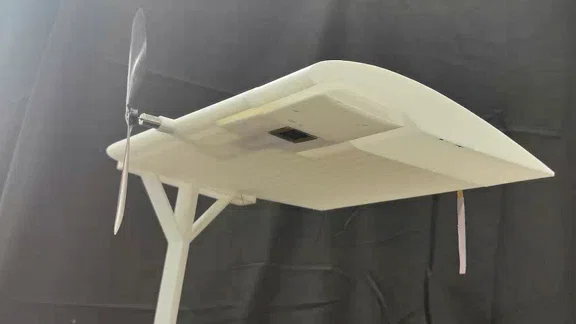
Next, the team integrated the energy conversion system onto a stationary lab drone and also added airflow channels to the wings. In subsequent laboratory tests, laser bombardment supplied sufficient energy to power the drone’s propeller, while the airflow channels effectively cooled the thermoelectric layer’s cold side, maximizing heat-to-electricity conversion.

“Previous studies largely focused on the materials or the device itself,” Han explained. “We wanted to think beyond the laboratory, to how the system could actually be integrated into an aircraft, cooled during operation, and made compatible with flight. It isn’t just a materials science problem; it’s an engineering one.”
Work continues on this wireless drone charging system, with outdoor flight tests on a lightweight frame scheduled. These will be paying particular attention to the system’s reliability under real-world outdoor conditions. However, the team notes that energy conversion efficiency will not be their sole research area, as the accuracy of laser tracking will be essential to the system’s safe operation.
“Our work demonstrates the possibility of ‘refueling aircraft with light,’” Han concluded. “Going from 1 to 100 will require solving many engineering challenges, but we hope this provides a starting point for future development.”
The paper, “Sb2Se3 Nanocrystals Enable Efficient Perovskite-Thermoelectric Tandem Devices for Laser-Powered Unmanned Aerial Vehicles,” appeared in Matter & Light on July 29, 2026.
Ryan Whalen covers science and technology for The Debrief. He holds an MA in History and a Master of Library and Information Science with a certificate in Data Science. He can be contacted at ryan@thedebrief.org.