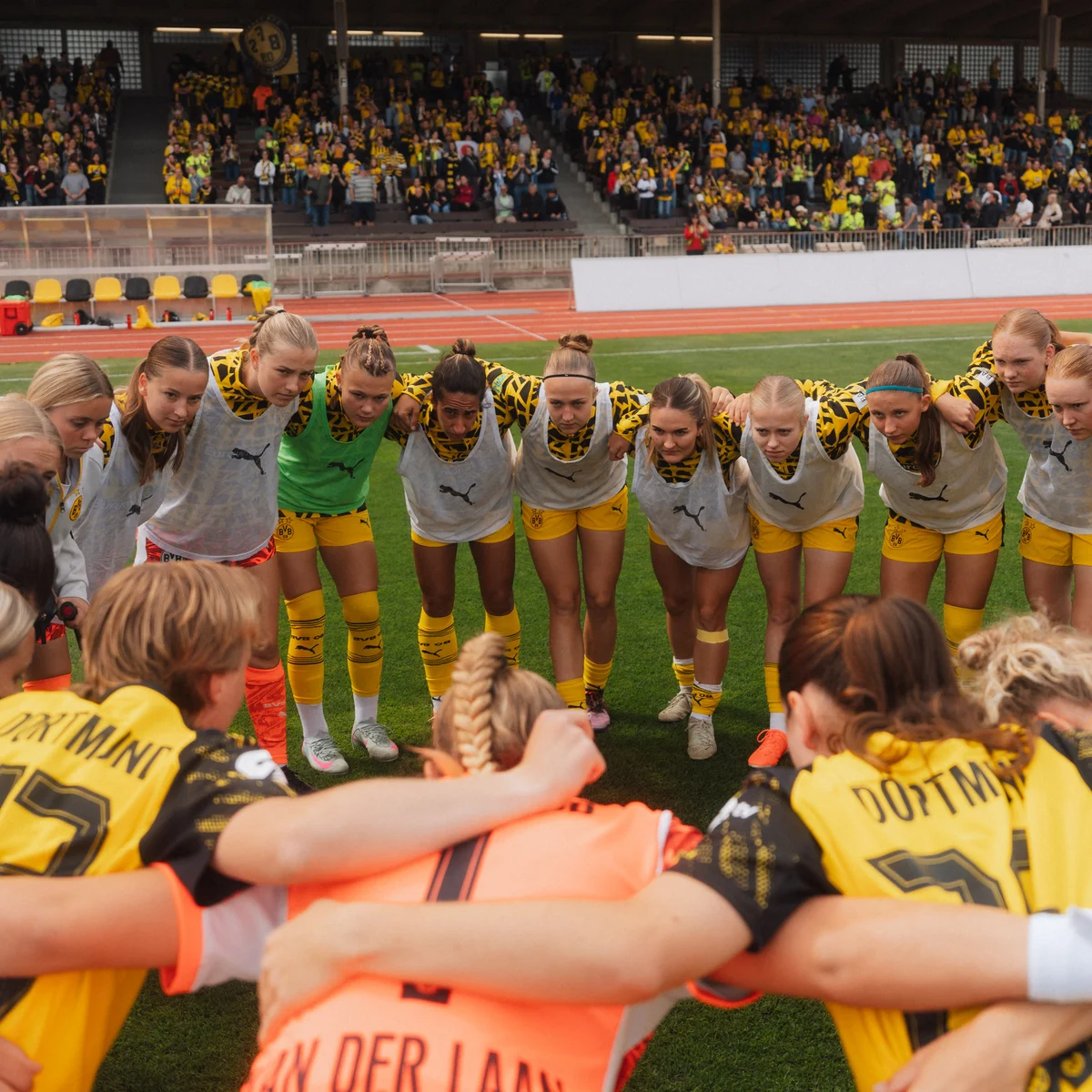
Located in Austria during a pre-season training camp, the Borussia Dortmund women’s team, squad as well as staff, are plotting how to reach the 2. Bundesliga after missing out on promotion during their rapid rise last season.
Dortmund finished two points off the top and a place in the regional playoffs despite a goal difference of +101, and the club have wasted no time in signing big names to make sure there is no such near-miss this time around.
The team’s managing director, Svenja Schlenker, says: “We have great new players, we have a great environment, Manuela, wouldn’t you agree?” Manuela refers to Manuela Zinsberger, the Austria goalkeeper who played previously for Bayern Munich and Arsenal. Alongside the Germany legend Alexandra Popp, Zinsberger is one of two major summer signings for the third-division side, and a statement of Dortmund’s intent.
“Definitely,” Zinsberger says. “I’m looking forward to the new season and the first matches, so it couldn’t be better right now.” Her decision to leave Arsenal at the end of last season for life in the third tier of German football was a surprise to many, but the 30-year-old had reasons for doing so. “They were partly family decisions, but also my conversations with Svenja,” she says.
“The vision of the club, where they are now, where they want to be, what my role would be in that, and coming out of my comfort zone was a big part of it, to challenge myself on another level.
“The conversations were good. We spoke about the DNA of the club, what I can bring with my experience to the group of players, and to help achieve what we’ve literally put on paper. Dortmund is doing really well. The level from a club perspective, staff, infrastructure, is already high for a third-division club. We’re setting the bar high, it’s showing what the club is putting into women’s football, and that makes me happy.”
Dortmund are not shy in their ambitions, and really it is not a surprise a club of their size have aspirations of joining the likes of Bayern, Wolfsburg and Eintracht Frankfurt in the Frauen-Bundesliga. Their success can also help push women’s football in Germany as a whole, with no team from the country having won the Champions League since 2015.
“It means we will have to spend a lot of money, and that’s OK on one end, but I don’t know what will happen in the next few years,” Schlenker says. “Other countries are a bit further on than we are, we just concentrate on the third division and then we think about what we have to do in the next few years.”
“If you put Bayern versus Borussia on paper people want to watch, but we have to work hard to get there,” Zinsberger says. “We’ve made the first steps, now it’s down to us to connect as a team and get the results. We are a little behind England in general, we have to push it.”
The arrival of Zinsberger and Popp, as well as that of the longtime Wolfsburg sporting director, Ralf Kellermann, to the same role, are all key markers of the club’s ambitions, according to Schlenker. “We’re so happy to have both of them, as well as Ralf. They bring huge experience to Borussia Dortmund,” she says. “We started in the seventh division, so we have a lot of firsts every year and we don’t all have the experiences they do, so we use that to improve every day.”
“Svenja and Ralf are really close to the team, which is really nice,” Zinsberger says. “They try to have conversations on a daily basis about what we can improve. It’s really nice to see, because if you’re not close to the team, it’s hard to make those decisions.
“We have internal goals, but we look game by game. We have a job to do and that’s to win every single game, that’s the aim of the club. We can’t take any game less seriously than the other, we have to go into every game wanting to win, and what comes out at the end is hopefully positive.”
Dortmund’s ambitions are wide-ranging, as Schlenker explains: “We will build our own training facility next to the men’s campus. I’ve spoken to so many players and [for them] it’s about that – facilities, infrastructures. That’s what I’m working for and have worked really hard for it because I want to build a great second home for all our players.”
“We all need money, we all need to pay our bills, but we need the right infrastructure to build for the next generations,” Zinsberger says. “I’m so happy we’re doing that here.”
Get in touch
If you have any questions or comments about any of our newsletters please email moving.goalposts@theguardian.com.
-
This is an extract from our free email about women’s football, Moving the Goalposts. To get the full edition, visit this page and follow the instructions. Moving the Goalposts will be sent out once a week, on Wednesdays, in the close season but will be back on Tuesdays and Thursdays from September.