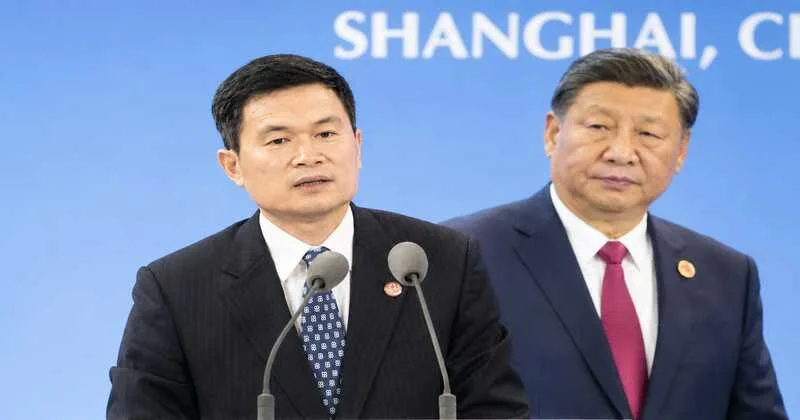
New Delhi: The investigation into former China Securities Regulatory Commission (CSRC) Vice Chairman Fang Xinghai is fueling fresh speculation that Beijing’s latest anti-corruption campaign is no longer focused solely on financial misconduct but is increasingly targeting market-oriented technocrats whose economic outlook diverges from the political priorities of Chinese President Xi Jinping.
Fang, a 62-year-old U.S.-educated economist widely regarded as one of China’s most internationally connected financial officials, was placed under investigation on July 24, nearly two years after retiring from the securities regulator. While China’s disciplinary authorities have not disclosed the precise allegations against him, analysts argue that his case reflects a broader political shift in which ideological conformity and political loyalty are taking precedence over professional expertise and international experience.
For decades, Fang symbolised the generation of Western-educated Chinese officials who were encouraged to return home to modernise China’s economy and integrate it with global financial markets. His downfall has now raised questions about whether that era has effectively come to an end.
From global financial reformer to political target
Fang Xinghai built an extraordinary international profile long before joining China’s top financial regulator. After earning a PhD in Economics from Stanford University under renowned economist Joseph Stiglitz, who later received the Nobel Prize in Economics, Fang worked at the World Bank before returning to China in 1998.
His return reflected the aspirations of a generation of overseas-trained Chinese economists who sought to participate in the country’s economic transformation. Fang himself had previously explained that he decided to return after then Vice Premier Zhu Rongji lamented during a 1997 meeting with foreign visitors that many of his former students had chosen to remain abroad rather than contribute to China’s development.
Following his return, Fang held several influential positions across China’s financial establishment, including senior roles at China Construction Bank, China Galaxy Securities, the Shanghai Stock Exchange, and the Shanghai municipal government.
His fluent English, global financial experience and extensive international contacts made him one of Beijing’s most recognisable faces among foreign investors. At the China Securities Regulatory Commission, where he served as vice chairman and Communist Party committee member, Fang became one of the country’s strongest advocates for capital market reforms, frequently representing China at major international financial forums.
Ironically, Fang also benefited from Xi Jinping’s own political rise. During Xi’s brief tenure as Shanghai Party Secretary in 2007, Fang served as a senior financial official in the city, becoming one of several Shanghai administrators who later advanced under Xi’s leadership.
However, analysts believe that despite this earlier association, Fang and Xi ultimately represented two fundamentally different visions for China’s economic future.
Unlike many current Chinese officials, Fang belonged to the Chinese Communist Party’s reform-oriented camp, heavily influenced by former Premier Zhu Rongji, which supported greater market liberalisation and deeper integration with global financial markets. His educational background and policy outlook increasingly stood in contrast to Xi Jinping’s more ideological approach to governance and economic management.
Some observers argue that Xi initially relied on experienced financial officials such as Fang because the government urgently needed capable administrators following the 2015 Chinese stock market turmoil. But as Xi consolidated power, ideological differences gradually became more significant than technical competence.
Although Fang once served under Xi and was entrusted with major financial responsibilities, analysts believe he fundamentally remained a reform-minded official, making him increasingly out of step with China’s evolving political direction.
Political loyalty replaces professional expertise
Fang’s investigation has also renewed attention to a 2019 appearance at the World Economic Forum in Davos, where a video of his remarks has recently resurfaced online. During the discussion, Fang remarked that Western democracies faced serious problems and required “political reform,” prompting laughter from the audience.
Analysts caution that such statements should not be interpreted as evidence of ideological extremism. Within China’s political system, even relatively reform-minded officials are generally expected to publicly articulate orthodox Party positions while serving in office.
Like many senior Communist Party officials, Fang is unlikely to have remained entirely untouched by questionable financial practices in a system where corruption has long been considered widespread. Nevertheless, several observers believe that politics, rather than financial misconduct, is the principal driver behind the investigation.
They argue that any eventual disciplinary charges are likely to include familiar political accusations such as “political disloyalty” and “dishonesty”, labels frequently employed during Party disciplinary campaigns against officials who fall out of favour.
More significantly, Fang’s downfall is increasingly being viewed as a symbol of Xi Jinping’s changing attitude towards overseas-educated officials.
For many years, Chinese authorities actively encouraged talented professionals trained abroad to return home and contribute to national development. International education and global experience were regarded as valuable assets capable of strengthening China’s economic competitiveness.
That perception now appears to be changing. Analysts argue that as Xi declares the reform era effectively over and promotes what he calls the “new era,” overseas-educated technocrats are no longer viewed as indispensable contributors but increasingly as potential sources of ideological divergence.
Rather than being promoted into senior leadership positions, many are now seen as vulnerable to political scrutiny.
Fang Xinghai’s case therefore extends beyond a conventional anti-corruption investigation. It reflects the growing politicisation of China’s policymaking apparatus, where political loyalty increasingly outweighs economic expertise, and where international education, once considered a qualification for leadership, has begun to evolve into a political liability.
Whether they are long-established overseas returnees or members of a new generation of internationally trained professionals, analysts warn that Western-educated officials may increasingly find themselves under suspicion as Xi Jinping further centralises control over China’s economic decision-making, signalling a profound transformation in the country’s governing philosophy.