Gold’s rally this week may prove to be one of the more important developments across financial markets—not simply because prices have reclaimed the $4,100 level, but because the move appears to contradict the macro forces that have governed precious metals for much of the second quarter. Silver has joined the advance, climbing back toward $60, even as Brent crude trades above $92, US Treasury yields continue rising and markets price in an more hawkish Federal Reserve.
Those are precisely the conditions that had repeatedly weighed on precious metals since the US-Iran conflict erupted earlier this year. Under that framework, higher oil prices fed inflation expectations, pushing Treasury yields and Fed tightening expectations higher. As non-yielding assets, gold and silver consistently lost ground as investors favored interest-bearing alternatives. That relationship drove silver below $55 and kept gold under sustained pressure despite periodic bursts of geopolitical demand.
The latest price action therefore raises an important question: Is the market beginning to price geopolitical risks differently?
Why is Gold no longer behaving as expected?
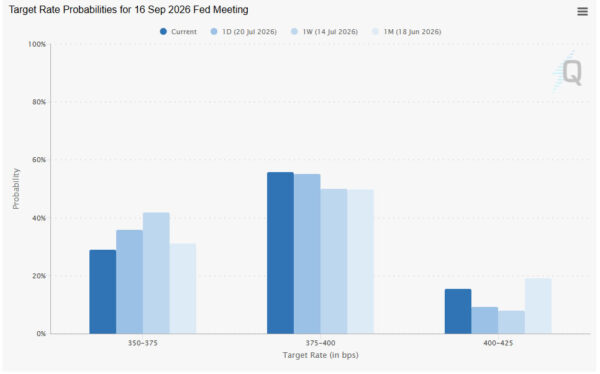
The current market backdrop would ordinarily be hostile for precious metals. Brent crude has extended its rally above $92, increasing concerns that higher energy prices could feed another round of inflation. Reflecting those concerns, markets now price around a 71% probability of a Fed rate hike in September, up from roughly 58% just a week ago, while the US 10-year Treasury yield has climbed to 4.63%.
Viewed through the lens that dominated the second quarter, each of those developments should have been bearish for gold. Higher oil implies stickier inflation. Stickier inflation points to tighter monetary policy. Higher policy expectations lift Treasury yields and typically strengthen Dollar, increasing the opportunity cost of holding non-yielding assets.
Yet instead of weakening, both gold and silver have accelerated higher. The fact that all of these bearish inputs are moving in the same direction while precious metals continue rallying suggests investors may be assigning less weight to interest-rate dynamics than they did only a few weeks ago.
Is the market shifting from an inflation story to a stagflation story?
One possible explanation is that investors are beginning to reinterpret the oil shock.
Earlier in the conflict, higher crude prices were primarily viewed as an inflation problem. The market’s focus was on how rising energy costs would delay Fed easing or even require further tightening, making higher yields the dominant driver of asset prices.
Now, the emphasis may be broadening. Persistently elevated oil prices also increase the risk of slower global growth, weaker corporate profitability and policy mistakes if central banks tighten into an economy already facing supply-side shocks. Under that interpretation, gold regains its appeal not only as an inflation hedge but also as protection against geopolitical escalation and stagflation risks.
If that shift in thinking is indeed underway, it would represent a meaningful change in how markets transmit geopolitical shocks into asset prices.
Why is it still too early to call a regime change?
Despite the striking divergence, caution remains warranted.
The relationship between higher oil, higher yields and weaker precious metals persisted for several months. Declaring that framework broken after only a handful of trading sessions would be premature. Markets often experience temporary dislocations before reverting to established trends.
Positioning may also be contributing to the rebound. Both gold and silver endured heavy selling over recent months, leaving room for short covering once fresh geopolitical headlines emerged. Some of the current rally may therefore reflect positioning adjustments rather than a fundamental reassessment of macro risks.
The coming weeks will reveal whether investors continue to favor precious metals even if Treasury yields and Fed tightening expectations remain elevated.
Technical outlook: Is Gold approaching confirmation?
Technically, momentum is clearly improving.
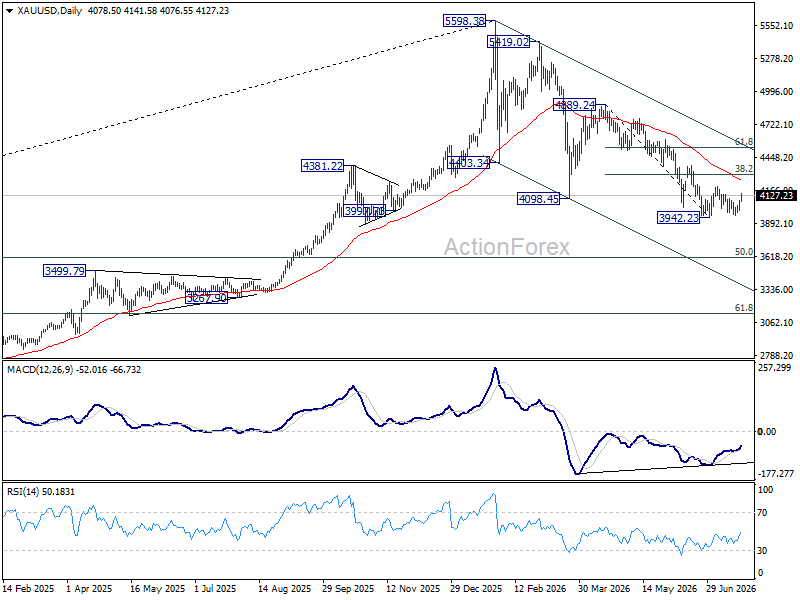
Gold’s break above 4,102.95 minor resistance suggests the decline from 4,202.87 likely completed at 3959.42, just ahead of the 3,942.23 low. Further gains are now favored toward 4,202.87, with scope for an extension to the falling 55 D EMA, currently around 4,262.15.
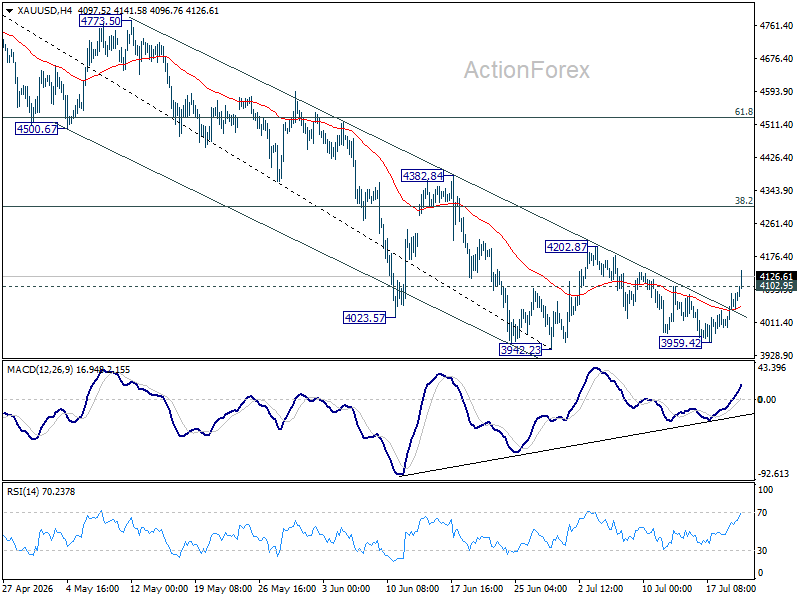
Even so, it is still too early to conclude that a lasting bullish reversal has begun. The current advance could yet prove to be merely the third leg of a corrective pattern from 3,942.23. Initial resistance is expected around 38.2% retracement of 4,889.24 to 3,942.23 at 4,303.98.
That said, the broader technical picture is becoming increasingly constructive. Daily MACD continues to display bullish convergence against price, indicating downside momentum has been fading for some time. A decisive break above 4,303.98, accompanied by sustained trading above the 55 DEMA, would provide much stronger evidence that gold is reversing the broader downtrend from the 5598.38 peak rather than simply staging another counter-trend rally.