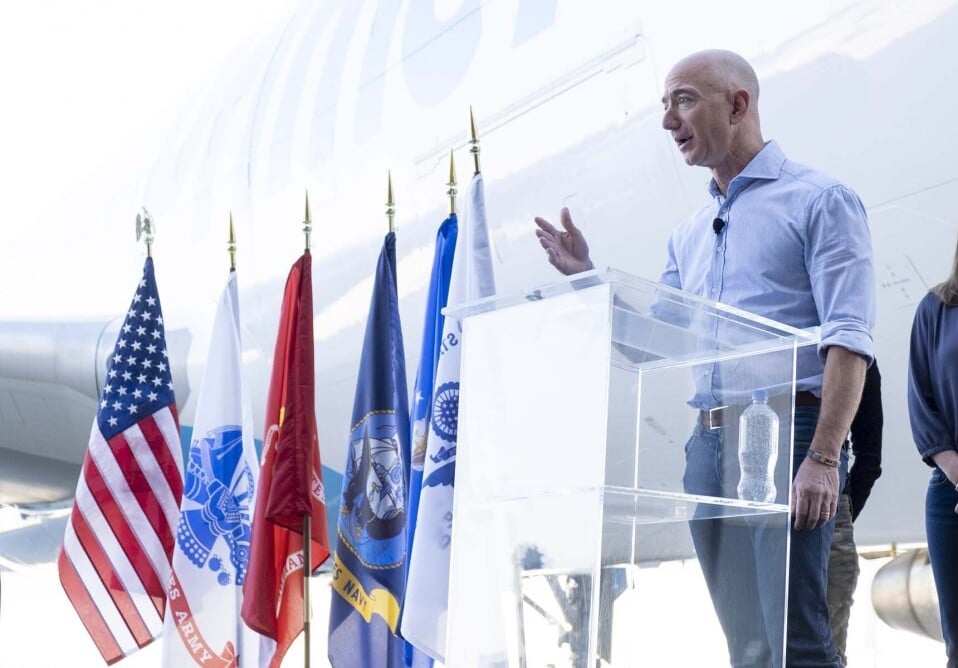
It has been about five years since Amazon (AMZN 0.91%) founder and CEO Jeff Bezos stepped down from his role as CEO and handed over the reins to Andy Jassy.
Those five years were pretty favorable for the stock market, but not so much for Amazon stock.
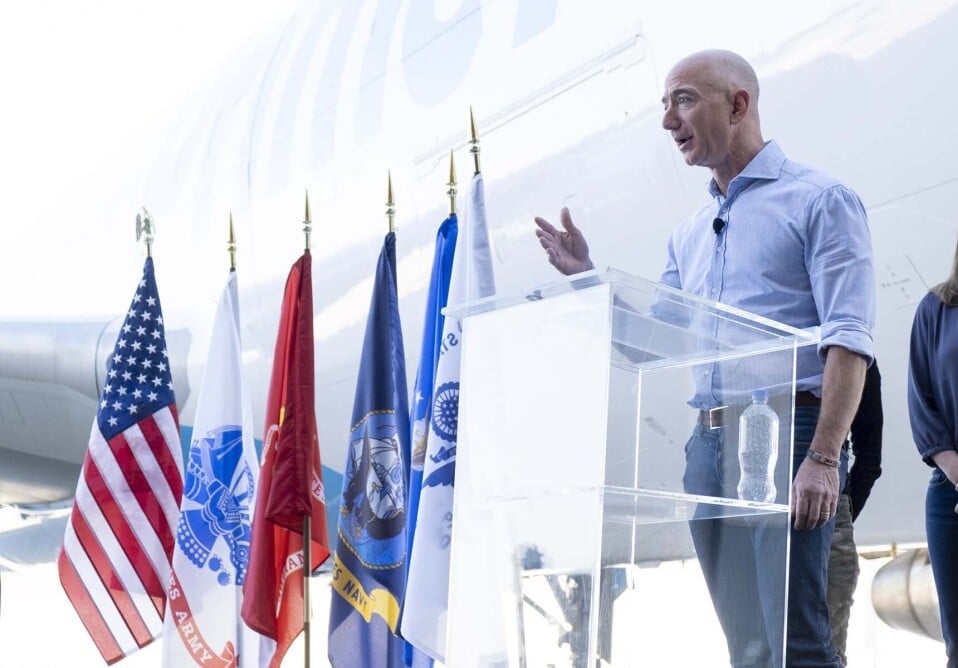
Jeff Bezos. Image source: Amazon.
Amazon has posted an average annualized return of just 6.8% over the past few years. That not only trails all of the other “Magnificent Seven” stocks, it’s also worse than the S&P 500 and the Nasdaq-100.
The S&P 500 averaged an 11.5% annualized return over that stretch, while the Nasdaq-100 averaged a 14.2% return. The only Magnificent Seven stock that came remotely close to Amazon’s underperformance was Microsoft (MSFT 1.81%). The others all averaged double-digit percentage annualized returns.
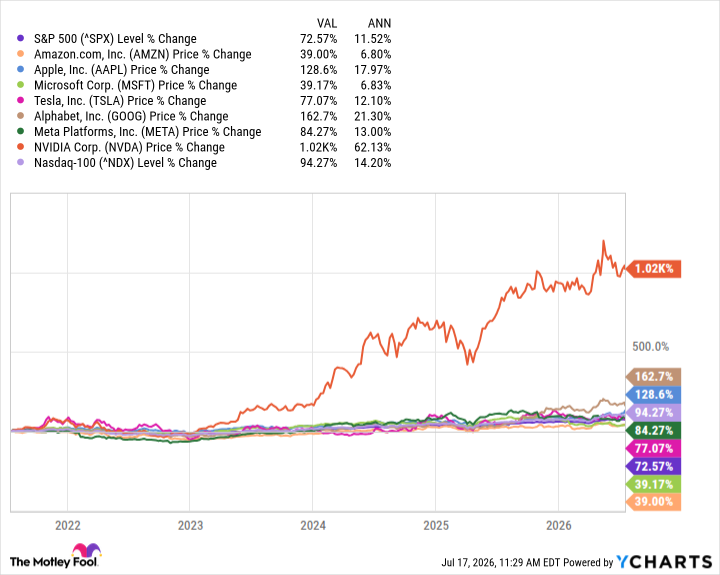
Even this year, Amazon stock has lagged the S&P 500 — the stock is up 7% year to date, while the index is up 9% — but it is beating several of its magnificent brethren.
So why has Amazon stock underperformed?
Losing market share
The tech giant hasn’t navigated the AI boom as well as some of its competitors. While Amazon Web Services (AWS) remains the world’s largest cloud computing infrastructure provider, it has steadily lost market share to rivals Microsoft and Alphabet (GOOG 2.06%) (GOOGL 2.05%). In 2021, Amazon’s cloud market share was about 33%, but now it’s down to about 28%. Meanwhile, Microsoft and Alphabet’s Google have gained market share.
At the same time, Amazon has made massive investments in AI data centers, but many investors don’t see those investments paying off well enough.

Today’s Change
(-0.91%) $-2.28
Current Price
$247.61
Key Data Points
Market Cap
Day’s Range
$243.61 – $250.21
52wk Range
$196.00 – $278.56
Volume
13.3K
Avg Vol
49.3M
Gross Margin
50.60%
In its e-commerce business, growth has slowed since the pandemic-era surge. Shoppers’ shift back toward normal retail behaviors initially left Amazon with an excess of inventory and shrinking margins. In more recent years, rising inflation and costs have also cut into its margins.
So where does Amazon go from here? Will the next five years be better for Amazon and its investors than the last five?
An inflection point for Amazon?
Amazon stock is up 8% year to date and up 14% over the past 12 months, but it still lags the S&P 500 over both time frames.
However, its growth numbers have improved. Jassy has also repeatedly reminded investors that the company’s heavy spending on AI infrastructure is needed to grow AWS. Last quarter, net sales for AWS increased by 28% to about $38 billion. That was higher than the 23% growth rate in the fourth quarter or its 19% pace in 2025.
In fact, on the first-quarter earnings call, Jassy highlighted that it was the best growth rate in 15 quarters. He also said the company has $364 billion in contracted backlog, not including its recently inked $100 billion deal with Anthropic. That’s up from a backlog of just $244 billion in the previous quarter.
Amazon is also seeing significant revenue growth from its Trainium AI accelerator chips. Jassy said recently that these chips could be a $50 billion business for Amazon. It has already secured some $225 billion in revenue commitments for the chip business.
The years of underperformance have made Amazon stock less expensive. It trades now at 29 times forward earnings. At that valuation, with the backlog Amazon has amassed, its promising AI chip venture, and a data center build-out that should start to pay off, the stock looks like a solid buy.
Dave Kovaleski has no position in any of the stocks mentioned. The Motley Fool has positions in and recommends Alphabet, Amazon, Apple, Meta Platforms, Microsoft, Nvidia, and Tesla. The Motley Fool has a disclosure policy.