Key Points
-
The PHLX Semiconductor Index closed in a bear market on Friday, more than 20% below its June peak.
-
Apple set a record intraday high the same day and passed Nvidia to become the world’s most valuable company.
-
Apple spent $12.7 billion on capital expenditures in fiscal 2025, a fraction of what AI rivals are spending.
- 10 stocks we like better than Apple ›
The PHLX Semiconductor Index closed in a bear market on Friday, finishing more than 20% below its June peak. Apple (NASDAQ: AAPL) spent the same session touching a record intraday high of $334.98 — and passing Nvidia for a moment to reclaim its title as the world’s most valuable company, at about $4.9 trillion.
The divergence isn’t random. Global chip stocks have erased about $3.3 trillion in market value since June 22 as investors rethink what the AI (artificial intelligence) build-out costs and who actually profits from it. Memory chipmakers, among the build-out’s biggest recent winners, have been leading the declines.
Where to invest $1,000 right now? Our analyst team just revealed what they believe are the 10 best stocks to buy right now, when you join Stock Advisor. See the stocks »
Apple, however, is the one technology giant that never signed up to pay for the build-out in the first place.
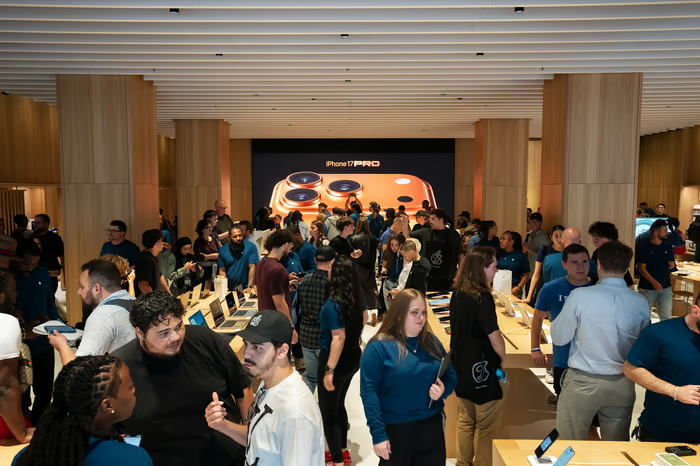
Image source: Apple.
The cheapest AI strategy in big tech
Apple spent just $12.7 billion on capital expenditures in fiscal 2025 while generating $98.8 billion in free cash flow. Rivals such as Microsoft and Amazon have committed hundreds of billions of dollars to AI infrastructure — spending Apple has simply avoided matching. That leaves the iPhone maker’s profits far less dependent on the AI spending boom continuing.
Apple’s underlying business is performing, too. Apple’s revenue for its fiscal second quarter (the period ended March 28) rose 17% year over year to $111.2 billion, with earnings per share up 22% and iPhone revenue setting a March-quarter record. Shares have gained nearly 59% over the past year, and the stock now sits more than 60% above its 52-week low of $201.50.
So while the market punishes companies whose earnings lean on ever-rising AI capital spending, money is crowding into the megacap whose earnings don’t. On Friday, that rotation was strong enough to push Apple back to the top of the market on the very day the chip index broke down.
The shelter has a price, though. At about $332 per share as of this writing, Apple trades at roughly 40 times earnings, a steep multiple for a company growing revenue 17%. Investors are no longer just paying for iPhone sales and services growth. They’re paying a premium for safety.
That premium could keep expanding if the chip sell-off deepens, and Apple’s light spending model means no wave of depreciation is coming to weigh on future earnings. Of course, a multiple this high leaves little room for disappointment if iPhone momentum cools. Friday’s divergence says more about the chip trade than about Apple — and investors chasing the safety should know they’re buying a great business at a price that arguably already reflects it. With that said, I’m not selling my Apple shares.
Should you buy stock in Apple right now?
Before you buy stock in Apple, consider this:
The Motley Fool Stock Advisor analyst team just identified what they believe are the 10 best stocks for investors to buy now… and Apple wasn’t one of them. The 10 stocks that made the cut could produce monster returns in the coming years.
Consider when Netflix made this list on December 17, 2004… if you invested $1,000 at the time of our recommendation, you’d have $371,842!* Or when Nvidia made this list on April 15, 2005… if you invested $1,000 at the time of our recommendation, you’d have $1,244,783!*
Now, it’s worth noting Stock Advisor’s total average return is 900% — a market-crushing outperformance compared to 207% for the S&P 500. Don’t miss the latest top 10 list, available with Stock Advisor, and join an investing community built by individual investors for individual investors.
*Stock Advisor returns as of July 18, 2026.
Daniel Sparks and his clients have positions in Apple. The Motley Fool has positions in and recommends Amazon, Apple, Microsoft, and Nvidia. The Motley Fool has a disclosure policy.
The views and opinions expressed herein are the views and opinions of the author and do not necessarily reflect those of Nasdaq, Inc.