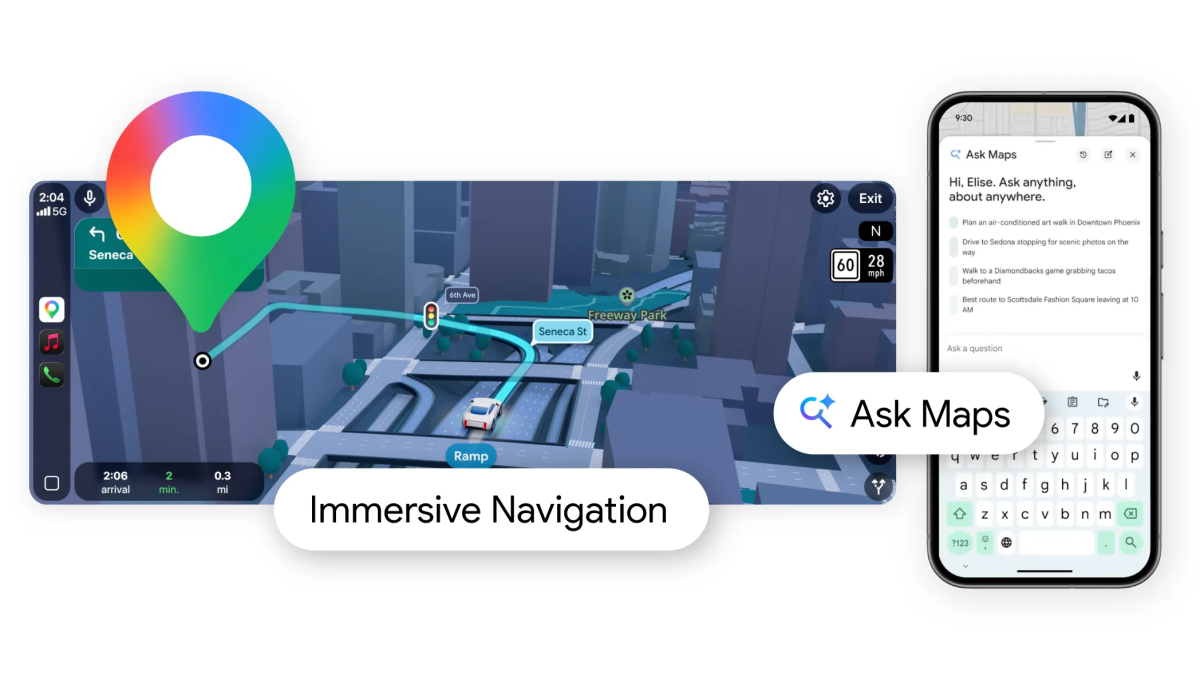
The 3D view of the maps during navigation, in particular, looks quite impressive. Whether this actually makes navigation easier or whether the whole thing might even distract the driver – as some critics claim – is something everyone must decide for themselves. In any case, the buildings and terrain look more realistic. Individual lanes, as well as traffic lights and stop signs, are clearly visible. In this context, drivers should also be able to plan their route better thanks to an improved zoom function.
Google also claims to have improved the voice instructions. They are now said to sound more natural, like instructions from a passenger: “Drive past this exit and take the next exit for XY.” Google Maps also provides detailed information on suggested alternative routes to help with decision-making. For example, if there is less traffic on the alternative route, but the journey is longer as a result.
When you’re nearing your destination, Google Maps displays a Street View preview so you can immediately recognise your destination in real life. If you’ve entered a house number as your destination, Google Maps should show the corresponding entrance to the property. With a bit of luck, you might even get a parking recommendation.
Who will be getting the new Google Maps?
In principle, Google intends to roll out the new Google Maps across all supported platforms and in all countries. To do this, Google is enabling ‘Immersive Navigation’ via the server after the upgrade was announced back in March. However, it’s launching now on Android and iOS, as well as on Android Auto and Apple CarPlay, but only in the US to begin.
It will roll out to other markets in the coming weeks and months, so look out for an update for the app.