
I have written before about the Trump administration’s headlong rush to adopt regulations that stifle dissent and force conformity to its ideological bent. The latest effort is the Office of Management and Budget’s proposed rule, “Regulation for Federal Financial Assistance,” which would diminish peer review panels to mere advisory status and place decision-making on all scientific grant proposals in the hands of political appointees who are tasked with making sure that the proposals conform to “Administration policies and priorities.”
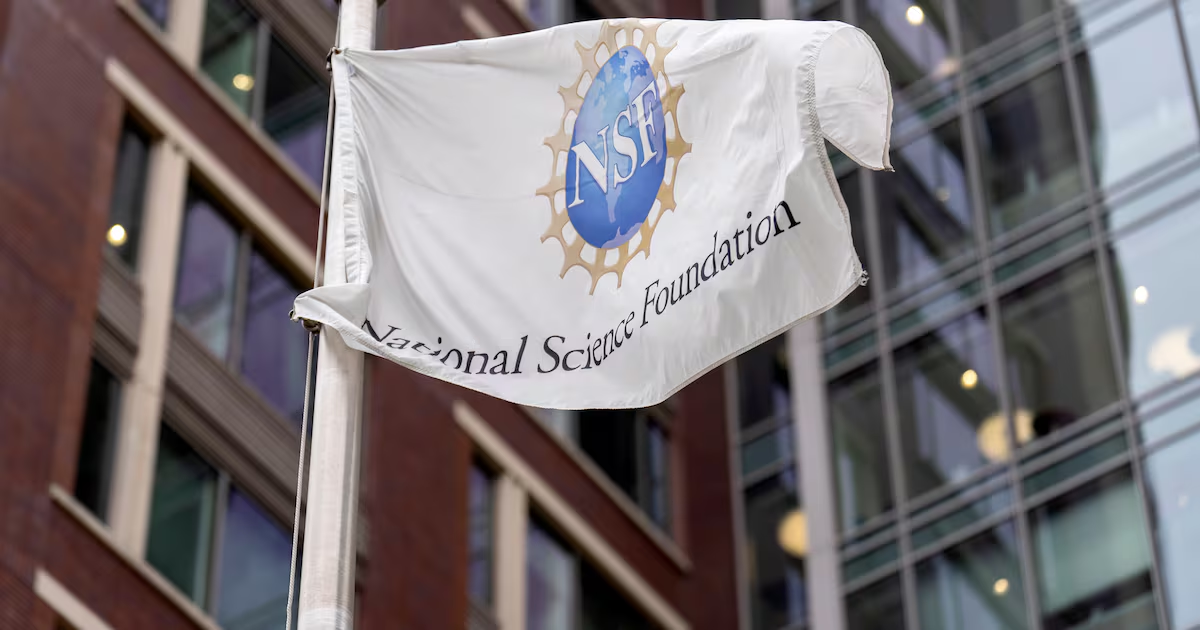
The proposed rule disfavors research dealing with climate change, racial disparities in health and other “anti-American” values. Grants can be terminated at will for any reason. This initiative joins a long list of efforts to eviscerate America’s leading role in advancing science, much of it being carried out under the guise of slashing a bloated bureaucracy or, in the case of universities, their “failure” to stop antisemitism. The resulting cuts in our nation’s scientific research have included dismantling the United States Agency for International Development, as well as staff losses at the Centers for Disease Control and Prevention, the National Institutes of Health and the National Science Foundation, to name a few. Other agencies that rely on scientific research to fulfill their missions have also experienced loss of scientific expertise: the departments of Agriculture, Commerce and Interior, and the Environmental Protection Agency are examples.
Some impacts on Alaska from these dramatic shifts are already evident. Consider the U.S. Forest Service. This spring, the Trump administration announced a sweeping reorganization that shutters dozens of research labs across the country. Among them is the Anchorage Forestry Sciences Lab, now slated for closure, while the future of the Pacific Northwest Research Station lab in Juneau hangs in limbo. Alaska’s Forest Service scientists study everything from forest health and carbon storage to salmon habitat and wildfire risk.
Trump’s staffing cuts at the National Oceanic and Atmospheric Administration, which includes both the National Weather Service and the National Marine Fisheries Service, have caused drastic curtailment of vital services. The NWS has been forced to suspend routine weather balloon launches in Alaska due to lack of personnel. Those balloons provide the upper-air data that feed the forecast models upon which villages, fishers, pilots and emergency managers rely. National analyses have already warned that these cuts leave Alaskans more vulnerable during major storms, forcing forecasters to issue warnings “without the aid of accurate model projections.” In a state where a missed forecast can mean a lost fishing opening, a medevac that cannot fly, or a village cut off by storm surge and sea ice, hollowing out basic observational capacity is not fiscal prudence. It is reckless disregard.
Reductions at NMFS harm Alaska’s fishing industry groups that depend upon the agency for fisheries data, stock assessments and regulatory support. These cuts and constraints weaken U.S. efforts to combat illegal, unreported and unregulated fishing, including critical missions in the Bering Sea that directly affect Alaskan fishing communities.
Similarly, the Trump administration recently moved to dismantle the National Science Foundation’s Ocean Observatories Initiative, a $368 million network of more than 900 high-tech sensors and buoys in the Pacific and Atlantic, including arrays of instruments off Alaska’s coastline. These instruments track ocean temperatures, currents, oxygen levels and acidity — data that help scientists understand climate change, forecast extreme weather and manage fisheries. Fortunately, the U.S. Senate unanimously blocked the move in a resolution co-sponsored by Alaska Sen. Lisa Murkowski and Oregon Sen. Jeff Merkley.
President Trump has cast the 250th anniversary of our founding as a triumphal occasion to celebrate the nation’s achievements. Rightly so. But he would do well to reflect on our founders’ engagement with science and natural philosophy, and its linkage to civic virtue. John Adams, Thomas Jefferson and Benjamin Franklin all wrote about “natural knowledge” as careful observation and exploration of the physical world through evidence and experimentation, and they treated this as a hallmark of enlightened leadership. Jefferson in particular tied science to liberty, describing “freedom” as “the firstborn daughter of science,” signaling his belief that rational inquiry underpinned republican self-government.
The Constitution’s only explicit reference to science appears in Article I, Section 8, Clause 8, the Intellectual Property Clause. Although brief, this clause is revealing. It treats the advancement of science and useful arts as a national objective. More broadly, the First Amendment’s protections for speech, press and assembly created constitutional space for scientific inquiry and debate, even though they are not framed explicitly in scientific terms. By securing robust freedom to publish and discuss ideas, the founding generation fostered an environment in which scientific theories could circulate, be contested and evolve without direct state censorship.
Trump’s approach to science stands in stark contrast to that of the founders. Undoubtedly, he has favored science in advancing defense technology, conquering the moon and taming artificial intelligence. Yet his governing stance has repeatedly cast science as a threat when it complicates deregulation, culture war messaging, or his personal narrative. It overlays a pattern of suppressing, downplaying, or ignoring research that demonstrates the need for regulation to protect public health and the environment, resulting in relaxing environmental rules despite scientific evidence, reducing the federal science workforce, and misrepresenting or sidelining data in areas ranging from climate to infectious disease.
In the end, one is left to ask what science this president actually believes in. It is not the science of observation, hypothesis and evidence that keeps Americans safe or advances our knowledge as a civilization. The only science Donald Trump appears truly committed to is alchemy — in his case, turning the presidency itself into gold.
Bruce M. Botelho is a former Alaska attorney general who served both Republican and Democratic governors. Initially appointed by Gov. Wally Hickel, he was subsequently retained as attorney general by Gov. Tony Knowles. He was born in Juneau, and was Juneau mayor.
• • •
The Anchorage Daily News welcomes a broad range of viewpoints. To submit a piece for consideration, email commentary(at)adn.com. Send submissions shorter than 200 words to letters@adn.com or click here to submit via any web browser. Read our full guidelines for letters and commentaries here.