Published on
July 11, 2026
By: Antara Mitra

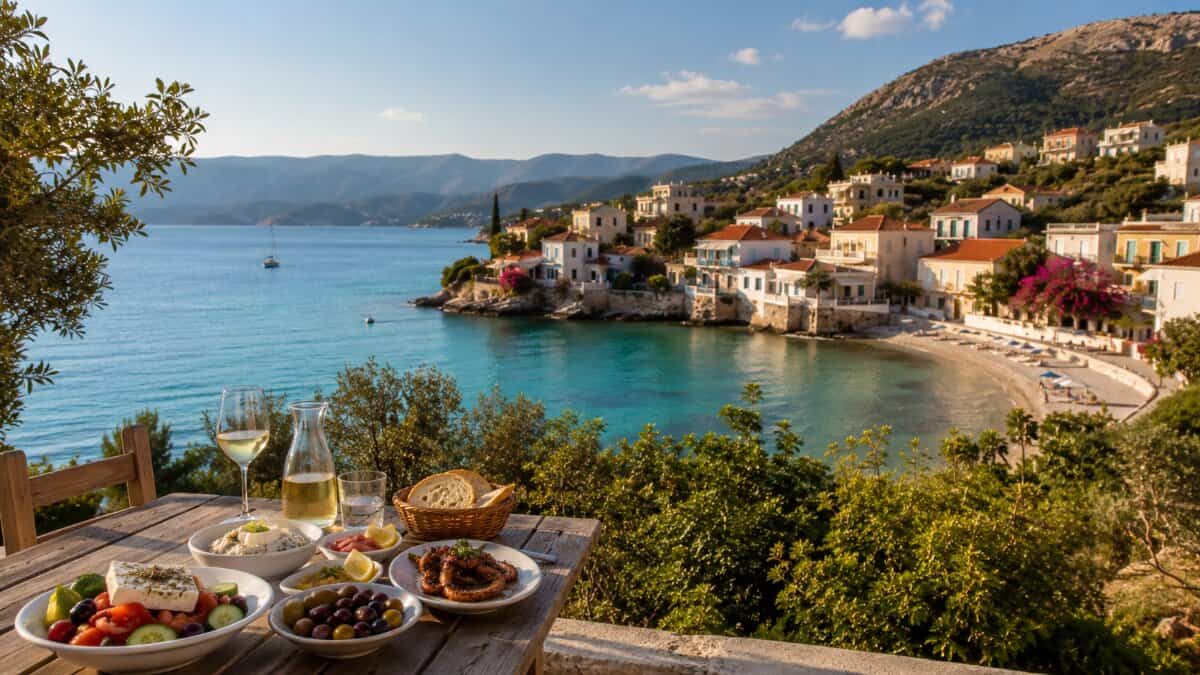
Image generated with Ai
Greece’s first bilateral tourism cooperation agreement with the United Kingdom matters because it targets value and regional dispersal, not simply higher arrivals. British residents generated €3.742 billion for Greece in 2025, up 18.4%, while visitor numbers rose 7.6% to 4.893 million. Between January and April 2026, UK receipts reached €331.7 million and arrivals increased 51%. The pact connects this demand with film, gastronomy, wine, luxury shopping, rural, mountain and hiking products, supported by investment, digitalisation, skills and sustainability cooperation.
The United Kingdom and Greece have created a five-year tourism framework that could change how one of Europe’s largest bilateral leisure markets is managed.
The agreement was signed in London on 2 July 2026. It is the first formal tourism cooperation agreement between the two countries. Its initial five-year period will renew automatically for further five-year terms unless the arrangement is changed or ended.
The immediate opportunity is not limited to attracting more British holidaymakers. Greece already welcomes close to five million travellers from the UK each year.
Advertisement
Advertisement
The larger objective is to improve visitor value, reduce dependence on peak summer demand and direct more tourism expenditure towards inland, rural and lesser-known destinations.
UK–Greece Tourism Pact Moves Beyond Conventional Destination Promotion
The memorandum covers institutional cooperation, destination promotion, investment, sustainability, innovation, digitalisation, tourism education and vocational training.
Advertisement
Advertisement
It also supports information sharing on tourism policy, legislation, visitor satisfaction, international market developments and emerging travel products.
Special-interest tourism has been placed at the centre of the agreement. The identified segments include film tourism, culture, luxury shopping, gastronomy, wine tourism, rural experiences, mountain holidays and hiking.
These categories provide a practical structure for moving travellers beyond conventional sun-and-sea packages. They can support longer itineraries, higher local expenditure and wider distribution of tourism income.
Fairs, exhibitions, seminars and tourism promotion events are also included. This creates potential for greater travel trade engagement, destination investment forums and business-to-business product development.
However, the published framework does not establish a dedicated MICE programme, guarantee new air routes or identify specific commercial projects.
British Tourism Value Rose Faster Than Visitor Volume
Bank of Greece data show why the agreement has considerable commercial importance.
Advertisement
Advertisement
British residents made 4.893 million trips to Greece in 2025. This represented growth of 7.6% compared with 2024.
Their travel receipts increased by 18.4% to €3.7416 billion. British overnight stays rose by 6.8%.
The gap between revenue growth and arrival growth suggests that the British market became significantly more valuable during the year. An indicative calculation based on official receipts and traveller flows places average receipts at approximately €765 per UK traveller in 2025, compared with about €695 in 2024.
| 2025 indicator | United Kingdom | Germany | United States |
|---|---|---|---|
| Travellers to Greece | 4.893 million | 5.951 million | 1.551 million |
| Annual change | 7.6% | 10.2% | 0.2% |
| Travel receipts | €3.742 billion | €3.785 billion | €1.737 billion |
| Receipt growth | 18.4% | 2.2% | 9.7% |
| Indicative receipts per traveller | €765 | €636 | €1,120 |
| Overnight-stay change | 6.8% | 2.1% | minus 2.5% |
Germany remained larger by both arrivals and total receipts in 2025. However, the difference in revenue between Germany and the UK was only €43.1 million, despite Germany delivering around 1.06 million more travellers.
This makes the UK exceptionally productive as a major European market.
British visitors represented about 11.3% of recorded inbound traveller flows but generated approximately 15.8% of Greece’s total travel receipts. These proportions are indicative because the Bank of Greece applies specific survey treatment to cruise passengers and border-survey travellers.
Advertisement
Advertisement
Early 2026 Growth Strengthens the Off-Season Case
The latest official country-level figures available by 11 July cover January to April 2026.
During this period, Greece received 445,000 travellers from the United Kingdom. This was 51% higher than in the corresponding period of 2025.
British travel receipts reached €331.7 million. The UK generated more revenue than Germany and narrowly exceeded the United States during the four-month period.
| January to April 2026 | United Kingdom | Germany | United States |
|---|---|---|---|
| Travellers | 445,000 | 534,500 | 327,800 |
| Change in travellers | 51.0% | 12.4% | minus 3.4% |
| Travel receipts | €331.7 million | €263.0 million | €327.3 million |
| Indicative receipts per traveller | €745 | €492 | €998 |
Greece’s overall inbound travel receipts increased 36.9% to €2.791 billion during the same period. Total traveller flows rose 27.1%, while average expenditure per trip increased 8.6%.
These results support the agreement’s off-season relevance. British travel growth was already accelerating before the main summer peak.
The next Bank of Greece travel-services release, covering May 2026, was scheduled for 22 July. Therefore, no later country-level figures should be treated as officially confirmed at the 11 July reporting cutoff.
Advertisement
Advertisement
Greece Faces a Major Regional Tourism Concentration Challenge
The most commercially important role of the pact may be its ability to redistribute established British demand.
Five Greek regions accounted for 89.9% of regional travel receipts recorded through the Bank of Greece Border Survey in 2025.
The Southern Aegean, Attica, Crete, Ionian Islands and Central Macedonia also captured most visits and overnight stays.
| Greek region | 2025 travel receipts | Share of regional receipts |
|---|---|---|
| Southern Aegean | €6.625 billion | 29.3% |
| Attica | €5.838 billion | 25.8% |
| Crete | €4.343 billion | 19.2% |
| Ionian Islands | €1.902 billion | 8.4% |
| Central Macedonia | €1.624 billion | 7.2% |
| Combined total | €20.332 billion | 89.9% |
This concentration creates strong demand for accommodation, aviation and visitor services in successful gateways. It can also intensify seasonal pressure on transport, water supplies, waste systems, historic centres and coastal communities.
Rural tourism, wine routes, mountain travel and hiking can broaden the product base. They can connect visitors with mainland communities, agricultural producers, local accommodation operators and smaller cultural attractions.
The agreement will not produce dispersal automatically. Tour operators will require bookable inventory, reliable ground transport, multilingual interpretation, clear trail information, digital distribution and adequate emergency support.
Advertisement
Advertisement
Film Tourism Could Become the Pact’s Most Effective Demand Tool
Film tourism offers a direct link between destination marketing, regional dispersal and off-peak travel.
VisitBritain’s latest screen-tourism study was published in June 2026 using data from the Anholt Nation Brands Index 2025.
It found that 53% of recent UK leisure visitors had participated in at least one film or television-related activity.
Around half reported that screen content had encouraged off-peak travel. A further 47% visited lesser-known places because those destinations appeared in films or television programmes.
Among travellers considering a future UK trip, 59% indicated that film and television could encourage an earlier visit. Another 58% associated screen content with travel during quieter periods.
| Screen-tourism behaviour | VisitBritain finding |
|---|---|
| Recent visitors undertaking at least one screen activity | 53% |
| Visitors influenced to travel during quieter periods | 49% |
| Visitors reaching lesser-known locations | 47% |
| Future travellers encouraged to visit sooner | 59% |
| Future travellers encouraged to travel off-peak | 58% |
The research measures travel behaviour linked to the United Kingdom. It does not prove that identical results will occur in Greece.
Advertisement
Advertisement
However, it provides an official evidence base showing how screen exposure can influence destination choice, timing and geographic dispersal.
VisitBritain’s Starring GREAT Britain campaign generated £217 million in additional visitor spending during its first six months. The agency calculated £20 in additional visitor spending for each £1 invested. The campaign continued during 2026 with trade activity and advertising in high-value international markets.
Greece Already Has a 40% Production Incentive
Greece has an established audiovisual investment mechanism that could support the film-tourism element.
The Cash Rebate Greece programme provides a 40% return on qualifying production expenditure incurred in Greece. Eligible Greek expenditure cannot exceed 80% of the project’s total production cost.
The subsidy can reach €8 million for one audiovisual work. Strategic projects of national importance may receive up to €10 million, subject to approval.
| Greek audiovisual incentive | Current official provision |
|---|---|
| Rebate rate | 40% of eligible Greek production costs |
| Maximum eligible cost ratio | 80% of total production cost |
| Standard subsidy ceiling | €8 million per work |
| Strategic project ceiling | Up to €10 million |
| Fiction film minimum local spend | €200,000 |
| Documentary minimum local spend | €60,000 |
| Short film minimum local spend | €45,000 |
| Application deadline | Up to ten days before production begins |
| Target evaluation period | Three months |
Foreign producers can participate through qualifying structures involving a Greek-established production company or branch.
Advertisement
Advertisement
The incentive covers production and post-production. It does not include marketing, promotion or publicity expenditure. Payment is made after completion and audit rather than as an advance during production.
This distinction matters for tourism authorities. A production rebate can attract filming and local expenditure, but separate destination-marketing funds may be needed to convert screen exposure into itineraries, tours and bookings.
Climate Resilience Gives Rural Tourism a Wider Strategic Purpose
Climate adaptation formed part of the bilateral tourism agenda before the final agreement was signed.
The 2025 UK–Greece Strategic Bilateral Framework linked tourism cooperation with local-community prosperity, social sustainability, tourism-system resilience and the effects of climate change.
The framework also covered wider cooperation on forest-fire management, crisis response, training and the exchange of operational knowledge.
This creates a clear policy connection between tourism diversification and destination resilience.
Advertisement
Advertisement
Mountain, hiking and rural tourism can extend the season and reduce pressure on coastal centres. These products also require heat planning, wildfire protocols, water management, trail maintenance, traveller communication and coordinated emergency procedures.
Travel businesses should not market lesser-known regions solely as uncrowded alternatives. Product expansion must be matched by safety capacity and local infrastructure.
Original Analysis: The Agreement Is About Market Conversion, Not Market Creation
The central commercial opportunity is to convert an established mass market into a higher-value network of specialist journeys.
Greece does not need to introduce British travellers to the country. Awareness, air access and holiday demand already exist. The challenge is to persuade repeat visitors to travel in April, May, October and November, add inland nights and buy experiences beyond accommodation and beach services.
Film can create the inspiration. Gastronomy and wine can provide bookable expenditure. Rural and mountain tourism can supply geographic dispersal. Digitalisation can make fragmented inventory easier to sell. Training can improve service quality. Sustainability and climate cooperation can protect destination capacity.
This creates an integrated tourism-development model rather than a standalone marketing campaign.
Advertisement
Advertisement
The main weakness is the absence of disclosed delivery metrics. The official announcement does not identify a budget, pilot region, annual visitor-value target, regional-spending target, first working-group date or joint film-tourism campaign.
The pact should therefore be judged by implementation rather than ceremonial importance. Its first major test will be whether the bilateral working group converts broad policy language into funded, measurable and trade-ready products.
Operational Takeaways for Travel Agents and Tour Operators
- Build shoulder-season inventory: Develop April to June and September to November programmes around culture, food, wine, walking and film locations.
- Combine established gateways with inland stays: Link Athens, Thessaloniki, Crete or major island arrivals with mainland villages, mountain areas and regional producers.
- Audit transport before launching rural packages: Confirm transfer times, vehicle availability, seasonal road access and contingency arrangements.
- Verify heat and wildfire procedures: Require local partners to provide emergency contacts, evacuation processes and traveller-communication plans.
- Avoid unverified film-location claims: Use confirmed production records before marketing a site as a screen destination.
- Track visitor value, not only bookings: Measure length of stay, activity spend, regional nights and off-season conversion.
- Monitor bilateral working-group announcements: New funding, training schemes, investment events or pilot destinations could create first-mover advantages.
- Do not assume new air services: The memorandum contains no published airline route commitment. Capacity decisions remain subject to commercial airline planning.
Long-Term Outlook for Greece–UK Tourism Growth
The agreement gives Greece and the United Kingdom a renewable institutional framework for tourism cooperation, but its strategic value lies beyond the five-year timetable.
British demand already delivers scale. It is also delivering stronger revenue growth.
The next stage is to distribute that value across more months, products and communities. Film tourism can support destination discovery. Gastronomy and wine can increase local spending. Rural and mountain travel can expand regional participation. Digital tools and vocational training can improve bookability and service delivery.
Success will require measurable projects, commercial distribution and transparent performance indicators.
Without implementation, the pact will remain a broad statement of intent. With funded pilot routes, production partnerships, trade-ready experiences and climate-resilient destination management, it could become a model for converting mature European holiday flows into more balanced, higher-value international tourism.
Advertisement
Advertisement
