Key Points
While Nvidia (NASDAQ: NVDA) has been one of the biggest drivers of the market during the past five years, its performance has slowed recently, with the stock up just around 26% over the past year. Part of the reason is the company’s sheer size, which has climbed to around $5 trillion in market cap. Still, as the company transforms from a graphics processing unit (GPU) maker into a complete AI infrastructure company, its future remains bright. The stock is also cheap, trading at a forward P/E of 16 times analyst estimates for fiscal 2028 (ending January 2028), even after it reported 85% revenue growth last quarter.
That said, let’s look at three AI stocks that have crushed Nvidia’s stock performance over the past year. (Note all returns are as of this writing, and even seemingly small moves can have big impacts on one-year returns.)
Missed Nvidia in 2009? This Rare Signal Is Flashing Again. In 2009, a “Double Down” signal flashed for a little-known chipmaker called Nvidia. For the first time in years, that same “Total Conviction” signal is flashing for a company 1/100th the size of Nvidia. Continue »
Image source: Getty Images.
Sandisk: No flash in the pan
Up over 3,990% in the past year, Sandisk (NASDAQ: SNDK) has been the hottest stock in the market, even after a recent 19% pullback. The memory maker has benefited from a shortage of NAND (flash) memory, as demand for huge SSDs (solid-state drives) that use flash memory to store AI data has surged. This has driven up NAND prices, which in turn has boosted Sandisk’s sales and gross margin. Last quarter, its revenue surged 251%, while its gross margin climbed from 22.5% to 78.4%.
Flash prices continue to climb, and Wedbush recently raised its fiscal Q4 outlook for the company, saying Sandisk likely materially underestimated the impact of higher industry price gains in its original forecast. The stock only trades at a forward P/E of less than 7.5 times next year’s fiscal estimates, but its multiple remains low due to the NAND market’s historically cyclical nature. However, it has started to lock in some longer-term deals with $42 billion in minimum value to try to reduce some of its cyclicality, which could still make the stock a bargain if the NAND cycle continues.
Micron Technology: Riding the DRAM supercycle
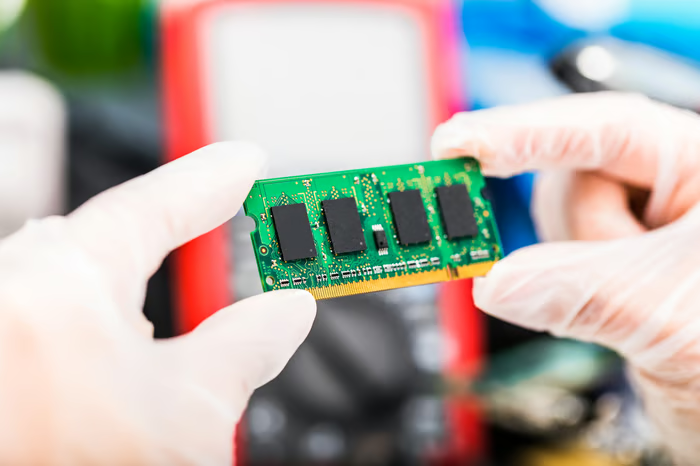
Memory maker Micron Technology (NASDAQ: MU) has also been crushing it the past year, with its stock up roughly 721%. Micron derives approximately 75% of its revenue from DRAM (dynamic random access memory) and 25% from NAND. Like Sandisk, the company is seeing big boosts from rising memory prices, which in turn is driving revenue growth and expanding its gross margin.
The DRAM market is benefiting from surging demand for high-bandwidth memory (HBM), which is used to optimize the performance of GPUs and other AI chips. This dynamic is becoming even more pronounced with the rise of inference, which tends to be more memory-bound than compute-constrained. The supply shortage has helped the company lock in long-term contracts for the first time, now covering 40% of its revenue, which should help reduce some of the cyclicality of its business. The stock trades at a forward P/E of under 6.5 times fiscal 2027 estimates, making it a bargain if the DRAM supercycle continues to have legs.
AMD: Riding the inference and agentic AI waves
A direct competitor to Nvidia, Advanced Micro Devices (NASDAQ: AMD) has nicely outperformed its rival, with its stock up about 302% over the past year. The company’s stock performance has been driven by its position in the inference and agentic AI markets.
While Nvidia has dominated the AI training market due to its strong CUDA software moat, AMD is much better positioned in the fast-growing inference market. Its chiplet designs allow its GPUs to be packaged with more memory, making them well-suited for inference, and it has signed $100 billion GPU partnerships with both OpenAI and Meta Platforms. It is also believed that Anthropic will use its newest chips.
On top of that, as a leader in data center central processing units (CPUs), the company is set to ride the wave in agentic AI. More CPUs will be needed in AI data centers to manage AI agents, with AMD predicting this will grow into a $120 billion addressable market over the next few years. It’s a huge opportunity, and the company is already designing high-performance CPUs specifically for agentic AI.
Given its opportunities with both inference and agentic AI, AMD looks like it could have more room to run.
Should you buy stock in Sandisk right now?
Before you buy stock in Sandisk, consider this:
The Motley Fool Stock Advisor analyst team just identified what they believe are the 10 best stocks for investors to buy now… and Sandisk wasn’t one of them. The 10 stocks that made the cut could produce monster returns in the coming years.
Consider when Netflix made this list on December 17, 2004… if you invested $1,000 at the time of our recommendation, you’d have $395,679!* Or when Nvidia made this list on April 15, 2005… if you invested $1,000 at the time of our recommendation, you’d have $1,294,805!*
Now, it’s worth noting Stock Advisor’s total average return is 929% — a market-crushing outperformance compared to 211% for the S&P 500. Don’t miss the latest top 10 list, available with Stock Advisor, and join an investing community built by individual investors for individual investors.
*Stock Advisor returns as of July 11, 2026.
Geoffrey Seiler has positions in Advanced Micro Devices and Meta Platforms. The Motley Fool has positions in and recommends Advanced Micro Devices, Meta Platforms, Micron Technology, and Nvidia. The Motley Fool has a disclosure policy.
The views and opinions expressed herein are the views and opinions of the author and do not necessarily reflect those of Nasdaq, Inc.