Published on
July 9, 2026
By: Paramita Sarkar

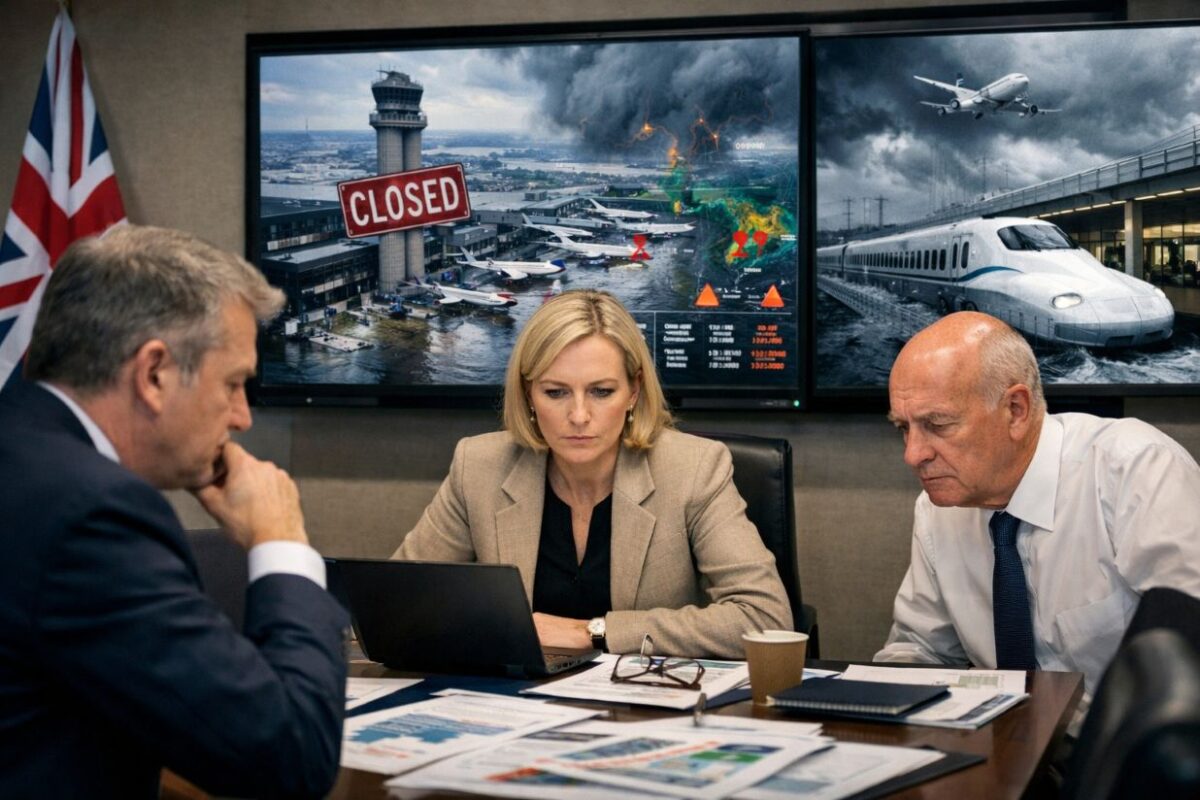
Image generated with Ai
Severe meteorological anomalies present an escalating threat to global transport infrastructure, forcing regulatory bodies to rethink operational resilience. On the 4th of July 2026, the structural fragility of international aviation networks was exposed when severe thunderstorms triggered a Federal Aviation Administration (FAA) ground stop at Chicago O’Hare International Airport (ORD). Official FAA flight tracking logs confirm this event resulted in over 400 cancellations and 1,000 delays, rendering ORD the most disrupted aerodrome globally on that date. For global readers and policy analysts, understanding this incident is critically important; it moves beyond a viral novelty to expose the legal vulnerabilities of international passenger protections and the hidden economic costs carriers absorb to maintain network equilibrium. The case is entirely unique in its own right, demonstrating an extraordinary asymmetry in regulatory enforcement: a legacy transatlantic carrier legally detached itself from its customer care mandate under “extraordinary circumstances,” leaving a domestic competitor to inadvertently run a multi-thousand-pound “ghost flight” for a single stranded traveler.
The resulting logistical cascade directly impacted transatlantic routes, notably forcing the diversion of United Kingdom-originating flights. British Airways flight BA299, travelling from London Heathrow (LHR) to Chicago, was redirected to Cincinnati/Northern Kentucky International Airport (CVG), landing at approximately 18:00 local time. Verified flight tracking data indicates that at least two additional BA flights, including BA295, were similarly diverted to Cincinnati during the afternoon programme due to the severe environmental degradation.
These diversions necessitated complex passenger rebooking protocols and highlighted the rigid regulatory necessity of aircraft repositioning. The incident culminated in a statistical anomaly: a single passenger operating as the sole occupant on a commercial Boeing 737-900 flight, laying bare the immense logistical mechanics required to maintain global flight schedules.
Primary Analysis: The United Kingdom and United States Aviation Continuity Frameworks
When international flights are diverted, airlines must adhere to strict regulatory guidelines regarding passenger duty of care and aircraft repositioning. Following the diversion to CVG, officially logged passenger flight manifests confirm that one individual secured onward travel on United Airlines Flight UA1813, scheduled from Cincinnati to Chicago. This followed a breakdown in standard carrier-led recovery; the passenger logged multiple unsuccessful service communications with British Airways and its domestic partner, American Airlines, where he was instructed to arrange independent transport.
Advertisement
Advertisement
Due to the identical weather systems causing the initial BA diversions, UA1813 was subjected to a severe ground delay. Originally scheduled to depart at 18:12 Eastern Time, FAA departure logs record the aircraft remaining grounded for over seven hours. As the delay extended, all other manifested passengers either cancelled, secured alternate ground transport, or rebooked onto subsequent flights.
Despite the lack of commercial payload, United Airlines was compelled to operate the flight. According to US Department of Transportation (DOT) operational guidelines, aircraft must be repositioned to designated hubs to ensure network integrity for the following day’s schedule. This regulatory necessity meant the Boeing 737-900—a narrow-body jet configured with 179 seats, including 20 in United First and 159 in Economy—departed CVG at 01:28 on the 5th of July with only one passenger.
Advertisement
Advertisement
Flight UA1813 Operational Timeline (4-5 July 2026)
| Operational Phase | Scheduled Time | Actual Time | Official Log Source |
| Scheduled Departure (CVG) | 18:12 EST (4 July) | 01:28 EST (5 July) | FAA Departure Logs |
| En Route Duration | 55 Minutes | 47 Minutes | Air Traffic Control |
| Arrival (ORD) | 18:07 CST (4 July) | 01:15 CST (5 July) | FAA Arrival Logs |
Verified accounts cross-referenced with airline operational procedures confirm the flight crew adhered strictly to standard regulatory protocols. The passenger, seated in 1B of the United First cabin, received mandatory safety briefings directly from the cabin crew. Furthermore, standard flight deck operational transparency allowed the passenger a pre-departure cockpit visit, culminating in the presentation of a collectible Boeing 777 pilot trading card—a documented customer relations initiative utilised by the carrier.
Aviation Law Note: Under UK261 and corresponding EU passenger rights frameworks, weather disruptions are legally classified as “extraordinary circumstances.” This classification exempts carriers from direct financial delay compensation, exposing a significant gap in cross-border consumer liability when international passengers are left to navigate domestic routes independently.
Advertisement
Advertisement
Global Parallel Trends: Japan and Australia
The operational rigidity observed in the United States closely mirrors the transport resilience protocols enforced by other geographically vast or meteorologically vulnerable nations.
Japan’s Ministry of Land, Infrastructure, Transport and Tourism (MLIT) and the Japan Civil Aviation Bureau (JCAB) mandate virtually identical repositioning strategies. During the Pacific typhoon season, international arrivals into Tokyo Haneda (HND) or Narita (NRT) are frequently diverted to regional centres such as Kansai (KIX) or Chubu Centrair (NGO). JCAB regulatory data demonstrates that Japanese carriers routinely operate empty or near-empty wide-body aircraft back to Tokyo hubs immediately following the lifting of weather warnings. This ensures the national economic supply chain, highly dependent on air freight, remains unbroken.
Similarly, the Australian Civil Aviation Safety Authority (CASA) oversees comparable protocols. When tropical cyclones disrupt operations at Brisbane (BNE) or Darwin (DRW), flights are diverted hundreds of miles south to Sydney (SYD) or Melbourne (MEL). According to structural analyses by the Organisation for Economic Co-operation and Development (OECD) on transport resilience, both Japan and Australia absorb the short-term financial losses of flying empty repositioning flights to prevent long-term macroeconomic network collapse. The adherence to schedule integrity supersedes individual flight profitability.
The Counter-Trend Divergence: The United Arab Emirates
Conversely, a diametrically opposed approach to aviation resilience is observed in the United Arab Emirates (UAE). Regulated by the General Civil Aviation Authority (GCAA), the UAE relies on a hyper-centralised mega-hub model, primarily focused on Dubai International Airport (DXB) and Abu Dhabi International (AUH).
Advertisement
Advertisement
Unlike the US, UK, or Australia, the UAE does not possess a vast domestic network of regional aerodromes to accept diverted wide-body aircraft. Furthermore, the local meteorological profile—while subject to extreme heat and occasional severe rain events—does not routinely produce the hyper-localised, rapidly forming thunderstorms that plague the American Midwest.
When extreme weather does threaten the UAE, official GCAA procedures favour delaying aircraft at their international point of origin (e.g., holding a flight at LHR) rather than launching it and diverting it to a secondary Middle Eastern airport. This fundamental policy divergence eliminates the need for domestic repositioning “ghost flights” entirely, prioritising ground-holding over airspace diversion.
Future Outlook: Macroeconomic Consequences of Climate Disruption
The incident on the 4th of July 2026 is a micro-indicator of a mounting macroeconomic crisis. Data compiled by the World Meteorological Organization (WMO) indicates a sharp global increase in severe, localised weather events capable of paralysing critical infrastructure.
For the aviation sector, the short-term consequence is clear: increased reliance on highly inefficient repositioning flights to maintain schedule integrity. The long-term geopolitical and economic outlook, however, is significantly more concerning. The International Monetary Fund (IMF) and OECD have both issued white papers warning that legacy transport infrastructure in North America and Western Europe is inadequately prepared for escalating climate volatility. Without massive state-sponsored investment in meteorological prediction arrays and aerodrome expansion, the global supply chain will face compounding daily disruptions, driving up logistical costs and, ultimately, consumer inflation.
Conclusion
The solitary passenger aboard United Airlines Flight UA1813 is not merely an amusing anecdote of travel disruption; rather, it is a stark illustration of modern aviation’s inflexible operational reality. Bound by strict FAA and CAA regulatory frameworks, airlines are forced to execute highly inefficient manoeuvres to preserve the fragile equilibrium of global transport networks. As meteorological anomalies become increasingly severe, the international community must urgently re-evaluate the resilience of its infrastructure, lest these costly logistical anomalies become the new standard.
Advertisement
Advertisement