China’s test-launch of a ballistic missile from a nuclear-powered submarine into the Pacific on Monday caused a backlash from the US, Japan, Australia and New Zealand over what they regarded as Beijing’s expansionist display.
China said a submarine fired the unarmed intercontinental ballistic missile towards international waters at 12.01pm on Monday and it flew thousands of kilometres.
The launch was a “routine arrangement”, a part of annual military training, and did not target any specific country, Xinhua news agency said.
It was China’s first test of an intercontinental ballistic missile in the Pacific Ocean in almost two years.
It was carried out “safely and in a standardised and professional manner throughout”, foreign ministry spokesperson Mao Ning said.
After some countries, including Australia and Japan, complained that Beijing had notified them only a few hours before the launch, Ms Mao said China hoped they “will not over-interpret the matter”.
The US monitored the launch and confirmed that the missile landed in the southern Pacific.
What do we know about the projectile China tested?
According to the Pentagon, it was a long-range missile capable of reaching continental US from inside China’s coastal waters.
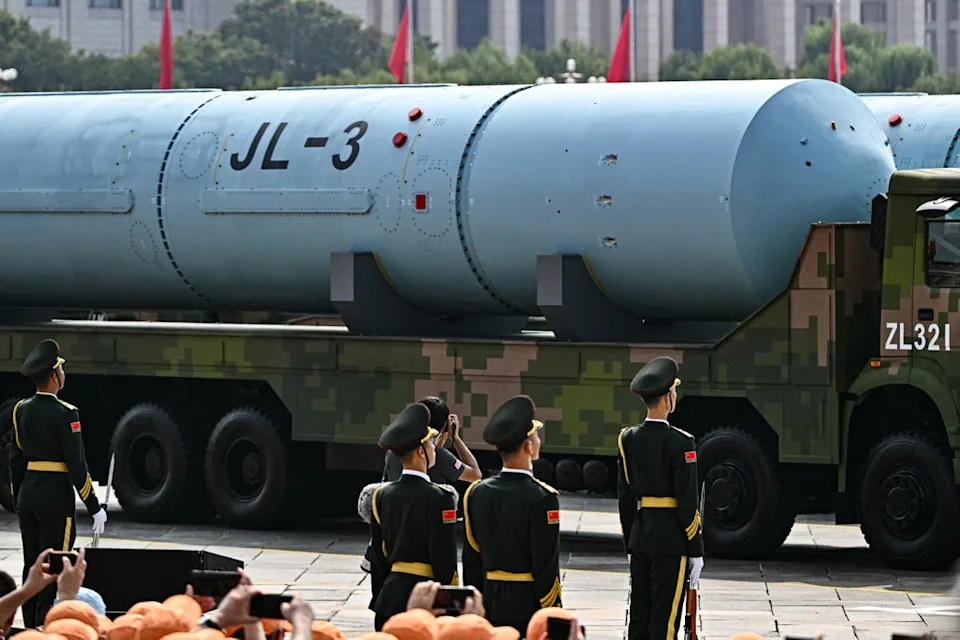
A picture of the missile was published by Xinhua on Tuesday without many details, suggesting it could be a JL-2 or a JL-3, both submarine-launched ballistic missiles.
Global Times speculated it was “most likely” JL-3, China’s most advanced submarine-launched missile that debuted at a military parade last year.
JL-3 missile ranges over 10,000km. The older JL-2 variant can reach targets at a distance of 7,300km.
The missile launched on Monday covered at least 7,300km. If it was indeed a JL-2, it was tested to the maximum range.

The JL-3 submarine-launched ballistic missile is seen during a military parade (AFP/Getty)
Why did the test cause alarm?
The test came at a time of heightened tensions between China and the US and its allies in the region.
That it was conducted in the South Pacific Nuclear Free Zone only further alarmed the US, Australia, Japan, and New Zealand.
The zone was established under the 1986 Treaty of Rarotonga, which prohibited nuclear weapons throughout the region. China ratified the treaty’s protocols in 1987, pledging not to test nuclear weapons within the zone or threaten to use them against signatories with territory in the region.
The State Department said China’s actions undermined efforts to uphold nuclear agreements at a time of major global conflicts.
“At a time when the United States is working harder than ever to prevent nuclear proliferation, China is doing the opposite,” spokesperson Tommy Pigott said.
China’s “rapid and opaque nuclear weapons build-up”, he added, was “of great concern to the region and the world”.
The spokesperson urged China to engage in arms control talks and establish regular notification arrangements for intercontinental ballistic missile and space launches.
In Australia, prime minister Anthony Albanese said the test was “a provocative act by China which does destabilise the region”.
“This was a test of a nuclear-capable intercontinental ballistic missile fired from a nuclear-powered submarine. That’s of real concern because what we need is less nuclear weapons, certainly not more. And the fact that this test took place yesterday with very little notice is of real concern,” Mr Albanese said during his visit to Honiara in the Solomon Islands.
His foreign minister, Penny Wong, highlighted that the test came “in the context of a rapid military build-up by China which is lacking in the transparency and reassurance as to intent that the region expects”.
New Zealand’s foreign minister Winston Peters called it “unwelcome and concerning”. The government claimed the test violated a bilateral agreement as it was launched into treaty waters in the South Pacific Nuclear Free Zone.
What did China’s neighbours say?
Taiwan said the test was an attempt by China to intimidate the international community. A senior security official said on Monday that the self-governed island was tracking an “upward trend” in Chinese naval movements during the peak military exercise season, including drills with Russia.
Matthew Wale, prime minister of Solomon Islands, said China was a good friend of his country “but this is not something a friend does”.
“This is not good in our region,” he said.
“We don’t want to see any more countries – China, America, anybody – we don’t want anybody testing their ICBMs in the Pacific Islands region. Be our friend, but don’t threaten us,” he said.
What is China signalling with the test?
There’s much to read into the test from China, experts say.
Australia and Fiji were signing a mutual defence pact, requiring each to come to the other’s aid in the event of an attack, when Beijing conducted its test.
Beijing is competing with the US and its regional allies, like Australia, for influence in the strategically located island nations of the Indo-Pacific and some analysts suggest the timing may be linked.
Although the test was likely planned long in advance, the timing of the notification to the neighbours was “interesting, to say the least”, said Mark Douglas, an analyst at New Zealand-based ship-tracking firm Starboard Maritime Intelligence.
Meia Nouwens, senior fellow for Chinese security and defence policy at the International Institute for Strategic Studies, said the US and others concerned would be “watching and analysing the test launch closely for any insights into PLA capability”.
Ms Nouwens added that China could be signalling discontent about the Australia-Fiji agreement. “That said, the launch could be counterproductive and negatively affect China’s image among countries in the South Pacific.”