Key Points
-
Warren Buffett retired as Berkshire Hathaway’s CEO on Dec. 31, and his successor, Greg Abel, wasted little time transforming the company’s investment portfolio.
-
Abel has been aggressively purchasing a virtual monopoly that has strong artificial intelligence (AI) ties.
-
Additionally, Abel’s first letter to shareholders highlighted Berkshire’s largest investment holding as a multidecade compounder.
- 10 stocks we like better than Alphabet ›
It’s a year of new beginnings for the trillion-dollar conglomerate that Warren Buffett helped build, Berkshire Hathaway (NYSE: BRKA)(NYSE: BRKB). Following the Oracle of Omaha’s retirement as CEO on Dec. 31, Berkshire has its first new leader in more than half a century.
Buffett’s protégé, Greg Abel, is now at the helm — and he’s wasted no time making his presence felt. Since taking over, Abel has completely exited 16 positions and amassed a mammoth stake in Google parent Alphabet (NASDAQ: GOOGL)(NASDAQ: GOOG). When combined with Berkshire’s largest position, Apple (NASDAQ: AAPL), Abel has 30% of Berkshire’s $343 billion investment portfolio tied up in two foundational artificial intelligence (AI) stocks.
Missed Nvidia in 2009? This Rare Signal Is Flashing Again. In 2009, a “Double Down” signal flashed for a little-known chipmaker called Nvidia. For the first time in years, that same “Total Conviction” signal is flashing for a company 1/100th the size of Nvidia. Continue »
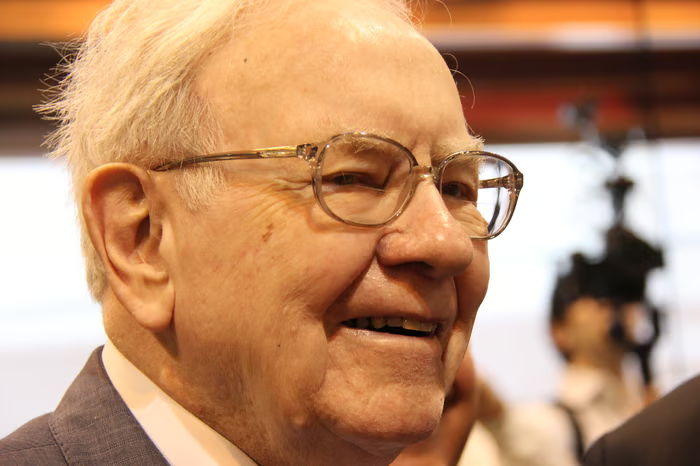
Warren Buffett retired as Berkshire Hathaway’s CEO on Dec. 31. Image source: The Motley Fool.
Alphabet: 9.1% of invested assets
There’s no stock that Greg Abel has purchased more aggressively since taking over as CEO a little over six months ago than Alphabet.
During the first quarter, he more than doubled Berkshire’s stake in Alphabet’s Class A shares (GOOGL) and opened a position in its Class C shares (GOOG). More recently, Berkshire committed to buy a $10 billion private placement from Alphabet ($5 billion of each share class).
Alphabet checks an important box for both Abel and his predecessor, Warren Buffett. Namely, it offers a sustainable moat. The Google search engine accounted for approximately 91% of global internet search traffic in June. When coupled with streaming platform YouTube, the second-most-visited site on the planet, it’s easy to see how Alphabet commands such incredible ad pricing power.
But Alphabet’s growth engine is powered by cloud infrastructure services platform Google Cloud and its AI integration. Since Google Cloud began offering clients access to generative AI and large language model solutions, sales growth for this high-margin segment has reaccelerated from 28% in the first quarter of 2025 to 63% in the comparable quarter ending in March 2026.

Image source: Apple.
Apple: 20.5% of invested assets
Although Warren Buffett sold 75% of Berkshire Hathaway’s Apple stake over the nine quarters leading up to his retirement, the remaining stake still accounts for more than a fifth of invested assets.
When Buffett began selling a substantial number of Apple shares, he framed the decision as being tax-driven at Berkshire Hathaway’s annual shareholder meeting in 2024. But in Greg Abel’s first letter to shareholders, he alluded to Apple as a multidecade compounder. Despite being sold off heavily by Buffett, Apple isn’t going anywhere.
For well over a decade, physical devices such as iPhone, Mac, and iPad have made Apple tick. However, CEO Tim Cook has charted a new course. He’s transforming Apple into a platform-driven company, led by high-margin subscription services that’ll keep customers loyal to the Apple ecosystem, and the integration of AI solutions.
In June 2024, at Apple’s Worldwide Developers Conference, the company unveiled Apple Intelligence. Apple’s generative AI tool was introduced into its physical devices in late 2024/early 2025. It aims to assist users with text summarization and substantially enhance Siri’s onscreen awareness.
While Apple remains dependent on sales of its physical devices, its subscription services and AI integration are expected to improve customer loyalty and bolster the company’s margins.
Should you buy stock in Alphabet right now?
Before you buy stock in Alphabet, consider this:
The Motley Fool Stock Advisor analyst team just identified what they believe are the 10 best stocks for investors to buy now… and Alphabet wasn’t one of them. The 10 stocks that made the cut could produce monster returns in the coming years.
Consider when Netflix made this list on December 17, 2004… if you invested $1,000 at the time of our recommendation, you’d have $409,970!* Or when Nvidia made this list on April 15, 2005… if you invested $1,000 at the time of our recommendation, you’d have $1,200,223!*
Now, it’s worth noting Stock Advisor’s total average return is 916% — a market-crushing outperformance compared to 210% for the S&P 500. Don’t miss the latest top 10 list, available with Stock Advisor, and join an investing community built by individual investors for individual investors.
*Stock Advisor returns as of July 8, 2026.
Sean Williams has positions in Alphabet. The Motley Fool has positions in and recommends Alphabet, Apple, and Berkshire Hathaway. The Motley Fool has a disclosure policy.
The views and opinions expressed herein are the views and opinions of the author and do not necessarily reflect those of Nasdaq, Inc.