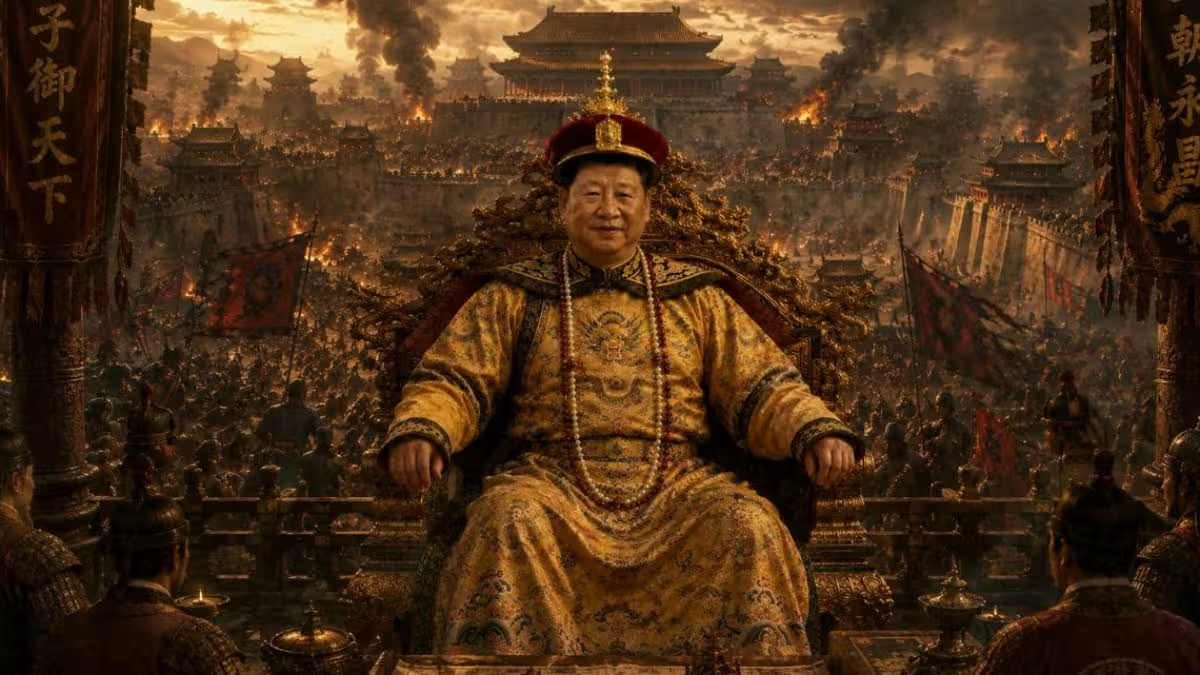
The defining paradox of dictatorship is that the stronger a ruler appears, the more frightened he usually is. In authoritarian systems, overwhelming displays of power are often admissions of insecurity. A confident ruler does not constantly eliminate his own loyalists. Only a ruler haunted by betrayal sees enemies everywhere. That is why Xi Jinping’s latest military purge deserves far greater attention than the routine headlines it has generated. Xi is not behaving like a leader in complete control. He is behaving like an emperor who suspects that control is slipping away.
The recent dismissal of six of China’s top generals is no routine administrative reshuffle. It is part of an extraordinary campaign that has penetrated the highest ranks of the People’s Liberation Army (PLA). According to the China Military Tracker maintained by Anushka Saxena at the Takshashila Institution,
Xi has purged at least 104 generals over the past four years, including 47 four-star officers. Sixty-two have been removed in the past year alone — the most extensive military cleansing since the Cultural Revolution.
Even more telling is the profile of those who have fallen. Five of the seven members of the Central Military Commission, whom Xi himself elevated at the 20th Party Congress, have already disappeared from power. Two vice-chairmen and three other members have been removed in barely three years. If even Xi’s own hand-picked commanders cannot survive, who can?
History offers a simple lesson: dictators do not purge because they are invincible. They purge because they are afraid. The broader the purge, the deeper the insecurity. A ruler who trusts his institutions does not dismantle them. A ruler who trusts his generals does not randomly replace them.
Xi Jinping, in that way, is increasingly resembling Mao Zedong — not only in ideology but also in political psychology. Mao turned paranoia into an instrument of governance. Revolutionary credentials, personal loyalty and military brilliance offered no protection. In fact, the higher one rose, the greater the danger one encountered.
Nothing illustrates this better than the fall of Marshal Lin Biao in 1971. Lin was not only China’s Defence Minister but Mao’s designated successor, vice-chairman of the Central Military Commission and one of the architects of Communist China’s military victories. Yet Mao’s growing suspicion transformed his closest lieutenant into his greatest enemy. Accused of plotting a coup, Lin allegedly attempted to flee to the Soviet Union before dying in a mysterious plane crash in Mongolia. Whether the official account is entirely true remains disputed. What is beyond dispute is what followed: Mao unleashed a sweeping purge throughout the PLA. Thousands of officers were interrogated, purged and killed.
The message was unmistakable: absolute power demands perpetual purification. Xi appears to have embraced exactly the same logic.
The timing is equally revealing. These purges coincide with China’s most serious economic slowdown in decades. For years, both China and the outside world believed the Dragon’s rise as sole superpower was imminent and inevitable. The 21st century, we were told, would belong to China. That certainty is beginning to unravel now.
The country’s once-mighty property sector has become its greatest economic liability. As the American journalist Linette Lopez wrote in Business Insider on October 15, 2023: “China has a population of 1.4 billion, but it has built housing for a population of 3 billion, according to expert estimates. Many of the mega-developments became empty monuments of Beijing’s insatiable desire for growth.”
The demographic outlook is even bleaker, with Rod D Martin, founder of US-based equity fund Martin Capital, forecasting China’s population crisis is now “mathematically irreversible”. As Vikram Sood writes in Great Power Games: “A consistent one-child policy has meant that a generation of Chinese lacks siblings to share the social and financial responsibility of ageing parents. Entrepreneurship and risk-taking in general become casualties… The average Chinese is now parking savings in long-term bank deposits to secure their future… Consumption has not risen much in response.”
Xi’s China today increasingly resembles the Japan of the 1990s — but without Japan’s democratic institutions, transparent financial system or affluent welfare state.
Frank Dikötter has argued persuasively that China’s apparent strength conceals extraordinary fragility. The opacity of the Chinese system makes objective assessment almost impossible. “Every piece of information (in China) is unreliable, partial or distorted. We do not know the true size of the economy, since no local government will report accurate numbers, and we do not know the extent of bad loans, since the banks conceal these. Every good researcher has the Socratic paradox in mind: I know what I don’t know. But where China is concerned, we don’t even know what we don’t know,” Dikötter writes in his 2022 book, China After Mao: The Rise of a Superpower.
Debt illustrates the problem vividly. China’s growth increasingly became dependent on borrowing rather than productivity. Between 2010 and 2020, debt expanded dramatically while economic growth itself slowed. Consumption never replaced infrastructure investment because wealth accumulated primarily in the hands of the state rather than households. Former Premier Li Keqiang unintentionally exposed this uncomfortable reality in 2020 when he admitted that more than 600 million Chinese citizens survived on roughly $140 a month — hardly the profile of a society poised to dominate the 21st century.
This is the central contradiction of modern China: the state is wealthy, but its people are not. That contradiction has political consequences.
In India Versus China, Kanti Bajpai cites Sungmin Cho of the Daniel K. Inouye Asia-Pacific Center for Security Studies. During the early months of Covid-19, Cho found that many Chinese openly criticised the central government. But as the pandemic unfolded, public anger shifted towards local and provincial authorities while support for Beijing and Xi actually increased. Cho argues that many Chinese are “liberal nationalists” — liberal in demanding accountability from local governments but nationalist in defending the central leadership against foreign criticism. As economic anxieties deepen, that local safety valve, which has allowed Beijing to escape blame, is slowly disappearing. Public frustration can no longer be indefinitely contained at the provincial level.
And that is when authoritarian regimes become dangerous. Their legitimacy rests on three pillars: ideology, economic performance and fear. Communism in China has long since lost much of its ideological purity. Economic performance is no longer delivering the legitimacy it once did. That leaves fear as the regime’s only currency. This may explain why Xi’s China is becoming simultaneously more repressive at home and more confrontational abroad. External tensions distract from internal anxieties. Military modernisation projects strength while political purges enforce obedience.
Many observers interpret every purge as proof of Xi’s absolute dominance. They mistake coercion for confidence. History suggests the opposite. Mao did not launch repeated political campaigns because he felt secure. He did so because insecurity had become inseparable from his rule. Xi appears to be following the same treacherous path.
Perhaps the greatest fear haunting Zhongnanhai today is not an external enemy but a dawning realisation that the 21st century may not, after all, belong to China. The greatest threat to a dictator is rarely outside the palace. It is the fear inside it.
(The writer is the author of ‘Bharat Rising: Dharma, Democracy, Diplomacy’ and ‘Eminent Distorians: Twists and Truths in Bharat’s History’. Views expressed in the above piece are personal and solely those of the author. They do not necessarily reflect Firstpost’s views.)