Get free access to the most comprehensive World Cup coverage in The Athletic app.
In a Dick’s Sporting Goods store in southern California, one employee of Oakley was sent to buy a dozen footballs.
Back at the eyewear brand’s headquarters in Foothill Ranch, the design team was racing against the clock to help a global football star remain in the 2024 European Championships in Germany.
Sketches were drawn, 3D masks printed and footballs blasted at a prototype sitting on a lifesize headform modelled on Kylian Mbappe’s face.
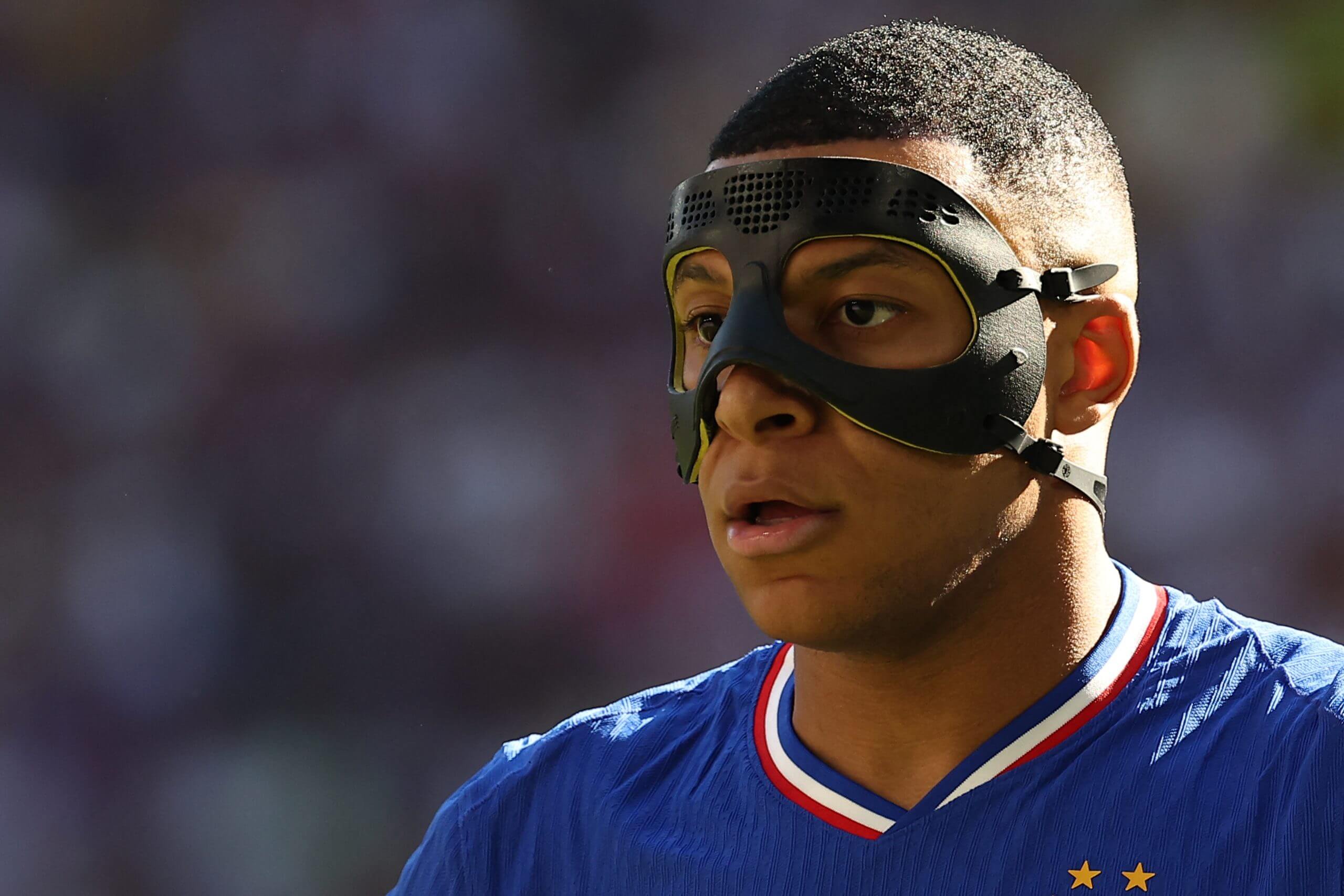
Mbappe, who became France’s all-time top scorer at the 2026 World Cup, had broken his nose in his country’s opening game two years ago. He heard the click when team doctor Franck Le Gall put his nose back into place in the dressing room. After a visit to Dusseldorf hospital in the early hours of the morning, medics told Mbappe, 25 at the time, he would not need surgery at this stage but the bone would take six weeks to heal. The striker did not have time to wait. A mask, however, could be fitted to enable his return to play.
Kylian Mbappe wearing a protective mask during the 2024 European Championships (Franck Fife/Getty Images)
A mask is not a cure nor does it eliminate the risk of further injury or complications, but it is a compromise between recovery and competition.
The mask-making process, however, is more complex than meets the eye as doctors, surgeons and designers explain to The Athletic.
The most frequent facial fractures are nasal, cheek and jaw. At this World Cup, several players such as England’s Djed Spence, Algeria’s Luca Zidane, Uruguay’s Sebastian Caceres and Austria’s Stefan Posch have been sporting protective facial gear, having sustained such injuries before or during the tournament.
Rest for the traumatised area is fundamental but a mask acts as a shield, allowing athletes to return to play before the bone has fully healed. In the event of subsequent impact, the mask absorbs the force and diverts it away from the healing zone to stronger areas of the skull.
The mask can act as a psychological barrier too, helping the athlete overcome fears of further trauma. Some players feel more confident wearing it while others are more cautious for fear of another blow.
The severity of the injury should not be underestimated. If a player is wearing a mask, it is for good reason. “Masks are not a joke,” says Bundesliga doctor Andreas Elsner. “It is not something they do from a stylish perspective. It’s about safety.”
Some players wear masks for weeks or months. If they have an osteosynthetic operation, a technique used to stabilise fractured bones using metal plates and screws, a player may have no choice but to wear the mask every time they play.
A whole team is involved in the process. Maxillofacial surgeons determine if the player can return to play and which areas need protection before external specialist orthopedic technicians make the custom device.
An optical scanner captures a precise 3D facial scan of the player, according to Manuel Chamorro, head of maxillofacial surgery at the Quiron Ruber Juan Bravo hospital in Madrid.
A mask is designed based on the digital scan and takes into account any swelling or bruising, plus the need to distribute the force of potential impact while allowing for clear vision, breathing and communication. The mask is secured with elastic straps and, sometimes, interchangeable padding before being tested on the player. Small details are adjusted until a perfect fit is achieved.
Back in Paderborn, France’s Euro 2024 basecamp in Germany and a 40-minute drive from the city of Bielefeld, after Mbappe was injured, France initially contacted Arminia Bielefeld striker Fabian Klos, who broke his skull and eye socket in April 2022, to ask where he had his mask made.
At first Mbappe, who left Paris Saint-Germain for Real Madrid in the summer of 2024, was pictured in training three days after his blow wearing a mask with the French national colours of red, white and blue — the Tricolore — and his initials and the French Football Federation (FFF).
Oakley, however, did not make that mask.
“You can tell when you look at that one it doesn’t fit his face very well,” Nicolas Garfias, Oakley’s vice president of design tells The Athletic.
The designers drew some quick sketches. The priority was Mbappe’s safety and comfort. But Garfias also thought: “How are we going to make this thing cooler than what’s out there?”

Uruguay’s Sebastian Caceres wearing a mask against Cape Verde in Miami (Michael Regan/Getty Images)
Crucially, Oakley already had a 3D digital scan of Mbappe’s head and face from when he visited their headquarters in California upon becoming the company’s ambassador in 2022. They try to scan all their talent.
“You never know what the ask is going to be,” says Garfias. A similar scenario arose with Tom Cruise, who, since breaking his nose, has difficulty fitting eyewear. During the filming of Mission Impossible, the actor called upon Oakley to make his custom eyewear.
Designers turned Mbappe’s 3D digital scan into a real-life model, similar to a Madame Tussaud’s waxwork, of Mbappe’s head. But to make the mask. they had to account for the distance needed for padding between his skin and the inside of the mask.
Oakley used a 3D printer to construct the mask, which was made of a resin-based plastic material. They created ventilation holes where heat builds up around the eyes and nose, but kept them small so as not to weaken the mask’s structure.
Oakley dyed it black, concerned that paint could rub off because of sweat accumulation and cause irritation and rubbing, with no other features. UEFA regulations also state: “Any medical equipment worn on the field of play must be a single colour and free of team and manufacturer identification.” FIFA has similar rules.
A retention system attached to a little bead on either side allowed Mbappe to adjust the pressure using a dial at the back. They then tested the prototypes by firing balls as hard as they could to simulate what Mbappe may experience.
“We didn’t want to give him something we were uncertain of,” says Garfias.
The entire process took around 48 hours. Oakley shipped several copies of the same mask to Germany the next day, along with laser-cut foam inserts of varying shapes and thicknesses so the France medical team could tailor the fit.
It is unusual that a brand like Oakely, that does not manufacture medical equipment, let alone masks, would make Mbappe’s device.
Their only other historically relevant example was in the mid 1990s when some NBA players such as James Worthy, who had an eye injury, wore clear goggles. When Oakley heard some of the athletes had problems with their eyewear, they made a functional piece called the Oakley Slash with a top lens, air ventilation and a leash to hold them in place.
Whatever mask Mbappe chose to wear, however, must have been approved by France’s medical team and UEFA.
Knowing what they know now and had they had more time, Garfias says he would have made the mask using a different material. Indeed, whereas Oakley made that mask using a resin-based plastic material, many masks, according to Chamorro and Elsner, are usually made of carbon fibre, a very lightweight and extremely resistant material. Sometimes they are finished with rubber to prevent chafing and discomfort.

The LA Lakers’ James Worthy wearing Oakley goggles in 1990 (Ken Levine/Getty Images)
“But different materials means more uncertainty and takes more time,” says Garfias. “We acted with what we had in the time we had.
“I don’t want to say we got lucky because we were triple sure that it wasn’t going to break but we were also taking a little bit of a risk too. That’s part of it.”
Interestingly, Oakley is planning to introduce products which focus on eye and face protection. Although eyewear is not permitted in football — Italian Annibale Frossi in the 1930s and Netherlands international Edgar Davids being notable exceptions — Oakley wants to change the status quo and overcome the historical perception of the safety of eyewear on the field. They are doing so in flag football, one of the fastest-growing sports in North America, which will feature in the 2028 Summer Olympics.
The irony is, despite Oakley saying they did not receive any negative feedback, Mbappe hated playing with any kind of mask.
He played with one for four games until Spain knocked out France in the Euro semi-finals. With the benefit of hindsight, however, the Frenchman would have done things differently.
“If I could go back, I wouldn’t play,” the 27-year-old admitted in an interview with Le Parisien ahead of the 2026 World Cup. “I’d leave.”
Mbappe struggled with limited vision and sweat clogging around his eyes. “As soon as I can take it off, I will,” he said two years ago in a press conference ahead of the round of 16 against Belgium.
“Right now, I’ve got no choice. I can’t play without it… I have to say ‘thank you’ to the masks.”