It was more than two years ago when the Football Association started thinking about life beyond Gareth Southgate. It wanted to aim for the stars, knowing that its window of opportunity to win a tournament with this group of players — not least Harry Kane — was finite. It had to find someone who could win the World Cup.
So it drew up a list of characteristics which it believed would correlate with tournament success. One of which, along with playing style and tactical flexibility, was the coach’s record in club knockout football.
And on this metric Thomas Tuchel — who was then at Bayern — scored spectacularly well. His ability to guide a team through cup competitions, one game at a time, was second to none. It became a key part of the argument to target him. Especially given that Pep Guardiola, the FA’s dream candidate, wanted to stay at Manchester City, doing two more seasons there.
When Southgate resigned after Euro 2024, it was time to put the plan into action. FA technical director John McDermott reached out to Tuchel, who had just left Bayern Munich, and who had held talks — which came to nothing — for the Manchester United job. There was a meeting with McDermott in Munich, one with Anthony Barry, and then another with McDermott and FA CEO Mark Bullingham. Tuchel wowed the FA delegation with a presentation about how he thought he could win the forthcoming World Cup.
And now here we all are, in June 2026, with England due to fly today from their base in Kansas City to Atlanta for their World Cup last 32 game with DR Congo tomorrow. It is no exaggeration to say that everything that has happened over the last few years was building up specifically to this. Or to this, and then the four potential games after that, all squeezed into the next three weeks.
This is precisely what Tuchel was appointed for. That reputation as a cup football maestro, that glow of knockout know-how, is integral to Tuchel’s mystique as a coach. He is among the elite coaches in the modern game, and yet he is one of those managers — perhaps like Carlo Ancelotti — whose standing owes more to knockout football than to leagues. Yes, he won Ligue 1 twice with PSG and the Bundesliga with Bayern Munich. But they are not where his aura derives from.
Why Jude Bellingham Is Still Being Underrated
What made Tuchel into this dominant figure — one ultimately entrusted by the FA to help them to add that second star — was his record in cups. And not just the domestic cups he won with Borussia Dortmund and PSG, but the Champions League, the competition that still ultimately defines the best coaches.
Until England called, that was Tuchel’s biggest ambition in football. In 2019-20, Tuchel took PSG all the way to their first-ever Champions League final, past Dortmund, past Atalanta, past RB Leipzig, only for them to lose 1-0 to Bayern in a tight, behind-closed-doors final in Lisbon. He was sacked four months later.
One month later, he was in charge of Chelsea. And he had another shot at the biggest club trophy of them all, the one that he was desperate to win. Tuchel’s work in those first few months at Chelsea was a masterclass. He arrived instantly ready to win. “He floated in, he didn’t walk,” said Anthony Barry, who had been part of Frank Lampard’s staff but stayed on and “fell in love” with Tuchel. Barry, speaking last season, compared Tuchel’s arrival in January 2021 to a “UFO”. “He was not like anything I had seen before.”
The remarkable thing about Tuchel’s time at Chelsea was how quickly he transformed them, devising a new 3-4-3 system and teaching the players as soon as he arrived. They went from a mess to one of the best-organised teams in Europe almost overnight. They beat Atletico Madrid in the last 16, Porto in the quarter-finals and then faced Real Madrid in the semis. It was another Tuchel masterclass, drawing 1-1 away then winning emphatically 2-0 at home. All of the traits of a Tuchel side — defensive structure, counter-pressing, quick breaks — were there on show.
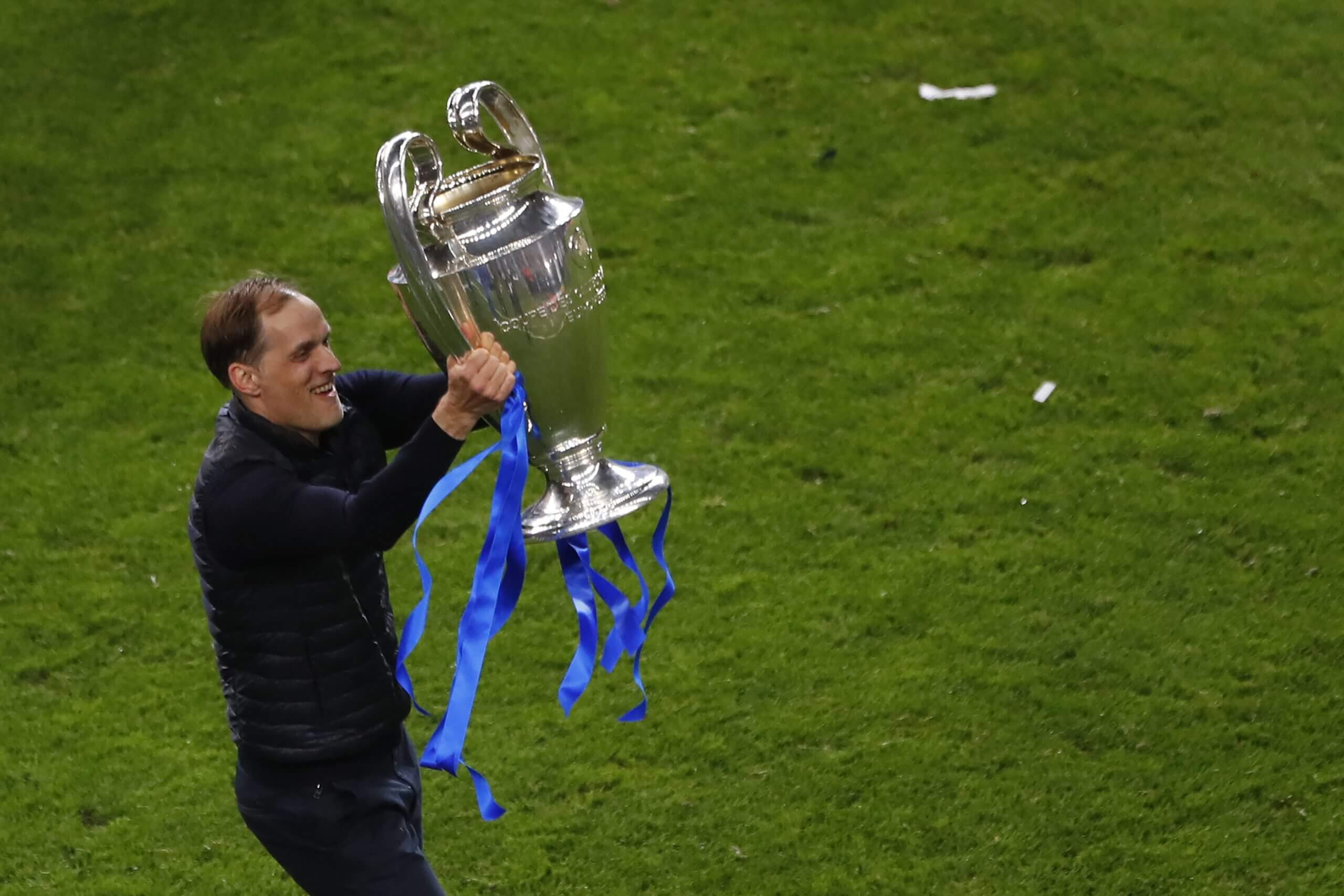
Chelsea went to Porto for the Champions League final, facing a Manchester City side who cruised to the Premier League title that season. It was the most tense that Tuchel has ever been before a game in his life, needing to do a breathing session with the wellness coach on the day of the game. But it went perfectly to plan, with Chelsea set up to hit City on the break. Their defensive structure was immaculate, so much so that they could survive an injury to Thiago Silva and his replacement by Andreas Christensen. Tuchel could not enjoy one minute of it, and could not wait for it to be over. But he ended it as European champion.
Tuchel celebrates winning the Champions League with Chelsea (Susana Vera/AFP via Getty Images)
That was the peak of his time at Chelsea — in fact, of his whole career so far — but his record in other cups was also good. Chelsea reached the 2021 FA Cup final, beating City in the semis, only to lose to Leicester City in the final. The following season, Chelsea reached both domestic cup finals, playing Liverpool, and lost on penalties both times. They did add the UEFA Super Cup and the FIFA Club World Cup, in its old form.
That was Tuchel’s last full season at Chelsea but when he went to Bayern, he came close to reaching a third Champions League final with a third club. Bayern were minutes away from facing Dortmund at the Wembley final, only for Manuel Neuer to spill the ball, allowing Real Madrid’s Joselu to pounce, and then add another. Real went to the final instead. It was one of Tuchel’s last games in club football.
But on all of these runs, Tuchel showed the same flexibility, the same intensity, the same tactical imagination to come up with a plan for every match. It is a form of the game in which his skills are masterful, making him one of the best in the world at this. That is why he is here in the U.S., managing this England team, with their World Cup hopes resting on the strength of his ideas.

