Get free access to the most comprehensive World Cup coverage in The Athletic app.
It’s May 1, 2005. It’s a week after the first video is uploaded to YouTube. It’s 18 days before Star Wars: Revenge of the Sith is released in cinemas. It’s the day Lionel Messi scores his first senior goal.
Messi is 17 years old at this point. His strike — a soon-to-be-typical deft chip against Albacete — makes him, at the time, the youngest scorer in Barcelona’s history.
Exactly 7,717 days (or 21 years, one month and 16 days if you prefer) later, he becomes the oldest player to score a World Cup hat-trick in Argentina’s 3-0 win against Algeria in Kansas City.
Messi has been scoring goals for longer than the iPhone has existed, for longer than Breaking Bad has been around. He, more than any other soccer player, is the one who knocks.
So much has been written about Messi’s goalscoring feats that it manages to feel familiar and yet still surprising.
Heading into Argentina’s final World Cup group game this Saturday, Messi has 916 goals to his name. That’s… a lot of goals. Most players would be glad to end their careers with 500 appearances — to have almost 1,000 goals is freakish, outlandish, historic.
Those 916 goals can, of course, be divided up in many different ways.
There’s the simple carve, like who Messi has scored for…
His move to Inter Miami was seen in some quarters as the winding down of a great man’s career, post his 2022 World Cup win with Argentina. Instead, he is hurtling towards 100 goals — which would be a standout achievement at a club for normal players in normal careers — with the MLS side.
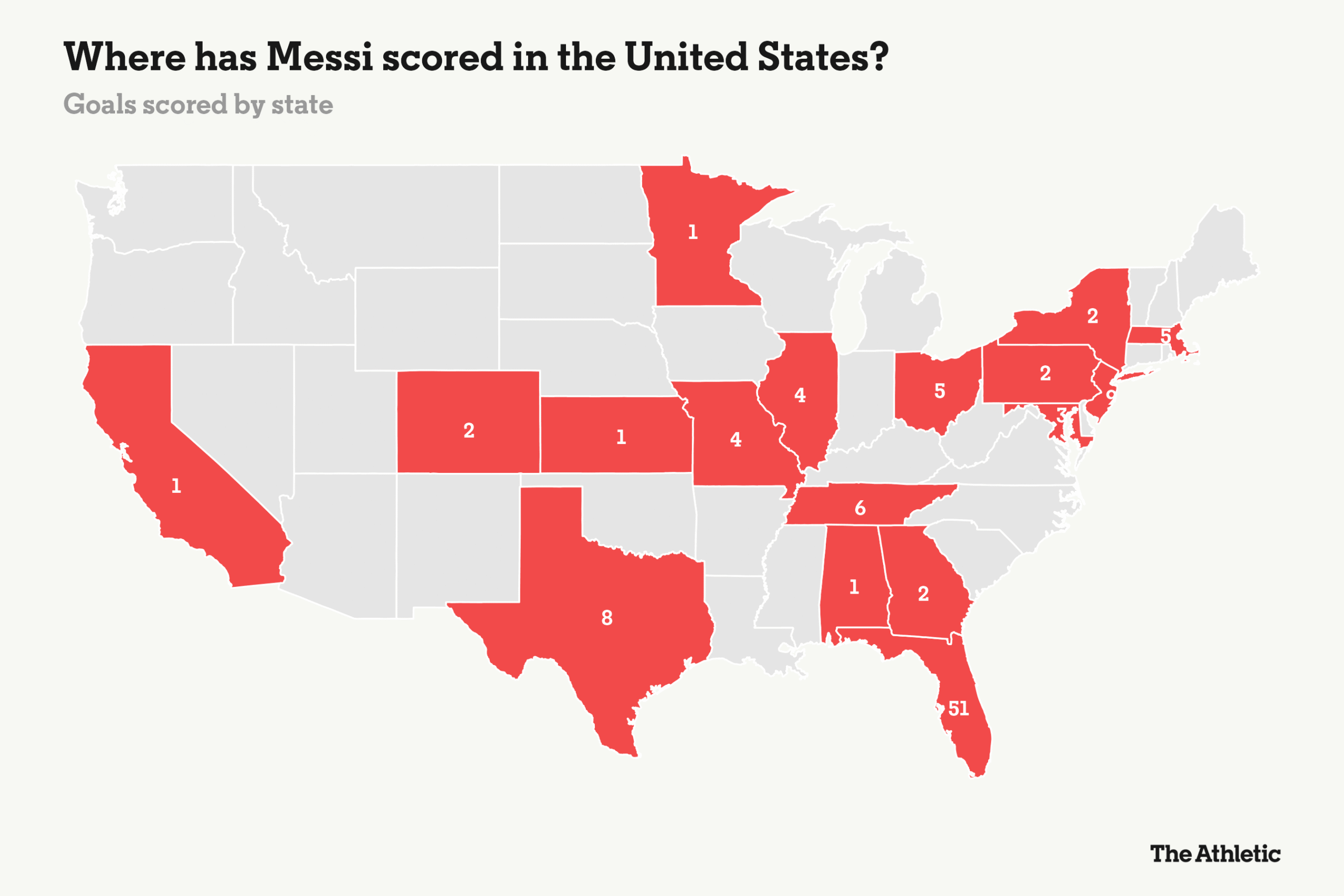
Messi’s spread of goals by state in the U.S. is broad but whoever has to face Argentina in Miami in the round of 32 has to contemplate the terrifying news that Messi has already scored more than 50 goals in Florida.
In fact, Messi’s goal total in the United States across his career dwarfs that of any other player at this summer’s tournament. If there’s one man at the 2026 World Cup who knows the way to goal in America, then it is Lionel Messi.

But Messi is not just restricted to the confines of the U.S. His ability to make goalkeepers have a long hard think about their career choice spreads across the globe, from Chile to Japan, from England to Scotland.
One notable absentee is South Africa, with the 2010 World Cup being the only edition Messi has played at and not scored in. Cristiano Ronaldo did, which explains why he was able to snap up a record earlier this week — scoring in six different World Cups — his great rival has no chance of matching. Probably. Let’s revisit in 2030.

The profile of the graph below may, at first glance, look like the stage profile of a medium mountain stage at the Tour de France, but it is in fact Messi’s goal total by calendar year.
Now, soccer seasons don’t run January to December, so some purists may recoil at this way of presenting it. They would be wrong, though, because Messi’s 91 goals in 2012 is undoubtedly one of his greatest achievements in a career that’s full of them.
If you want to understand Messi at his imperial best, then this is an excellent way to do so. The first half of that year was Messi’s final period working under Pep Guardiola. Guardiola left Barcelona in summer 2012, but any notion that Messi was reliant on his coach, or would slow down once they had been separated, was quickly forgotten.
Plenty of Messi’s goals in that year of plenty came in the form of hat-tricks. He scored three or more goals in a single game on nine different occasions, which remains a career high. He has a scarcely credible 61 across his career. Messi’s hat-trick against Algeria earlier this month means the last year not to contain a Lionel Messi hat-trick was 2008. Mexico’s Gilberto Mora, who started for his country in the victory against the Czech Republic earlier this week, was born in 2008.