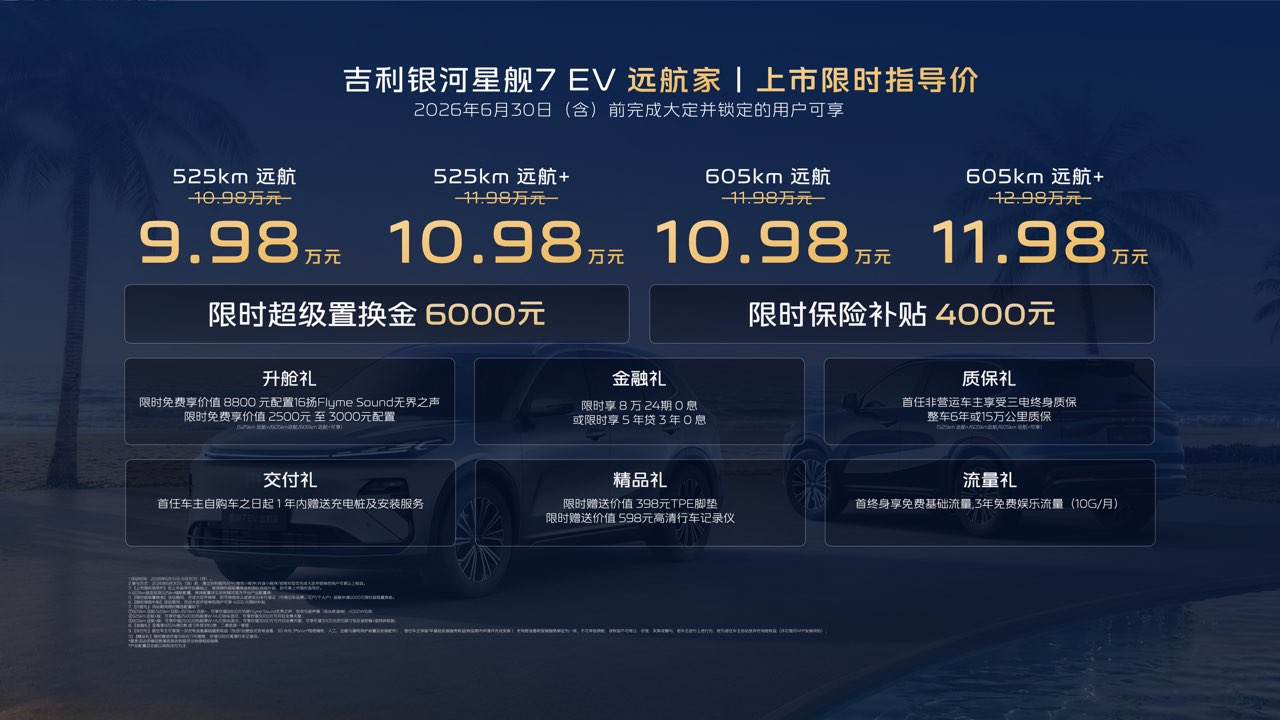
Gasgoo Munich- On June 10, the Geely Galaxy Starship 7 EV Yuanhangjia Edition officially launched. The new car offers two versions: the 605km Yuanhangjia Edition and the 605km Yuanhangjia+ Edition. It also offers a 525km range option, reducing the price by 10,000 yuan. After applying these incentives, the limited-time guide price ranges from 99,800 to 119,800 yuan.

Image source: Geely
Judging by pricing and configuration logic, this isn’t just a simple product line extension. Instead, it’s a targeted move by Geely Galaxy to stake a claim in the A-segment pure electric SUV market. The Starship 7 EV Yuanhangjia Edition features standard Aegis Gold Brick batteries and a starting range of 605km. It aims to address two key challenges in this segment. These are the trade-off between range and price, and the balance between safety and cost.
Product Strategy:Standard Full Range + Full Gold Brick Battery
The prevailing strategy in the A-segment pure electric SUV market is to segment configurations based on range. Lower-range versions lower the entry price, while higher-range versions maintain profit margins. While this approach isn’t inherently flawed, lower-range models often sit between 400km and 500km. In real-world usage—facing winter range loss or high-speed consumption—that usable mileage can shrink even further.
The Starship 7 EV Yuanhangjia Edition takes a different route. It comes standard with 605km of CLTC range. Even accounting for winter and highway conditions, the actual range covers most urban families’ weekly commutes or single cross-city trips. However, if users consider 525km sufficient, they can opt for the lower-priced option. This effectively returns the choice to the consumer rather than using configurations to force customer segmentation.
On the powertrain front, the new car features Geely’s Thunder 11-in-1 smart electric drive, offering a maximum power of 160kW. It accelerates from 0-100 km/h in 7.3 seconds with a consumption of 12.4 kWh per 100km, costing roughly 0.04 yuan per kilometer. In terms of charging efficiency, the time to charge from 30% to 80% SOC is controlled within 20 minutes. Paired with Geely’s “Thousand Stations, Ten Thousand Piles” charging network, it theoretically achieves full coverage of mainstream public charging piles. Actual experience depends on charging pile density and maintenance quality in specific areas. This requires verification through future user feedback.
Battery safety is another critical dimension. The Aegis Gold Brick battery uses a short-blade cell design and has passed 36 tests. These include 8-needle simultaneous piercing, 24-hour water immersion, 2-meter drops, and 1,000℃ high-temperature fire exposure. While these test conditions exceed national standards, safety in extreme conditions doesn’t equate to zero risk in daily use. The BMS battery management system’s real-time monitoring and 39ms high-voltage power cut-off capability offer safety guarantees closer to real-world scenarios. CTB (Cell-to-Body) battery-body integration technology, combined with an “eight-transverse, two-longitudinal” body structure, gives the vehicle a torsional stiffness of 31,000 N·m/deg. This provides structural integrity supported by data in collision scenarios.

Image source: Geely
In terms of space, the Starship 7 EV Yuanhangjia Edition measures 4,750/1,905/1,680mm with a wheelbase of 2,755mm. An 84.3% space utilization rate, a flat rear floor, 528L of standard trunk space, and a maximum expanded volume of 2,065L make these figures competitive in its class. The 51L sunken storage compartment and drawers under the second-row seats are designed for specific family uses. Regarding comfort, the “Cotton Candy SPA” seats feature a 10-layer structure, 14-point massage, and 8 therapy modes. These are uncommon in vehicles under 400,000 yuan. Front double-layer acoustic glass, rear privacy glass, and CN95 filters improve the quietness and healthiness of the daily commute.
On the intelligence front, the Starship 7 EV Yuanhangjia Edition is equipped with the Flyme Auto cockpit system. It features a 14.6-inch central control screen, a 13.8-inch W-HUD, and a 16-speaker Flyme Sound audio system. Flyme Auto’s strength lies in its mobile ecosystem heritage. Designs like phone-car interconnectivity, windowed mode, and SmartBar align closely with mobile usage habits. Supporting Flyme Link, Carlink, and HiCar multi-ecosystem connectivity, it covers 100% of Android phones. This is a beneficial feature for users who don’t own Geely-brand phones.
Market Positioning: Dual Power Synergy, Completing the Starship 7 Family Lineup
The Starship 7 EV Yuanhangjia Edition does not start from scratch. It builds on the market foundation established by the Starship 7 series.
Prior to launch, the Geely Galaxy Starship 7 series had already entered 57 countries and regions worldwide. Cumulative sales exceeded 220,000 units. For 17 months, it has held a firm spot in the top tier of electric hybrid SUV sales. This data indicates two points. First, the Starship 7’s styling, space, and chassis hardware have been validated by the global market. Second, the user reputation and channel resources accumulated by the Starship 7 EM-i provide a ready-made traffic funnel for the pure electric version.
The Starship 7 EV Yuanhangjia Edition completes the Starship 7 family’s dual-power coverage of pure electric and electric hybrid. There is a clear distinction in target demographics. The EM-i targets users with long-distance travel needs who are sensitive to charging convenience. The EV targets those focused on city commuting who pursue lower usage costs and a purer electric drive experience. This dual-power strategy is not a Geely innovation. The combination of BYD’s Yuan PLUS and Song Pro DM-i has already proven its viability. The Starship 7 EV’s key task is to capture incremental users from competitors within the 100,000 to 150,000 yuan price band.
In the A-segment pure electric SUV market, the Starship 7 EV’s direct competitors include the BYD Yuan PLUS, GAC AION AION Y Plus, and Deepal S05. Compared to these models, the Starship 7 EV has two core differentiators. First, it offers a starting range of 605km across the lineup. Competitors’ entry-level versions mostly range between 430km and 510km. Second, it uses standard Aegis Gold Brick batteries across the lineup. Competitors’ mid-to-low configurations generally use generic LFP or NCM solutions. They rarely make “battery safety” a standard feature.
However, range parameters are just one dimension of user decision-making. Actual competitiveness also depends on comprehensive factors. These include final transaction prices, financial policies, replacement subsidies, and used-car residual values. The Starship 7 EV launch incentives include a 6,000 yuan replacement subsidy, 4,000 yuan insurance subsidy, and 80,000 yuan 24-month 0% interest financing. The cumulative effect of these incentives will be verified in sales data over the next two to three months.

Image source: Geely
The launch of the Starship 7 EV Yuanhangjia Edition tests the rules of the A-segment pure electric SUV market. In recent years, the competitive logic in this segment has been relatively simple. Attract users with lower prices and higher range specs, while generally accepting “good enough” compromises in battery safety, intelligent features, and space utilization. The Starship 7 EV’s approach is to make no compromises on the two most sensitive core metrics. These are range and battery safety. It maximizes them across the lineup while maintaining competitive pricing.
Whether this strategy succeeds depends on two variables. First, whether users will pay for “full-range standard + full Gold Brick battery.” Or if they prefer cheaper competitors with more flexible configurations. Second, whether Geely Galaxy’s channel capacity and delivery rhythm can support the Starship 7 EV’s sales expectations. Given the 220,000 global users of the Starship 7 EM-i, the EV version has a certain starting advantage. However, the intensity of competition in the A-segment pure electric SUV market continues to escalate. Price wars, configuration battles, and incentive wars occur simultaneously. Whether the Starship 7 EV can ultimately gain a foothold depends on product capabilities and pricing. It also depends on detailed performance in real-world user scenarios. These include range realization rates, charging compatibility, and after-sales service quality.