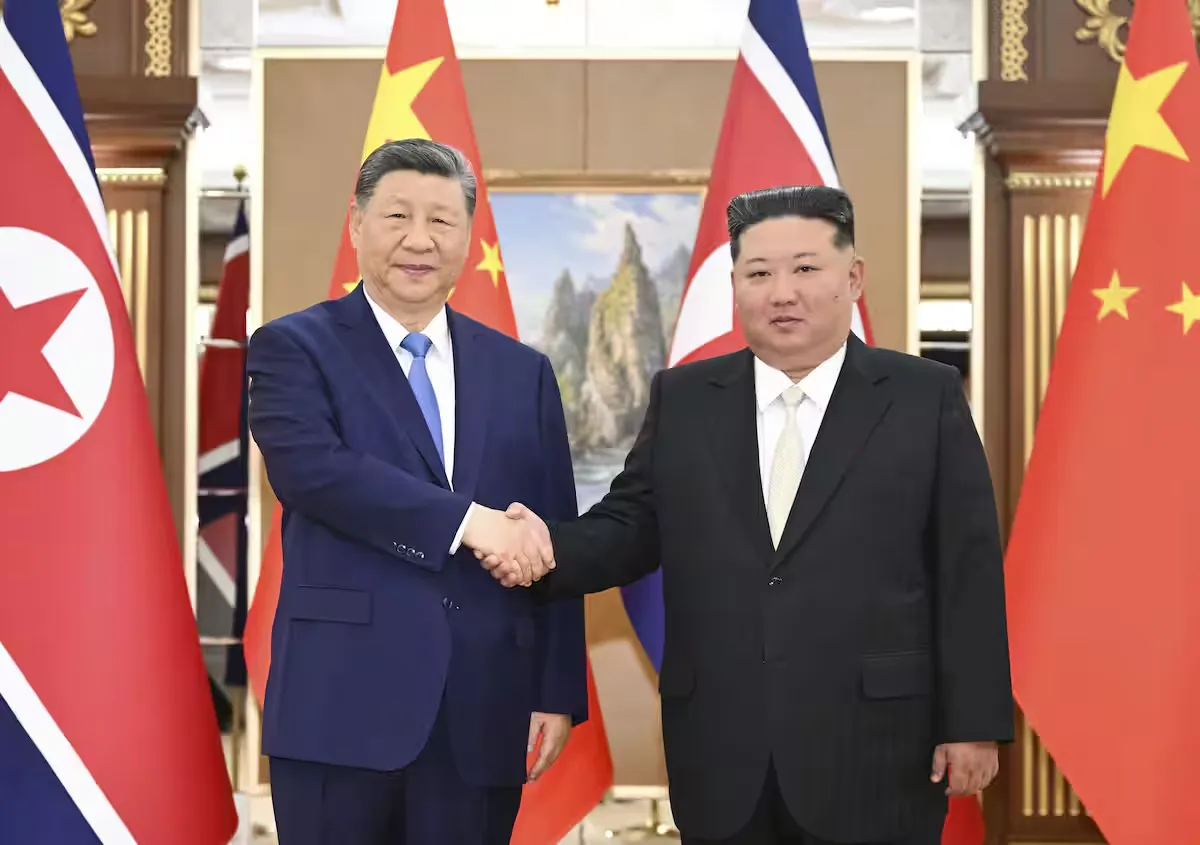
Chinese President Xi Jinping is visiting North Korea for the first time in seven years. On June 8, he held what Pyongyang’s state news agency described as a “historic face-to-face meeting” with North Korean leader Kim Jong Un.
According to the Korean Central News Agency (KCNA), during their summit on June 8, Xi and Kim agreed to strengthen strategic communication through high-level exchanges between their parties and governments and to expand cooperation in various fields, including politics, the economy, and culture.
Senior officials from the Workers’ Party of Korea and the Chinese Communist Party, as well as the foreign and defense ministers of both countries, attended the meeting.
Xi stated that “China’s position of valuing the traditional friendship between China and North Korea remains unchanged.”
Kim emphasized that “maintaining China–North Korea friendship as the foremost strategic undertaking and strengthening and developing bilateral relations into a solid strategic partnership” would remain a priority.
The two leaders also exchanged views on international and regional issues and were said to have reached a “satisfactory consensus.” Xi held successive meetings in May with US President Donald Trump and Russian President Vladimir Putin, raising the possibility that he shared details of discussions concerning developments on the Korean Peninsula.

Repairing Ties
It is believed that Xi is seeking to restore balance in China–North Korea relations, which were disrupted by Pyongyang’s growing closeness to Russia, through his first visit to North Korea in seven years. North Korea, meanwhile, has grown increasingly confident as its nuclear weapons program advances. Behind the two countries’ rhetoric of “traditional friendship,” tensions continue to simmer.
At a welcoming ceremony for Xi in Pyongyang’s Kim Il Sung Square, slogans such as “China–North Korea friendship will never change” were displayed in both Chinese and Korean. In an article published in the June 8 edition of the ruling Workers’ Party newspaper Rodong Sinmun, Xi emphasized that “China–North Korea relations now stand at a new historical starting point and face new opportunities for development.”
Relations between Beijing and Pyongyang cooled after North Korea and Russia drew much closer following Russia’s invasion of Ukraine. China made little effort to conceal its displeasure with North Korea’s tilt toward Moscow.
This time, however, Beijing appears inclined to manage its relationship with Pyongyang, partly to demonstrate its influence over North Korea to the Trump administration. During talks with Kim on June 8, Xi stressed the need to “raise the level of practical cooperation.” China appears to be using the economic cooperation that North Korea needs as leverage to draw Pyongyang back into its orbit.
Nuclear Defiance
Ahead of Xi’s visit, North Korea also displayed a hardline stance. On June 7, North Korean media carried a statement by Kim Yo Jong, director of the party’s General Affairs Department, rejecting denuclearization and declaring that North Korea would “not discuss it with anyone.”
The statement was widely seen as an attempt to discourage the issue from being raised at the summit. On June 4, state media also reported that Kim Jong Un had inspected a new nuclear-material production facility, effectively showcasing North Korea’s expanding nuclear capabilities to China.

Stability Over Denuclearization
Since the beginning of the year, North Korea has increasingly insisted that any resumption of dialogue with the United States must begin with recognition of North Korea as a nuclear-armed state, while further hardening its rejection of denuclearization. During a summit in May, China and Russia did not mention North Korea’s denuclearization and instead reiterated their opposition to sanctions on Pyongyang.
Beijing has become less explicit in opposing North Korea’s nuclear development. While it does not appear to have abandoned its concerns, China is likely prioritizing stability in China–North Korea relations and avoiding actions that could provoke Pyongyang.
South Korea is closely watching Xi’s visit. At a press conference on June 8, South Korean President Lee Jae-myung commented on sanctions against North Korea, saying, “I do not know whether China’s door is firmly closed, but Russia’s door is certainly open,” suggesting that sanctions may contain loopholes. He also stressed that “South Korea will not give up the goal of North Korea’s denuclearization.”
RELATED:
(Read the article in Japanese.)
Author: Shohei Mitsuka and Yuki Ishikawa, The Sankei Shimbun