As part of our Language of Soccer World Cup series, The Athletic is speaking to supporters of all 48 nations competing at the 2026 edition to capture their unique football culture, distilled into a single phrase. You can read the articles in one place here.
La unidad nos hace fuerte — Unity makes us stronger
“We’re a complicated country, in many ways, but something very curious happens when the Spain national team are playing — we all come together,” La Roja fan David Pinillos tells The Athletic.
“Football has something special, particularly big tournaments, that brings together the whole community, the whole city, every house that likes football.”
Spain’s complex mix of nations, cultures and languages has coexisted uneasily within its current national borders since the 16th century.
Communities such as Castile, Catalonia, Andalusia, the Basque Country and the Canary Islands have, over the centuries, been joined by immigrants from previous Spanish colonies in Latin America, while many of today’s Spaniards have family backgrounds from Africa and Asia.
That mix is reflected in the national team, featuring Rodri, Fabian Ruiz, Mikel Oyarzabal, Pedri, Nico Williams, Marc Cucurella and Lamine Yamal.
“Everyone puts their flag out on the balcony to support the national team for the month of a tournament,” says Spain fan Adrian Unipes. “And we all put aside our differences or political issues. There are players from all over Spain, people whose families have come from elsewhere. This is the 21st century.”
Spain in the 21st century also has plenty of political debate, sometimes bitter and divisive, around issues including ideology and immigration. Supporters of the national team can come together without having to think or talk about things which might divide them, says Epifanio Pastor, who was born in Cusco, Peru and moved to Spain for work 25 years ago.
“In Spain, there are lots of different cultures, which is really great too: the way people talk, the things they like, the way they think,” Pastor says. “Within our group, we don’t talk about politics or club rivalries. When everyone rows in the same direction, things always go well.”
International football has not always had this binding effect, especially when the Spain team were not very successful. Either side of their 1964 European Championship victory, they often flattered only to deceive if they qualified for tournaments. Their best result from the first 18 World Cups was fourth place in 1950.
Political and cultural pressures were also severe under the dictatorship of Francisco Franco from 1939 to 1975. Even after democracy returned to Spain in 1978, teams full of talented players from La Liga clubs Real Madrid, Barcelona and Athletic Club often fell apart under tournament pressure, while there was often apathy from Madrilenos, Catalans or Basques, whose primary allegiance was to their local club.
Things began to change when Atletico Madrid legend Luis Aragones assembled a Euro 2008-winning team from quality players who were rivals at club level. Ex-Real Madrid player and coach Vicente del Bosque was the coach when Barcelona’s Andres Iniesta scored the winning goal at the 2010 World Cup in South Africa, and the historic run continued with success at Euro 2012.
That unprecedented success of winning three successive tournaments came at a difficult moment for Spanish society, soon after a huge financial crisis, when national pride had taken a dent. A world-beating national team was something that many people who were suffering could be proud of.
“Sometimes in Spain we have low self-esteem and think other places are better,” Unipes says. “Victories help us to get past that feeling. I was unemployed in 2010, for example. I travelled from Asturias to Madrid for the party (when the team returned with the trophy). It gave us a sensation of winning — of being better than the others, for the next four years at least.”
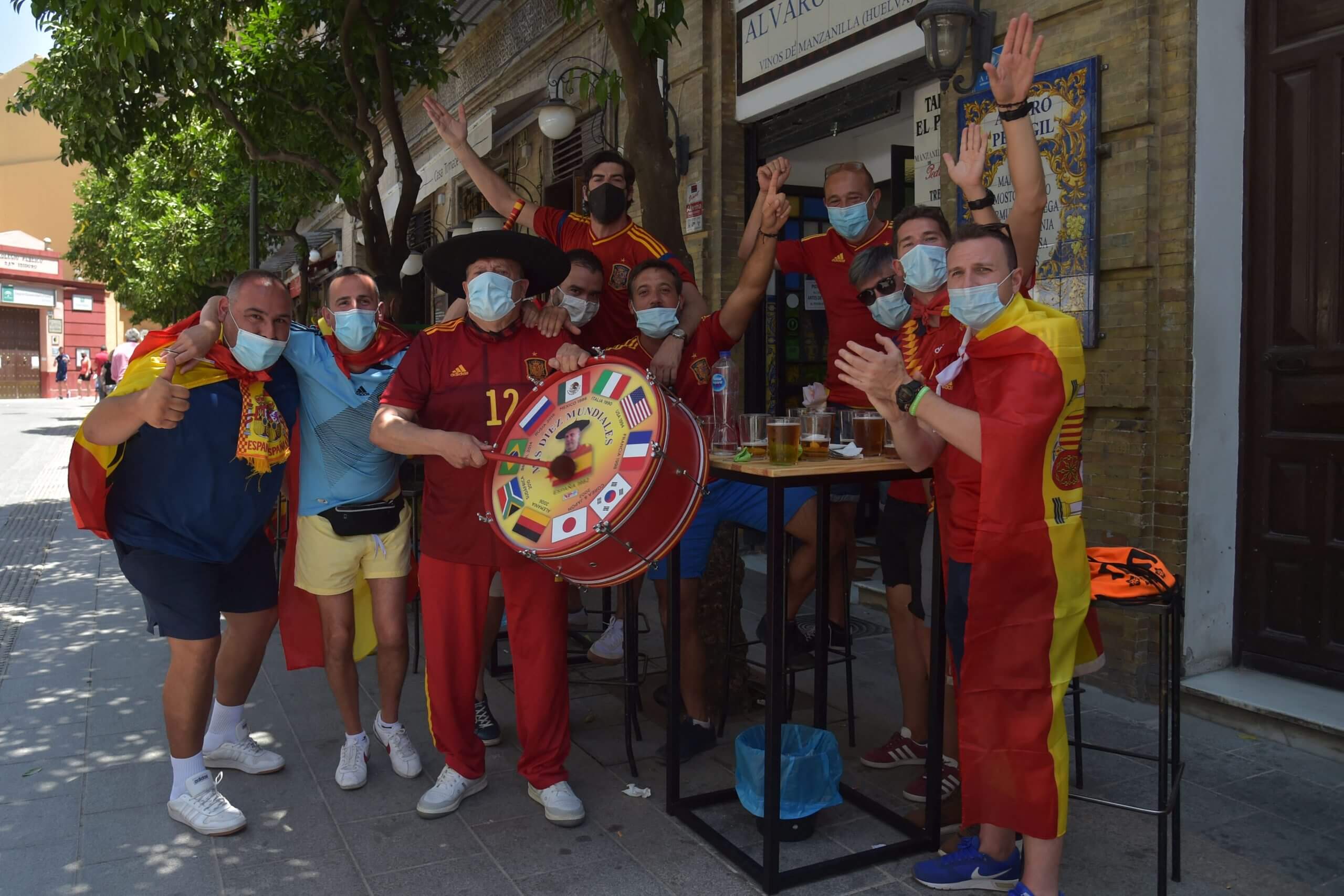
The team’s most famous supporter from that era was Manuel Caceres — or ‘Manolo el del Bombo’ — a fixture in the stands who became a nationally-recognised figure with his huge drum and wide-brimmed ‘boina’ hat.
Manuel Caceres with his drum and a group of fellow Spain fans in 2021 (Cristina Quicler/AFP via Getty Images)
David Cebollada met Manolo at the 2010 World Cup and “my connection with him was huge”. Two years later, he founded semi-official fans group La Marea Roja, with the idea of building a community among national team fans that had not really existed before.
“It’s difficult in Spain as La Liga is so strong and the national team can get forgotten,” Cebollada says. “Before La Marea, there was nothing organised. We had to create this habit. It’s not like in countries like Croatia or Scotland, for example. I remember the (2023) Nations League final (in Rotterdam), when we were 3,000 Spanish fans, and the rest were Croatians.”

David Cebollada, holding the flag, shows his support for Spain (David Cebollada)
“People say that in Spain there is not really a culture of following the national team,” Nieves Calatayud adds. “That is not completely true. But for better or worse, many fans have a bigger feeling for their club than for the national team. Madridistas don’t want to hear anything about the Cules (Barca fans), and the Cules don’t care about the Madridistas. But when Spain play, we are united, there is no problem in that sense.”
Many of the most passionate and dedicated Spanish fans come from smaller cities or lower-profile regions that lack a successful club team. La Marea Roja has members from Madrid and Barcelona, but also from Almeria, Alicante, Las Palmas, as well as other countries: Italy, the United Arab Emirates, Mexico and the United States. Cebollada is from Zaragoza, Pinillo is from Logrono, Calatayud is from Murcia, and Unipes is from Gijon.

Nieves Catalayud with Manuel Caceres’ famous drum (Nieves Catalayud)
“Often the people who travel with the team come from places that do not have a Primera Division team,” Unipes says. “Maybe your club is going through a tough time, down in the Segunda Division, or lower. You’re looking for a lift. It’s very different for Real Madrid fans (for example) who have won lots of Champions Leagues in recent years.”
Spanish supporters were cheering again when Luis de la Fuente’s side won the 2024 European Championship by beating England 2-1 in Berlin, with Basque forward Oyarzabal scoring the winning goal, in a tournament at which Yamal and Williams had shone.

Members of La Marea Roja attend the Euro 2024 final (La Marea Roja)
“We Spaniards are passionate people, more than most Europeans,” says Pinillos, who has a physical disability and values how other fans offer help when he needs it when attending games.
“That day in Berlin, I ended up crying like a kid, from joy. When (former Spain player, now Paris Saint-Germain manager) Luis Enrique received the famous elbow from (Italy defender Mauro) Tassotti at World Cup 1994, I felt like I was the one who was hit. That is what football does, it unites you to the rest of the people in your country.”
Pastor followed Spain and Peru at the 2018 World Cup, venturing all over Russia. He recalls only 2,000 Spanish fans in the fan zones before the games, but Peru were accompanied by a “flood” of an estimated 50,000 fans who travelled across.

A Spain fan shows their support during the 2018 World Cup in Russia (Yuri Cortez/AFP via Getty Images)
Spain supporters expect to be outnumbered by rival team fans at their games this summer — especially their Group H meeting with Uruguay in the Mexican city of Guadalajara on June 27.
“Playing against a brother country, Uruguay, in another brother country, Mexico, should be tremendous, spectacular,” Cebollada says. “But there will be more Uruguay fans, for sure.”
The Spanish fans will still make themselves known, says Calatayud, who still fondly remembers the party at Euro 2012 when Spain played the Republic of Ireland in the group stages. She also believes the nation needs the team to bring a boost, given the ongoing political and cultural arguments between different sectors of society.
“I love following Spain because it means you can bring your country to different places,” she says. “I’ve a good feeling — I’ve already bought a ticket for the final. The country needs it at the moment, that union, for all that has been going on. And football can unite us. I play the castanets, and can bring them to the stadiums. It’s really nice.”
Win or lose, Spain will have fervent support from those fans whose love for their country and love for the team are two sides of the same coin.
“My life is my family, then the national team, and then my work,” says Cebollada, who has now attended around 140 Spain games in person and already has tickets for all their matches this summer.
“Spain is what sustains me, gives me life. I did my military service, and I’d do it again. To be there, representing my country, is the greatest thing.”
The Language of Soccer series is sponsored by Google.
The Athletic maintains full editorial independence. Sponsors have no control over or input into the reporting or editing process and do not review stories before publication.