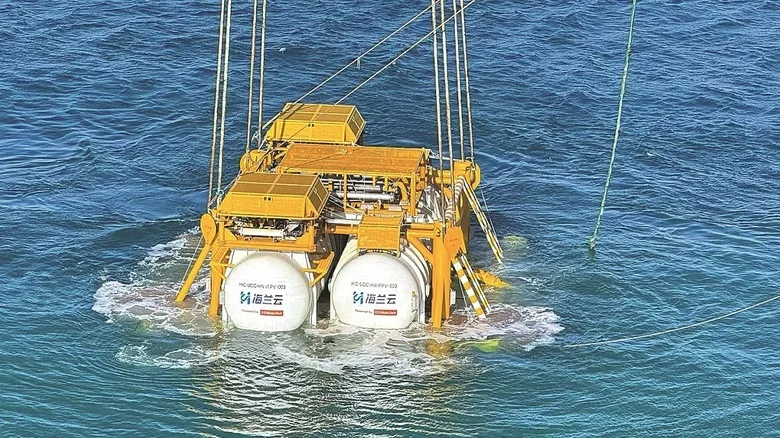
China is trying to solve its water-consuming, power-draining data center problems by moving them under the sea. Shanghai Hailanyun Technology (HiCloud), in collaboration with several government agencies, launched what it’s calling the world’s first wind-powered underwater data center in May 2026. It sits about 32 feet below the ocean’s surface off the coast of Shanghai’s Lin-gang Special Area, surrounded by a wind farm of more than 50 turbines. It houses about 2,000 servers, which is a small- to average-sized data center. Larger hyperscale data centers can house at least 5,000 servers. At full capacity, HiCloud’s facility will operate at 24 megawatts. If running continuously for a year, it would use the same electricity as 20,000 U.S. homes. Engineers hope the $228-million project will solve the three critical data center concerns: electricity, cooling, and land use.
Data centers need enormous spaces to house servers, cooling systems, power infrastructure, backup systems, and other infrastructure. Land use is why more than two-thirds of the 1,500 data centers planned for the U.S. are in rural areas. The Lin-gang data center will have a minimal on-land footprint, despite neighboring 31 million people. Because it’s in the ocean, the data center will stay cool using minimal fresh water, which is important because an extremely small percentage of the Earth’s water is drinkable. Ocean cooling also helps reduce energy use. For comparison, land-based data centers use up to 40% of their energy to keep cool. This potential helps explain why HiCloud recently signed an agreement to work on a new 500 megawatt underwater data center.
Read more: When A Submarine Implodes, What Actually Happens?
China’s earlier underwater data center shows what could happen next
An underwater data center installed in 2023 – China Daily
HiCloud has previous experience with underwater data centers. The company launched a group of modules off the coast of Hainan province in 2023. It’s not wind-powered, but it is designed similarly to the new facility to keep humidity and oxygen out of the interior while withstanding underwater pressure. HiCloud says the facility saves about 26,000 tons of water and enough electricity to cut carbon emissions by the equivalent of taking 600 cars off the road for a year.
Advertisement
Advertisement
Introducing anything to an underwater ecosystem can have unexpected effects on wildlife. When seawater cools servers, it carries waste heat into the surrounding water. Related studies show thermal discharge from power plants can alter oxygen and pH levels and sediment composition, ultimately reducing the number and variety of creatures that live nearby. HiCloud is monitoring the water at the Hainan data center. A spokesperson told the People’s Daily that the water temperature has risen less than one degree Celsius around the facility. The company says schools of fish are gathering around the modules, using them for shelter against stronger currents.
Microsoft’s underwater data center experiment helped inspire HiCloud
A Microsoft data center after it was pulled from the ocean near Scotland – Microsoft/Simon Douglas
The founder of HiCloud’s parent company, Highlander, was inspired by a Microsoft underwater data center experiment. The software giant launched Project Natick off the coast of Scotland in 2018. Microsoft ran 855 servers without human intervention for more than two years. Only six of the servers broke. At the same time, Microsoft had 135 land-based servers handling the same processing needs and eight of those servers broke. Microsoft’s team says the sealed environment reduced temperature swings, kept out oxygen, and eliminated human interference.
HiCloud’s new facility will face external challenges in the ocean. Seawater can cause faster corrosion of the facility and subsea cabling that powers it. There’s also constant pressure, which affects durability and sealing. It will also be harder to maintain and replace hardware. When Microsoft removed Project Natick, the pod was covered in marine growth like algae, barnacles, sea anemones, and sea urchins. Microsoft didn’t report any issues. The team brought the pod back to shore, then power-washed the exterior. It’s unclear how any of China’s underwater data centers will be affected by wildlife as they operate for up to 25 years.
Enjoyed this article? Sign up to BGR’s free newsletter and add us as a preferred search source for the latest in tech and entertainment, plus tips and advice you’ll actually use.
Read the original article on BGR.