Welcome to The Athletic’s 2026 World Cup tactical group guides, walking you through the key battles on the pitch, the players to look out for, and the fun facts to impress your friends ahead of the tournament.
Here we will break down Group I, statistically the strongest at the tournament, featuring France, Senegal, Norway and Iraq.
As 2018 winners and losing finalists four years ago, France have the most pedigree. Senegal, who made it to the round of 16 last time, will want redemption after seeing their Africa Cup of Nations title controversially stripped this January.
Then there are two returnees. Norway caused a stir in qualifying and are back at a World Cup for the first time since 1998. Iraq ended an even longer wait, sneaking in via the inter-confederation play-off — 40 years on from their sole appearance.
Can France reach a third straight final? Will Norway’s golden generation shine? Are Senegal going to surprise everyone?
The games
Matchday one
- Tuesday, June 16: France v Senegal (3pm ET, 12pm PT, 8pm BST) — MetLife Stadium, East Rutherford
- Tuesday, June 16: Iraq v Norway (6pm ET, 3pm PT, 11pm BST) — Gillette Stadium, Foxborough
Matchday two
- Monday, June 22: France v Iraq (5pm ET, 2pm PT, 10pm BST) — Lincoln Financial Field, Philadelphia
- Monday, June 22: Norway v Senegal (8pm ET, 5pm PT, 1am BST+1) — MetLife Stadium, East Rutherford
Matchday three
- Friday, June 26: Norway v France (3pm ET, 12pm PT, 8pm BST) — Gillette Stadium, Foxborough
- Friday, June 26: Senegal v Iraq (3pm ET, 12pm PT, 8pm BST) — BMO Field, Toronto
Key tactical approaches
Didier Deschamps is trying to guide France to a historic feat. They could become just the third nation to make three consecutive World Cup finals. Brazil did that most recently (1994, 1998 and 2002) and before them West Germany made the 1982, 1986 and 1990 finals.
There are key principles to Deschamps’ France. He’s been national team coach since July 2012, and this is his fourth and final World Cup. They play a 4-2-3-1 and, while he’s often critiqued for deploying pragmatic tactics, France remain effective. Since their semi-final exit against Spain at Euro 2024, they have won 13 times in 18 matches, including victories over Brazil and Colombia.
Their 2024-25 Nations League campaign was poor, though. France lost to Italy in Paris despite taking the lead inside a minute. They then had to recover a 2-0 first-leg deficit against Croatia in the quarter-finals and, the following round, went 5-1 down to Spain by conceding three goals in 13 second-half minutes. They recovered to 5-4 but failed to reach the final.
Let’s be clear: this is not the France of 2018 nor the team that was beaten on penalties by Argentina in the final four years ago. Antoine Griezmann has since retired from international football and Deschamps, blessed with unrivalled attacking depth, constantly shuffles his forwards.
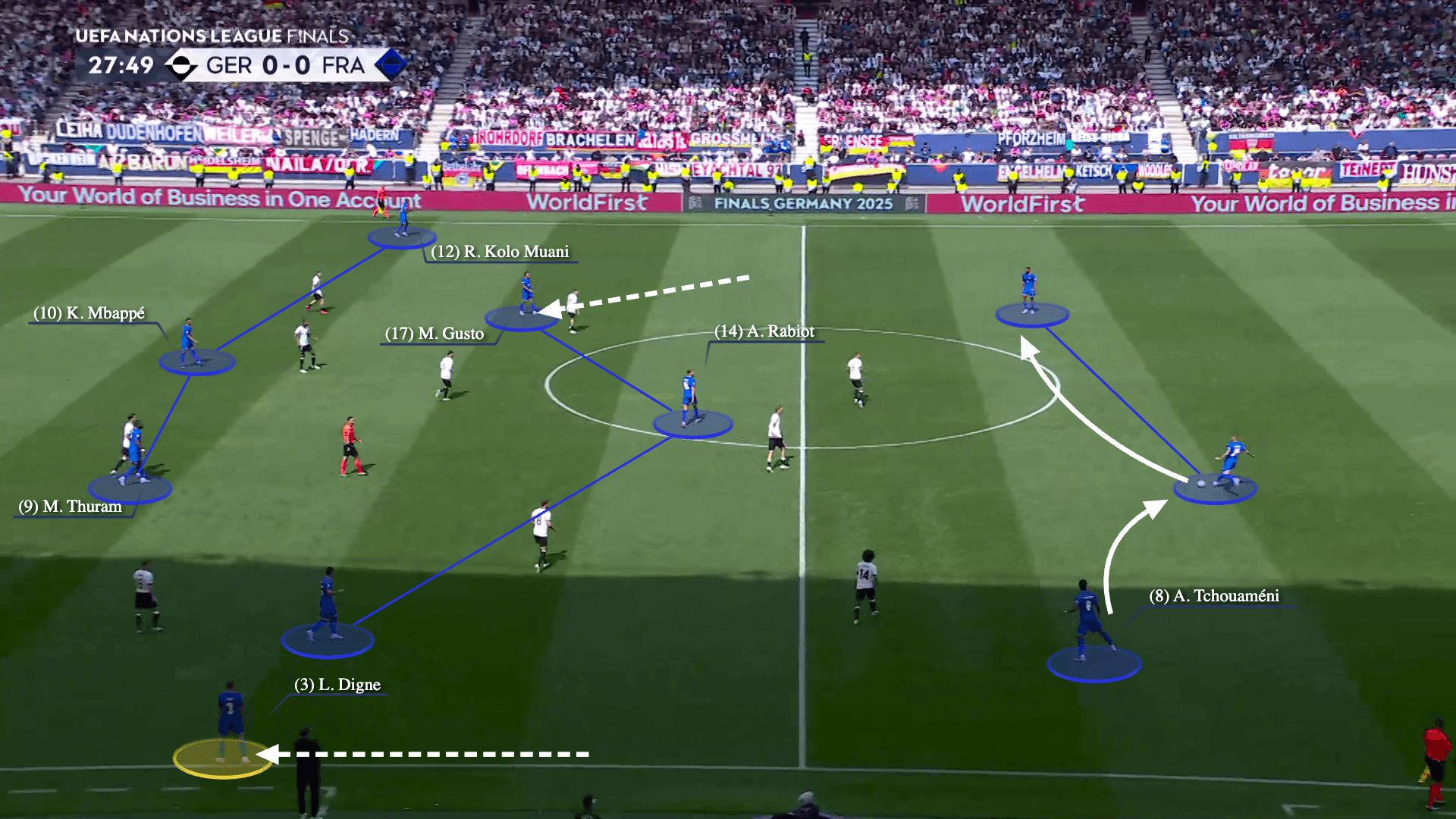
The latest French tactical evolution is Kylian Mbappe playing at No 9. Other forwards are fit in around him. In the Nations League third-place play-off win over Germany, nominal strikers Randal Kolo Muani and Marcus Thurman played wide roles, while Hugo Ekitike went to left wing against Brazil this March.


This team are physically imposing, threaten with back-post crosses and cut opponents apart with counter-attacks. They can press high or sit deep, rotate positions plenty, and like one-twos in their build-up.
There’s one major question mark: have France improved their creativity and finishing since Euro 2024? They scored only four goals in six matches there — just once in open play — leaning on their defensive strengths before Spain proved too much in the semi-finals.

Senegal had their 2025 AFCON title retrospectively stripped in mid-March because their players had left the pitch in protest at the end of regulation time when Morocco were awarded a dubious penalty — before Edouard Mendy eventually saved Brahim Diaz’s panenka.
So while technically not African champions, Pape Thiaw’s side are well-rounded and know how to navigate their way through a tournament. They won 1-0 in the quarters, semis and final in Morocco. Formerly their ‘A’ team coach, Thiaw has been in charge since December 2024 and has them playing a high-pressing 4-3-3 system.
They always defend on the front foot and, when sitting in a mid-block, their midfielders jump quickly onto central passes. They pose a real counter-attacking threat.

The attack is configured around Sadio Mane, their all-time top scorer (55 goals). The former Liverpool forward drifts inside from the left wing, with Iliman Ndiaye or Ibrahim Mbaye operating similarly on the right.
Attacking full-backs provide width while Idrissa Gueye, the deepest point of a midfield triangle, often drops between the centre-backs.

Those rotations can work in various ways. In the AFCON final, right-back Antoine Mendy positioned narrow to open a passing lane into Ndiaye.

Expect Senegal to want control. They ranked second at AFCON for possession (61.1 per cent) and created the second-most big chances (24, only behind Nigeria’s 27).
Routinely they threaten with early balls into the half-spaces, twice making goals this way against England last March in a 3-1 comeback win. For their second goal, centre-back Kalidou Koulibaly released No 8 Habib Diarra in behind to run through and score.

Thiaw switched to a 3-4-3 twice in qualifying and unsuccessfully tested a 4-2-3-1 (without Gueye) during a warm-up defeat to the U.S. Their major weakness is a tendency to overplay in their own half — high-pressing opponents will make turnovers.
“It’s about time” was how Norway head coach Stale Solbakken viewed Norway’s return to the World Cup. He played for them at Euro 2000, their last major tournament appearance.
Make no mistake, Norway have a golden generation. They outscored everyone in qualification (37 goals) and made a habit of scoring goals in flurries. “We feel we can always score. As a team, we have become much more solid defensively — a better mix,” Solbakken told FIFA.com during qualifying.
Unsurprisingly, Norway’s side is built around Erling Haaland. They play a lop-sided 4-3-3 with Alexander Sorloth used as a wide forward off the right. The hard-running Julian Ryerson complements him at right-back.

Their super strengths are wide crosses and counter-attacks.
First-choice left back David Moller Wolfe offers a final ball, as do dribbly wingers Antonio Nusa and Andreas Schjelderup with inswinging crosses. The presence of Sorloth and Haaland means Norway always have at least two aerial threats.


Expect variety in their build-up. They set up to play short from goalkeeper Orjan Nyland, but he often kicks long to Sorloth as the midfielders squeeze up to land on second balls. Martin Odegaard provides killer passes, notably through balls for Haaland.
Solbakken has them defend in a 4-1-4-1 mid-block. Midfielders and wingers do most of the work, meaning Haaland can conserve his energy. This lets them spring following turnovers — they scored seven times from counter-attacks in qualifying, the most in Europe.

So what’s their weakness? High pressing. Solbakken’s side can lock teams out wide but too often their defensive line is passive to press-breaking passes over midfield.

After four qualification rounds and two coaches, Iraq sealed their spot by beating Bolivia 2-1 in the inter-continental play-off. This was only Graham Arnold’s 13th match in charge. He stepped in when Jesus Casas was sacked last March over supposed contract breaches amid poor form.
Arnold brought the blueprint that he used to take Australia to the round of 16 at the last World Cup (their first knockout-round appearance since 2006). This Iraq side do the basics fantastically: stubborn defensively, a threat at set pieces and direct with the ball. A 1-1 draw in a friendly with Spain earlier this week is the perfect example of why Iraq should not be underestimated in this group.
They play variations of a 4-4-2. Sometimes that’s with proper wingers, while against Bolivia, Arnold picked a diamond midfield. A strike pairing of Luton Town’s Ali Al-Hamadi and Al Karma’s Aymen Hussein went through a lot of sideways running to try to block passes through midfield during mid-block defending. Expect to see them in that compact shape given their underdog status in the group.


Set pieces will be their main route to goal. They have limited possession and build-up is low-risk, concentrated to the wings. Playing with two No 9s could cause attack-minded opponents problems, especially as Iraq will threaten in the air.
Their five goals in three play-off matches (two games vs United Arab Emirates, one vs Bolivia) came as follows: two from wide free kicks, one header off a corner, a penalty, and one open-play goal. That was Ayman Hussein’s winner versus Bolivia, a tap-in from a low cross after he initially flicked on a long ball from deep.
It took them 75 minutes to break down Thailand, Indonesia and Jordan in qualifying — don’t expect champagne football, but they could be a real banana skin.
Key players
Mbappe, of course. He was France’s top-scorer in qualifying (five) and won the golden boot in Qatar. Deschamps has trusted him to be the focal point and needs goals in return. For all of France’s attacking quality, the second top-scorers in the squad behind Mbappe (56 in 97 caps) are Adrien Rabiot and Ousmane Dembele (seven each).

Mbappe and Haaland are two huge names in Group I (Oli Scarff/AFP via Getty Images)
Mike Maignan, the French No 1, goes into this World Cup after his best individual season for years. He kept 14 clean sheets for Milan last season and, based on post-shot expected goals (xG) data, put up the third-best numbers of any goalkeeper in Europe’s top-five leagues — his saves prevented 13 goals better than average.
Those are tournament-winning numbers.

Jalan Hassan, the Iraq goalkeeper, debuted in 2011 and will captain them aged 35. He kept 10 clean sheets in qualification, the joint-most of any goalkeeper in the Asian confederation (tied with Utkir Yusupov of Uzbekistan).
Mohanad Ali and Hussein carry the attacking burden — the latter netted eight times in qualifying. Amir Al Ammari brings technical quality, a left-footed midfielder with a wicked set-piece delivery.
Haaland had a ridiculous qualifying campaign for Norway. He was top European goalscorer, with his 16 goals as many as the entire France team. Off the back of winning a third Premier League golden boot in four seasons, he’s a huge contender to come out top scorer here, especially if Norway can navigate their way into the latter stages.

Odegaard is creator-in-chief. He likes pulling wide, looking to release Haaland or Ryerson, and came out as top assister in European qualification (seven). Sorloth is the unsung hero, taking pressure off Haaland and adding another goal threat, while Fulham midfielder Sander Berge is the heartbeat.
This will likely be the final World Cup for multiple key Senegal players. Mane, Koulibaly, goalkeeper Edouard Mendy and Gueye are all into their mid-30s, part of a national team which has made three of the past four AFCON finals. Their experience will be pivotal if Senegal are to come close to their 2002 debut run to the quarter-finals.
Two other Premier League forwards, Ndiaye of Everton and Crystal Palace’s Ismaila Sarr, bring extra goal threats — Ndiaye is an outstanding dribbler while Sarr loves to crash the box.

Things to watch for
Mbappe is just one goal away from equalling Olivier Giroud as France’s all-time men’s top scorer (57 goals). He’s 27, so the record is on borrowed time, and he’s scored at a faster rate than Giroud, but there’s no better stage to break it on.
Pre-tournament, Deschamps was coy about his forward selections. It will be interesting to see how and where he uses Ousmane Dembele, who has had two excellent years at Paris Saint-Germain. Now a two-time Champions League winner with 55 goals in two seasons, Dembele’s position switch from winger to No 9 by PSG coach Luis Enrique worked a charm, and earned him the 2025 Ballon d’Or. Deschamps has kept Dembele out wide to accommodate Mbappe, but must be tempted to experiment given his superior pressing and passing qualities.
Also look out for Lucas Digne’s set pieces. The Aston Villa left-back provides a pinpoint whipped cross. Twice from dead balls he set up Rabiot for headed goals in France’s Nations League win over Italy.
Senegal know how to stage a comeback. They beat Sudan 3-1 from 1-0 down in the AFCON group stages, and recovered after conceding first to beat DR Congo on penalties in the knockouts — and beat DR Congo again in qualification despite being 2-0 behind.
Their secret weapon is Pape Gueye’s long-range shooting. The left-footer delivered the AFCON match-winner against Morocco and has nine goals for Villarreal in the last two La Liga seasons (including one penalty). Mane, meanwhile, has scored 16 of his 19 penalties for Senegal, including all of the last nine.

Finally, watch out for Norway’s Ryerson. Opponents will prioritise defending Haaland, Sorloth and Odegaard, which means attention might not be focused on the athletic right-back.
Ryerson assisted 15 goals this season for Borussia Dortmund, operating as a wing-back in their 3-4-3. He set up Jorgen Strand Larsen twice in Norway’s 3-1 win over Sweden this month — he’s a menace on the overlap and offers a long throw too.