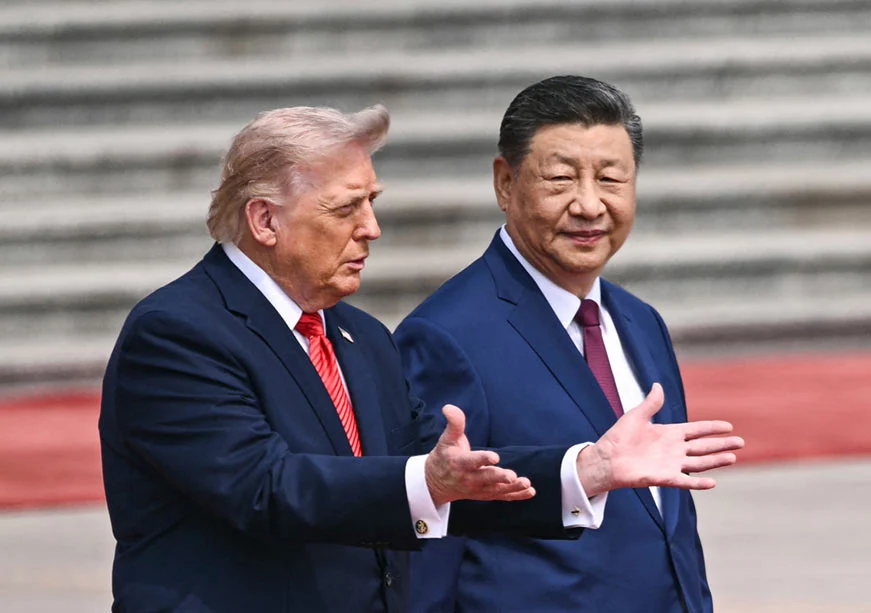

Beijing and Washington have had predictively different takes on the Xi-Trump summit. Each side heard what it wanted to and filtered out the rest. The Trump administration emphasised trade, commercial ties, and investment, while the Chinese focused on a new bilateral framework of relations. Both, however, view it in a positive light. We have seen a lot of what the Americans have thought about the outcome. Here are some Chinese perspectives.
Perhaps the most striking diplomatic outcome of the visit was Chinese President Xi Jinping’s introduction of the concept of a “constructive China-US relationship of strategic stability” during his call with Trump. It alluded to a relationship that emphasised cooperation, with manageable competition and stable relations amidst peaceful ties. Yet it was only after Trump had returned that the US formally adopted this term. It noted that “President Trump and President Xi agreed that the United States and China should build a constructive relationship of strategic stability”, adding that it would be “based on fairness and reciprocity”. The China Institutes of Contemporary International Relations (CICIR) suggests that China believes it has successfully achieved a strategic stalemate with the US. The article of 13 May, entitled “The World’s Great Transformation and the Path to US-China Coexistence”, argued that the post-Cold War liberal international order has effectively collapsed, and that the world is navigating a transitional phase between an old and an emerging one. It contends that US-China competition has entered what Beijing calls “comprehensive strategic stalemate”, driven by three factors: the changing balance of power; deep economic interdependence; and what the document describes as China’s “historical initiative” in responding to American pressure. The disruption of oil and gas flows through the Straits of Hormuz is one of the events that has shaped this change.
The Trump administration emphasised trade, commercial ties, and investment, while the Chinese focused on a new bilateral framework of relations.
According to analyst, Arnaud Bertrand, the document is shedding light on the fact that China is moving from a mindset ofof “how do we survive America” to one of “how do we manage America.” To this end, it has laid out a six-element framework covering Taiwan to AI cooperation to risk management. Bertrand argues that these six points define the relationship, and recast it in marital terms: Be partners, become friends, stop using the kids as leverage, communicate like adults, find shared interests like green energy, counter narcotics, AI governance, fight fair, promote people-to-people ties.
Not surprisingly, there was some surprise at this among Western scholars. In a commentary, Mareike Ohlberg, Senior Fellow at the German Marshall Fund, suggested that the Chinese had pulled one on the US by inserting this phrase into the White House statement. A Chinese scholar, Zichen Wang, challenged this by arguing that this phrase reflect the evolving discourse between the US and China in recent months. He pointed out the difference in the phrase as used by China and as put out by the White House, notably by the addition of the words “on the basis of fairness and reciprocity,” indicating that some thought had gone into it and it was not simply a case of lifting it from one document to another.
Another commentary noted that the Chinese academic commentary on the Trump visit was “markedly upbeat” and many scholars are willing to see the outcomes as a paradigm shift. Wang Yong, Professor at the School of International Relations in Peking University, argues that a “major change in the balance of power” have forced Washington to view China as “an opponent of comparable strength,” while Zheng Yongnian, a Chinese political scientist and commentator, frames Trump’s “new realism” as recognition that “China has already risen” and that the US “cannot defeat China.” Of the 50 scholars analysed, 17 express confidence in a lasting and sustainable thaw, while 11 saw opportunity in the coming three years of the Trump term. Only six stressed the developments as a tactical development that was easily reversible.
In a commentary, Mareike Ohlberg, Senior Fellow at the German Marshall Fund, suggested that the Chinese had pulled one on the US by inserting this phrase into the White House statement.
But not analysts were that confident, another analysis by scholar Haokai Li , based on the writings of prominent Chinese scholars, terms the summit outcome as tantamount to stalling tactics “designed to manage risk as both nations lock into a protracted strategic stalemate.” This in his view is “a much colder pragmatic reality” than its framing as “a positive stabilized phase” of the China-US relationship. He has examined the writings on the summit of three prominent scholars—Wu Xinbo Dean of the Institute of International Studies of Fudan University, Yan Xuetong of Tsinghua University who is regarded as one of China’s foremost international relations theorists and Jin Canrong of Renmin University.
Perhaps a more balanced view has come from Henry Huiyao Wang, founder of the Beijing-based Center for China and Globalization has noted that both the United States and China have embraced the need for strategic stability in their bilateral relationship. He said that both sides had shown that they could impose real costs but neither side “could convert this capacity for disruption into a stable foundation for national success.” The challenge now is for both sides to move from the disruptive phase in their relationship to a constructive one.
The Chinese South Asian scholar, Mao Keji, has written on how the outcomes in Beijing affect India. In his view, the US has “completed a paradigm level shift in its foreign policy strategy” by adopting the Chinese formulation “constructive strategic and stable China-US relationship.”
The energy shock, which the US has contributed by its ban on India purchasing Iranian oil and by the military strikes that have led to the closure of Hormuz.
This could have comprehensive implications for India, because New Delhi has deliberately or through “the lack of strategic imagination” framed the China threat as its most serious security problem. The reality, he asserts, is that there are four other real threats. First, the energy shock, which the US has contributed by its ban on India purchasing Iranian oil and by the military strikes that have led to the closure of Hormuz. Second, it has amplified India’s security anxieties regarding China, in part to facilitate arms sales. Third, India has no backup for the SWIFT network, AI computing capacity, cloud services, semiconductor and operating systems, yet the US “has been continuously siphoning talents from India” creating a “semi-permanent brain drain.” Fourth, the points to capital outflows through investment commitments directed towards the United States.Beijing entered not as a supplicant seeking relief from tariffs but as a co-equal power offering the US a managed exit from a confrontation neither side can win outright. The doctrine of “constructive strategic stability” is China’s terms for coexistence — offered generously, but on China’s intellectual ground. The fact that the White House signed onto the phrase, even with its own addendum, is Beijing’s evidence that the balance has shifted. Whether it has indeed done so remains to be seen.
Manoj Joshi is a Distinguished Fellow at the Observer Research Foundation.
The views expressed above belong to the author(s). ORF research and analyses now available on Telegram! Click here to access our curated content — blogs, longforms and interviews.