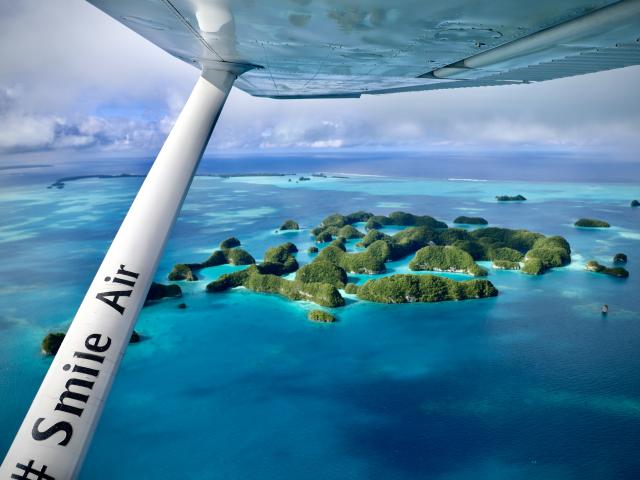
KOROR, Palau — With emerald-green islands rising from crystal-clear waters and coral reefs teeming with marine life, Palau is often described as one of the most beautiful places on Earth.
Yet beneath the postcard-perfect scenery, this tiny Pacific island nation is playing an increasingly important role in one of the world’s most consequential geopolitical contests: the growing rivalry between the United States and China.
CBN News traveled to the Western Pacific for a rare look inside one of the earth’s most beautiful places and why it’s becoming strategically critical to the United States.
There are places in the world that almost don’t look real. This is one of them.
“You will not see anything like this anywhere else in the world,” said Yosuk Kainuma, a pilot with Smile Air. That’s what makes Palau so unique.”

With the side door of a small plane removed, CBN News took a breathtaking view from above.
Palau is an archipelago consisting of over 350 of these beautiful islands.
“It does have these rocks, green-covered rocks, that are small but rounded, jutting out of shallow water,” said Cleo Paskal, with the Washington-D.C.-based Foundation for Defense of Democracies (FDD).

Below the surface, reefs teem with a vibrant array of marine life.
“I love diving,” said Joel Ehrendreich, the U.S. ambassador to Palau. “It’s like going and hanging out with the cast of Finding Nemo every time I go underwater here.”
At first glance, Palau feels untouched. Remote. Almost impossibly beautiful.
“It’s absolutely great,” said David Schultz, a German tourist visiting Palau. “It’s amazing.”

For visitors, Palau’s commitment to preserving its natural beauty becomes evident almost immediately. Every traveler entering the country is required to sign the “Palau Pledge,” a promise stamped into their passport committing them to help protect the islands’ environment for future generations.
President Surangel Whipps Jr. says conservation is deeply rooted in Palauan culture. “We ask you when you visit, and when you leave, the only thing that you leave is footprints in the sand that wash away,” President Whipps told CBN News in an interview from his office in Koror. “The beauty that you see, we want to maintain it. In our tradition, we say the land is our mother and the ocean is our father.”

Behind this extraordinary beauty, though, another story is unfolding. One centered on geopolitics, military strategy, and the growing rivalry between the United States and China.
“It’s a highly, highly strategic location,” said Cleo Paskal, a senior fellow focused on the Indo-Pacific at FDD.
To get here, this reporter traveled from the United States across the Pacific to Taiwan and then south to Palau.
Palau lies along what military planners call the “Second Island Chain,” a strategic arc stretching through the Pacific Ocean. The chain includes territories and nations that could play a crucial role in maintaining American access and influence throughout the region during a potential conflict.
Paskal, who has traveled here several times, argues the area has become increasingly important as China expands its military capabilities and seeks greater influence across the Indo-Pacific.
“So, it goes down from Japan through islands like Saipan and Tinian, then Guam, then Yap, then the islands and Palau, and then down through the Philippines,” described Paskal.

In recent years, Washington has been working to counter Beijing’s growing military reach across the Indo-Pacific by strengthening partnerships with countries along the Second Island Chain, including Palau.
“This whole central Pacific area, is an area that is, I would argue, the geographical pivot of history for the U.S.,” warned Paskal. “If a hostile foreign power controls the center of the Pacific, which includes Palau, mainland U.S isn’t safe.”
Palau is also one of a shrinking number of countries that maintains formal diplomatic relations with Taiwan rather than Beijing.
That position has made the island nation a target of persistent Chinese pressure, according to Palauan and U.S. officials.
“The rules of the game are continually being challenged and, and let you know that, even, our resolve has to be stronger. We have to be committed,” said Whipps.
President Whipps says shortly after he took office in 2021, a Chinese envoy approached him with an offer: One million tourists and lots of money for infrastructure. The catch: Palau would have to cut ties with Taiwan and instead recognize Beijing.
He refused. And according to officials here, Beijing responded by targeting Palau’s tourism industry.
*** Please sign up for CBN Newsletters to ensure you receive the latest news from a distinctly Christian perspective.***

“China used its economic coercion to try to punish Palau by suddenly, overnight, stopping all tourism to Palau from China,” said Ehrendreich.
President Whipps describes the impact as devastating.
“We have not recovered, in fact, Chinese tourists in 2015 were 70% of our market. So that’s why it was so devastating,” said Whipps.
Officials and analysts say the pressure extends beyond tourism. Paskal alleges China has sought to weaken institutions in Palau through organized crime networks, corruption, and other influence operations.
“What we’ve seen on the ground is China has used organized crime, an enormous amount of pressure through organized crime, call centers, bribery, corruption to try to weaken the political and economic structures,” Paskal told CBN News.
Palauan authorities arrested a record number of Chinese nationals posing as tourists last year, allegedly smuggling drugs, including methamphetamine, into the country.
“This is troubling because it involves, you know, our community; it weakens our youth. It compromises, our concern is that it will compromise leaders and others,” said Whipps.
And officials say it doesn’t stop there. Ambassador Ehrendreich says Chinese developers have also been leasing land near locations used by the United States to monitor Chinese activities in the region.
“What I would call the Chinese playbook, that’s just my wording for it, where we’ve seen China buys or lease land adjacent to US military or other interests, not just in Palau, but throughout the region, throughout the world, and we definitely seen that playbook being implemented here in Palau,” said Ehrendreich. “My personal my interpretation as U.S. Ambassador here is that China wants the ability to watch what the United States is doing.”

As China expands its influence campaign across the Pacific, the United States is deepening its military, economic, and diplomatic partnership with Palau.
“Under the Compact of Free Association, Palauans can live, work, study without a visa in the United States and as part of the compact, then the United States has access to Palau’s facilities and territory for military purposes,” said Ehrendreich.
About 80 U.S. troops are stationed on the island, upgrading a powerful military radar site here, while also helping rebuild ports, airfields, and other strategic infrastructure across Palau.

“I believe that presence is deterrence. And the only way you’re going to maintain peace is through strength, as Reagan said,” Whipps told CBN News.
For locals and tourists alike, Palau is paradise. But for the United States and China, these islands represent something much bigger.
American military planners see these Island Chains as strategic corridors that help protect American territories, secure vital shipping lanes, and project U.S. power that can hopefully deter Chinese military expansion deeper into the Pacific Ocean.
“There is this understanding that what happens in the Western Pacific doesn’t stay in the Western Pacific if you’re dealing with a hostile power,” said Paskal.
And while Palau’s extraordinary beauty may feel worlds away from Washington and Beijing, the geopolitical struggle unfolding here could help shape the future balance of power, security, and influence across the Indo-Pacific.