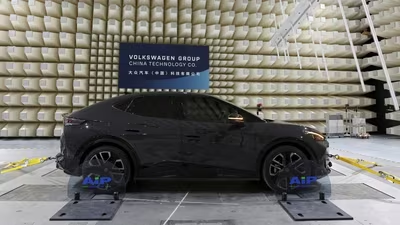
HEFEI, China—In a giant testing lab filled with huge spikes, Volkswagen is putting one of the new cars it has designed especially for China through its paces.

But the biggest test is still to come: Will Chinese drivers want to buy them?
The vehicles being assessed here at Volkswagen’s sprawling development center belong to a coming generation of China-focused models that the automaker is betting can revive its fortunes in the world’s biggest car market.
Volkswagen led the Chinese market for decades, with the country once estimated to account for more than half its annual profit. But the company’s position in China has rapidly eroded in recent years amid fierce competition from local electric-vehicle makers with more advanced digital technology.
To catch up, Volkswagen has sought to insulate its floundering Chinese business from the Eurocentric designs and slow decision-making of its German headquarters. It has invested $3.5 billion in cutting-edge development facilities here in Hefei and struck deals with several tech-savvy local firms.
Now, the first cars produced under its “in China, for China” strategy are hitting the road.
Whether the vehicles win over Chinese drivers is a litmus test for Volkswagen’s future prospects in the country. They are also a test case for the survival of other Western brands in China, where consumers increasingly favor local champions.
“Welcome to the fitness center of the automotive industry, where technology cycles are shorter, competition is more intense and customer expectations change faster than anywhere else,” Volkswagen Chief Executive Officer Oliver Blume said on a recent visit to China.
The company is set to launch more than 20 new cars in China this year, starting with the Volkswagen ID. Unyx 07.
The sedan, which began rolling off a Hefei production line in January, was the first Volkswagen to feature the kind of powerful central computers that allow brands to offer higher levels of autonomy and other AI-powered features.
On a recent ride around Hefei, the car drove itself through dense motorway traffic and around an underground parking lot. A safety driver had his hands on the wheel, as required in China.
To open a window, the driver simply asked the car’s digital assistant, rather than pressing a button—the kind of feature that is standard in newer Chinese cars.
Volkswagen developed the self-driving technology in partnership with Horizon Robotics, a Beijing-based tech company. Vehicles set to be released later this year will feature a more advanced version able to handle the tougher task of navigating city streets.
Partnerships are a hallmark of the German company’s drive to draw level with its new Chinese rivals.
Volkswagen bought a roughly 5% stake in local EV startup Xpeng back in 2023. It has since tapped the Chinese firm’s expertise to help develop the electronics debuted in the new ID. Unyx 07, and two more vehicles set to launch this year.
The trend is a reversal of an old pattern. For decades, Volkswagen provided the technology to its joint ventures in China—and high-margin licensing fees flowed back to Germany. Now, Chinese companies are supplying know-how and reaping the rewards.
Xpeng helped “jump-start” the task of catching up, said Thomas Ulbrich, chief technology officer for Volkswagen China and boss of the Hefei development center.
The facility in eastern China is the size of 18 football fields and houses several monumental new machines, including the so-called electromagnetic-compatibility lab—a huge room lined with spikes for minimizing interference when testing electronics.
Having the full range of testing facilities necessary to create a car in China cuts development times by 30%, the company says, allowing it to align more closely with local demand.
On a recent tour, a chassis was being bounced around on a new test bench that cuts road-worthiness testing from 30 weeks down to 10, according to the engineer in charge. Hefei received the machine even before Volkswagen’s German headquarters, he noted proudly.
Volkswagen’s profit in China has collapsed as it has lost market share and poured money into local development and partnerships. The company expects its Chinese operations to generate a profit of less than $500 million this year—down from $5 billion a decade ago.
In a recent investor update, Volkswagen said this year will be the low point, with its investments starting to bear fruit in 2027, albeit not on the scale of the prepandemic golden age.
The recovery will ultimately depend on how many Chinese consumers buy the new cars.
At a launch party ahead of April’s Beijing auto show, Volkswagen unveiled four new EVs alongside thunderous Chinese drumming and a performance by a local dance troupe.
They included the Volkswagen ID. Unyx 09. The company—the first global car brand to arrive in China in the 1980s—launched the Unyx subbrand in 2024 to attract a younger demographic.
“Chinese consumers used to look at Volkswagen and think quality. Now they think old,” said Michael Dunne, chief executive of auto-consulting firm Dunne Insights.
The company also showed off a new Audi, the E7X, with the brand spelled out on the hood rather than represented by the usual four overlapping rings. The Audi revamp is aimed at finding new buyers for a brand that was historically associated with government officials.
While Volkswagen’s new cars are a huge leap from the previous generation, they don’t put the brand at the bleeding edge of Chinese automotive technology, according to analysts. Autonomous-driving software from local tech giant Huawei now handles unpaved roads; Volkswagen’s technology won’t cover urban streets until later this year.
“Volkswagen has now basically burned all its fireworks. My question is: Are they ready to burn the next stage of fireworks? Are they ready to have the investments and people and capacity in place to do that all over again—because that’s what the Chinese do every day,” said Thomas Luk, a China-based consultant who used to work for McKinsey in Stuttgart, Germany’s automotive capital.
The new cars are also launching into a very tough market. In April, Chinese car sales fell for a seventh straight month.
EV sales have been particularly weak this year after the expiration of subsidies. In the first quarter, Volkswagen ironically re-emerged as the market leader in China, thanks to its still-huge business selling gas-engine cars.
Volkswagen’s response to the challenging market is the same as that of its Chinese rivals: exports. Volkswagen wants to sell its Chinese-developed EVs not just in China but in southeast Asia, the Middle East and South America.
The company said it had no plans to sell the new Chinese EVs in Europe, where it has a lot of factories, or the U.S., where they are essentially banned.
Still, Volkswagen’s Chinese strategy has already hit Europe, with development hires in Hefei offset by job cuts at its German headquarters. Dwindling profit and license fees from China have also forced it to reduce costs across the board.
“Developing cars in Europe for Europe and bringing them to the world: This business model has had its day,” said Blume.
Write to Stephen Wilmot at stephen.wilmot@wsj.com