As part of our Language of Soccer World Cup series, The Athletic is speaking to supporters of all 48 nations competing at the 2026 edition to capture their unique football culture, distilled into a single phrase. You can read the articles in one place here.
Hop Suisse – Hopp Schwiiz – Forza Svizzera – Ancora Svizra – Go Switzerland
Expectations are rising among Switzerland fans.
The Swiss national team — or ‘Nati’ as they’re usually called — have been a steady, reliable presence at most major tournaments in recent years. They have been at six of the past eight European Championships, and this will be their sixth World Cup in a row, their seventh since 1994. Before that, they had been absent from the previous six World Cups, a fallow period stretching back to 1966.
For a nation of around nine million people, whose club teams have never reached a major European final, much less won one, and which has never really had a proper global superstar, that’s a pretty good record. From that perspective, just being there is a decent achievement.
Now, though, ‘being there’ has become the standard. They had never won a knockout game until beating France at Euro 2020. They were knocked out in the next round by Spain, but only on penalties. Then they defeated Italy in the round of 16 at Euro 2024 and should have beaten England in the quarter-finals, going on to lose on penalties, again.
Little tastes of success have left the people wanting more. Thus, a sense that something bigger is required seems to be growing.
“I think that the supporters want to be in the quarter-finals because we lost the last two tournaments on penalties,” says Jerome Lambert, who is the supporters’ liaison officer for the Swiss Football Association. “We came so very, very close. It was very special, but we lost on penalties against England, and against Spain: every time it’s the same.
“So we hope that this time we’ll go one better. We hope change will come, and this will be our time.”
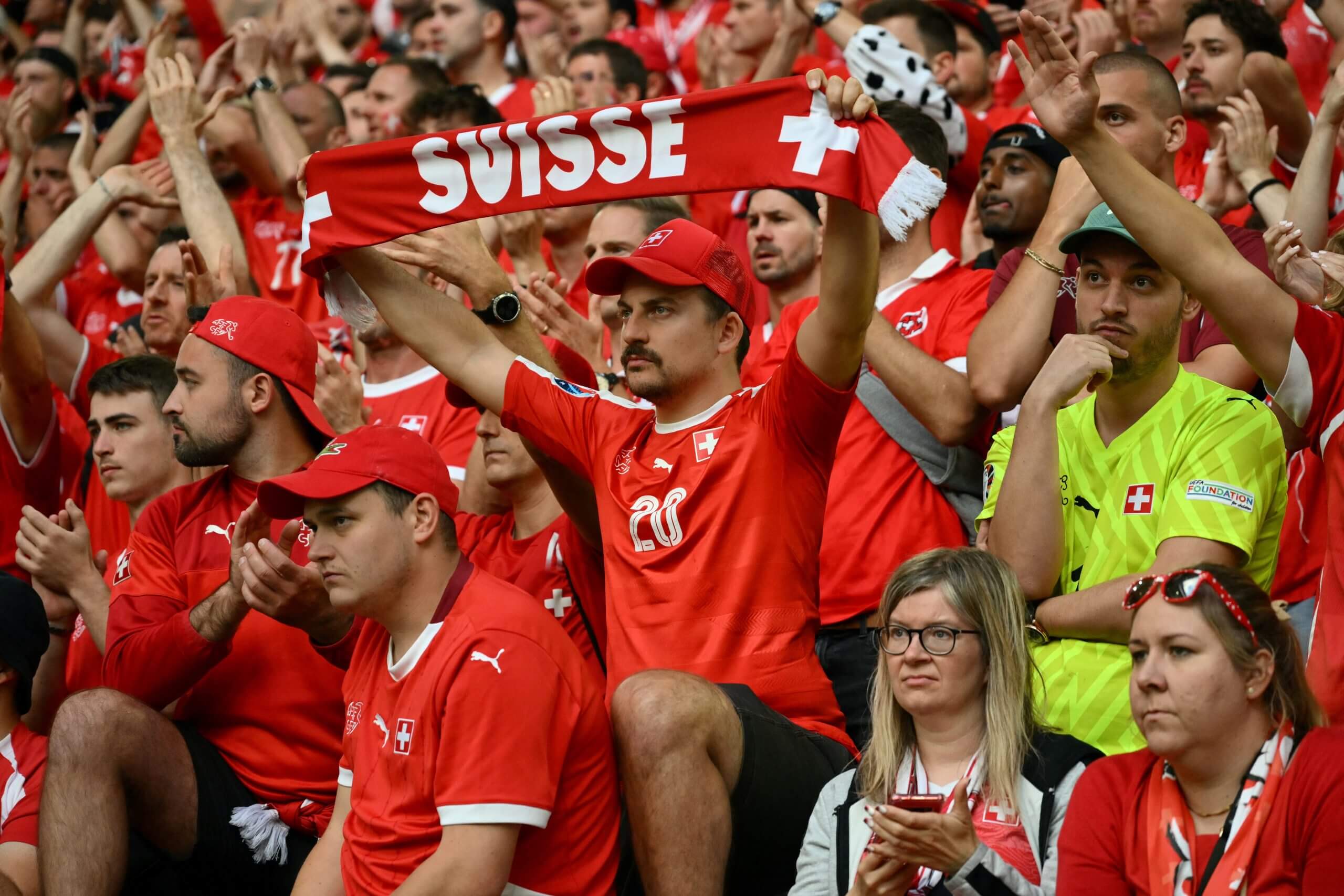
Switzerland fans show their support for their team at Euro 2024 (Alberto Pizzoli/AFP via Getty Images)
“Definitely the expectation level has risen,” says Tobias, a fan from near Zurich. “Steadily, we’ve grown from being a small team — if we score a goal, or maybe draw or win one game, that’s already a success — to getting out of the group regularly, to breaking the barrier of winning our first knockout round ever, which was legendary, and qualifying for the quarter-finals for the first time.
“Then we did it again, beating Italy convincingly. Now, the quarter-final is par, and the round of 16 is maybe a bit below par.”
Expectation has grown from frustration over the years. Take the group stage of the 2010 World Cup, when they shocked everyone by beating eventual champions Spain in their first game, only to be defeated by Chile and draw with Honduras, failing to qualify for the knockout rounds. “When we play against good teams, we’re not that far off from making it, but don’t quite,” adds Luca, another fan from Zurich. “When we play worse teams, we lose as well. And that’s very frustrating as a fan.”
“We didn’t concede a goal in 2006 and still got knocked out,” says Karl Leuenberger, a Swiss fan based in the UK, referring to the unwanted record of being the first team to exit the tournament despite shutting out every team they faced, winning their group ahead of France but losing on penalties after a 0–0 draw with Ukraine in the round of 16.
“We’re just treated as a little bit of an afterthought. But I think the general sense is moving away from the ‘small country’ mentality. Especially because we do have a good squad — it’s not that much of a plucky underdog thing anymore.”
The national team is a bigger deal to a lot of fans than domestic club football. The most successful teams — FC Basel, Young Boys, FC Zurich — have committed and passionate followings (as Arsenal discovered in 2022), but many in the rest of the country, especially younger fans, will support a big foreign side. Tobias follows Real Madrid, Luca is an Milan fan, and plenty favour Bayern Munich.
Partly this is a geography thing: Switzerland is sandwiched between Germany and Italy, so there are a plethora of storied clubs within easy reach, most notably Bayern to the north, Milan, Inter and Juventus to the south. It’s also partly that the standard of domestic football isn’t as good: if you’re not going to the games and just watching on TV, you might as well watch better football.
The atmosphere is certainly different with the national team.
“It’s not the same supporters,” says Lambert. “The club teams have a lot of ultras, dressed in black, who are mostly young people. It’s not the same as the national supporters. We go with the family and we are all in red. We are just here to enjoy the party, to visit the country and to stay together.”
The fan culture is one of the key things that comes up when discussing what people get wrong about Switzerland. Lambert says a remarkable number of people still mistake them for Swedes (in some languages, the two names are pretty similar), but in terms of perception, it’s clear that many people just don’t associate the Swiss with a passionate fan culture. Maybe that’s because the Swiss have a reputation for being nice, neutral people, maybe it’s because their club teams aren’t especially prominent.
But Luca remembers his trip to Euro 2024 and a sight that rivalled another smaller, more celebrated nation. “We had a lot of fans in Germany, huge crowds in red: we’re not the Netherlands, but it’s still fun. We were sitting in Frankfurt, and it was full of Swiss fans. The Netherlands are also a small country, but their fanbase is in the media because everything is orange: we haven’t reached that level, but we’re not far off. It’s still cool.”
Switzerland is unusual in that language — one thing that usually provides common ground for a nation — is a potential dividing point. There are four official national languages: French, German, Italian and Romansh, all spoken in different parts of the country. German is the most prevalent, but French is the default in the west of the country, Italian in the south (nearest to the borders of those countries), while Romansh is more obscure and pops up in a couple of cantons (states, or counties) towards the east.
Thus, there are different versions of the salutation you’ll hear the most when following the Nati: Hop Suisse/Hopp Schwiiz/Forza Svizzera/Ancora Svizra. They all mean the same thing — ‘Go Switzerland!’
“I think the atmosphere is passion,” says Lambert. “What is special about Switzerland is that it’s a little country and we have four languages. Football is one thing that brings all the people together.“
The Language of Soccer series is sponsored by Google.
The Athletic maintains full editorial independence. Sponsors have no control over or input into the reporting or editing process and do not review stories before publication.