Support CleanTechnica’s work through a Substack subscription or on Stripe.
The wealthiest country in the region, Chile is known for being ahead of the curve in adopting most new technologies in Latin America. In particular, this is visible in the country having the highest per-capita deployment of solar in the region by quite a margin. Unsurprisingly, Chile was also the first country to enact legislation to promote EVs and also to deploy public funds to build a comprehensive network, which today remains one of the most complete in Latin America. Chile was also a pioneer in electric buses, becoming the country with the second largest fleet in the world (only behind China).
Yet the country lagged in the passenger EV segment, closing 2025 at a mere 3.3% market share (2.3% BEV) and then seeing a slight increase to 4.72% (2.6% BEV) by the first quarter of 2026, a bit underwhelming when some countries were rising past above 10% or 15%, and in the case of Uruguay, 30%! This is why we haven’t had a report on Chilean EV sales since *checks notes* May 2024, when the market was getting close to 2%, tripling its share from the year prior. After that, I didn’t think it was worth it to write an article reporting on “share went from 2% to 3%,” so I focused on other countries.
The delay in adopting EVs has always come as a surprise to me. Chile produces minimal amounts of oil and depends almost entirely on imports to supply its economy. Plus, it has plenty of EV models available at good prices. EVs seem like a no-brainer, yet adoption grew stubbornly slow.
But, thanks to Trump & Co, this seems to have changed. Chile has felt the impact of Trump’s war in Iran reflected in a higher import cost for its fuel, which has promptly translated into more expensive gas at the pump. At $1.3/liter ($4.95/gallon), Chile already had very expensive gasoline prior to this mess, but it’s now gone up to $1.7/liter ($6.4/gallon), causing significant pain to consumers in the country.
And as a result of this, EV sales have exploded, reaching almost 10% market share nearly overnight! Let’s look at the numbers.
Market overview
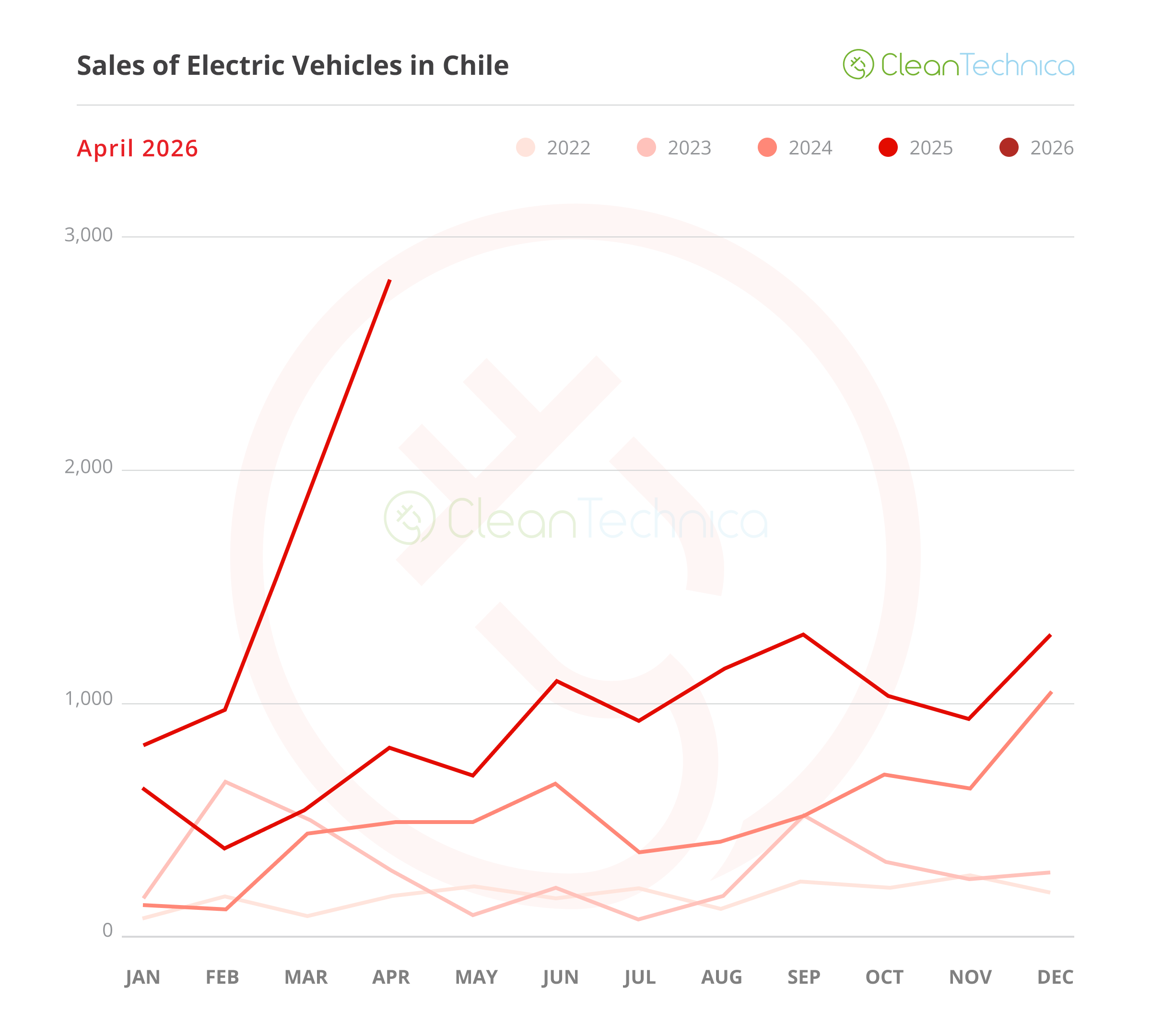
EV sales in Chile have grown significantly in April, getting close to the 3,000 unit mark for the first time ever and tripling the results from a year ago. Growth has increased quite a bit since the beginning of the year, with both March and April marking all-time high EV sales.

A very interesting development from Chile, and one we have not seen in other countries, is that the market has pivoted very fast from a BEV-heavy one to near parity: BEVs went from ~75% of the total last year to ~50% this one. As a result, even if BEVs are growing at a healthy 150% YoY, PHEVs have exploded and reached a massive 535% growth in the same period.

Market share has followed suit, reaching 9.9% (5.3% BEV) in April, up from 3.1% in January and 3% in April 2025. The increase has been substantial and extremely fast, starting in March, which is why I’m pretty confident it’s due to fuel prices spiking.

Brand-wise, this April, we find a surprising leader in Changan, a brand not normally seen on the podium or even in the top 10. The Chinese automaker, most known for its brand Deepal in other markets, has won over Chilean costumers thanks to its affordable Cs55 PHEV. Following come BYD and Tesla, two common players in the leading positions.

Looking at brands through 2026, Changan gets relegated to #2, with BYD leading and Tesla closing out the podium. Volvo and Riddara complete the top 5. A notable mention to Renault, the only non-Tesla, non-Chinese (or Chinese-owned) brand in this ranking, thanks to the Kwid E-Tech.

Model-wise, we find a very competitive list, with #1 (Model Y) having less than twice as many sales as #10 (Jaecoo 7). As a comparison, in Colombia, the leading model has 20 times more sales than the tenth highest selling one. This provides a glimpse into the Chilean market, which stands probably as the most competitive market in Latin America. Let’s also give notable mentions to models seldom seen in other countries, such as the Riddara 6 PHEV and the Jaecoo 7.

A tug of war: efficiency requirements & hyper-affordable ICEVs
Chile is the only country in Latin America with comprehensive efficiency regulations, meaning at least some part of the increase in EV adoption has been due to government requirements. It’s a bit complex, but in short, there are three categories, each with its own timeline and details, but all of them requiring higher efficiency as standards increase overtime, something only be achievable by selling more EVs.
- Standards for light passenger vehicles started to apply in 2024 (unsurprisingly, that was the last time we saw significant growth in the EV segment). The next round of stricter requirements will come in 2027.
- Light commercial vehicles are just entering their first year of efficiency requirements, with a second round in 2029. Perhaps this explains the popularity of the Riddara 6 PHEV.
- Heavy vehicles will face their first round of efficiency standards in 2028.
A particular note is that it’s not brands that are measured, but importers, meaning an importer from an ICEV-heavy brand can offset this by importing vehicles from EV-focused brands, even if those are not the same.
On the other side, Chile has significant availability of hyper-affordable ICEV models on its market, something that has undoubtedly slowed the transition. To provide just an example, the Geely EX2 was presented at CLP$16,990,000 (USD$19,100), which is the cheapest anywhere on the continent. Yet, on the same Geely website, you can order a larger ICEV Geely Coolray Lite for CLP$10,490,000 (USD$11,800).
Similar comparisons can be done all over the spectrum, and the truth is that even if Chinese brands have arrived in Chile with very compelling EV alternatives, they have also arrived with hyper-affordable ICEV models that make the EVs look uber-expensive by comparison, and this is not counting affordable propositions from Legacy Auto. Chile’s vehicle market ecosystem is extremely competitive, and it remains one of the few countries where you can still walk out of the showroom with a new car for under $10,000.
Even if sales have not ramped up as one would’ve hoped, having such a developed ecosystem, complete with affordable models and a strong charging network, has undoubtedly positioned Chile to be ready to adopt EVs at a far larger scale when the need arises … for example, when a global leader launches a war that ends up with the world losing 10% of its oil supply. Or when stricter standards require brands to increase EV sales.
Regardless, for now, it seems this tug-of-war has been enough to start a measurable decline in ICEV sales, no doubt aided by the fact the Chilean economy has not been that hot in the last few years. Looking at total vehicle sales from 2022 (Jan–Apr), we find that after that record year, sales have been falling, stabilizing around 100,000 in the first four months, and pretty much all the recovery seen in 2026 has gone to EVs, meaning combustion-only powertrains (ICEV+HEV) are stagnating:
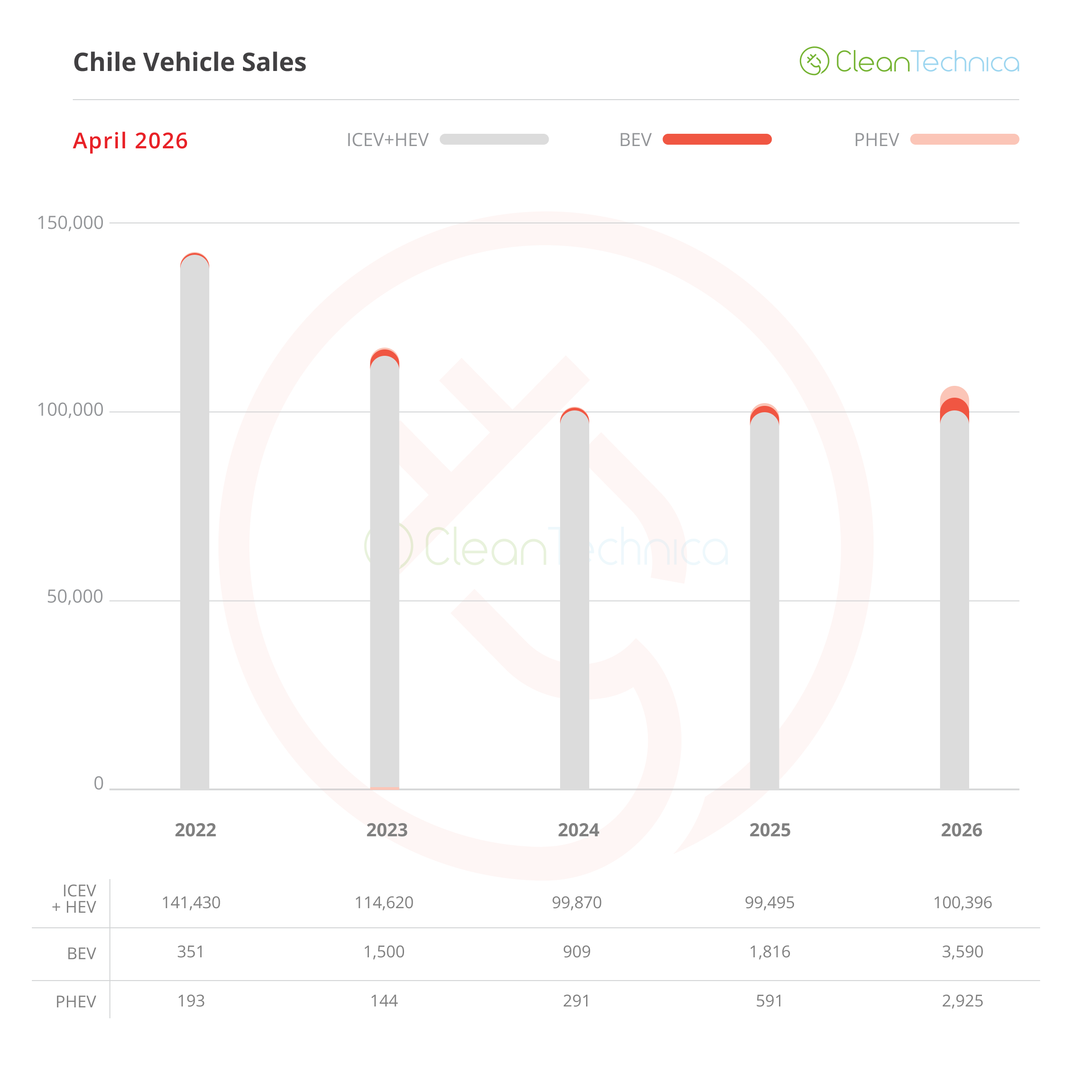
Since April was the first month with high EV adoption, it’s likely that this trend will continue through the rest of the year, perhaps turning Chile in the first country in the region where combustion vehicle sales are falling despite total sales growing.
Final thoughts
There are two countries who, on paper, have everything to be strong early adopters of EVs, yet who have stubbornly stuck on the ICEV side of the aisle: Chile and Peru. I’m excited to see Chile finally awakening from its slumber, but for Peru, it seems we will have to wait a bit longer.
However, it’s good to remember that even if Chile has not been a very strong contender in EV sales in the light passenger segment, it’s the indisputable leader in electric bus adoption, boasting the second largest fleet in the world. Three in every four buses sold this year have been electric. Since every bus displaces the equivalent fuel consumption of nearly a hundred vehicles, Chile may well be punching above its weight here, but sadly this is yet to translate into lower diesel consumption.
Regardless, thanks to Trump’s War, it seems Chile will have significant economic incentives to switch from gas and diesel to electrons, and if the disruption remains long — as many of us think it will — perhaps we will see this trend continue and even further strengthen as the Chilean economy, with plenty of electrons available thanks to its massive solar farms in Atacama, chooses energy independence over fossil fuels.
Sign up for CleanTechnica’s Weekly Substack for Zach and Scott’s in-depth analyses and high level summaries, sign up for our daily newsletter, and follow us on Google News!
Have a tip for CleanTechnica? Want to advertise? Want to suggest a guest for our CleanTech Talk podcast? Contact us here.
Sign up for our daily newsletter for 15 new cleantech stories a day. Or sign up for our weekly one on top stories of the week if daily is too frequent.
CleanTechnica uses affiliate links. See our policy here.
CleanTechnica’s Comment Policy