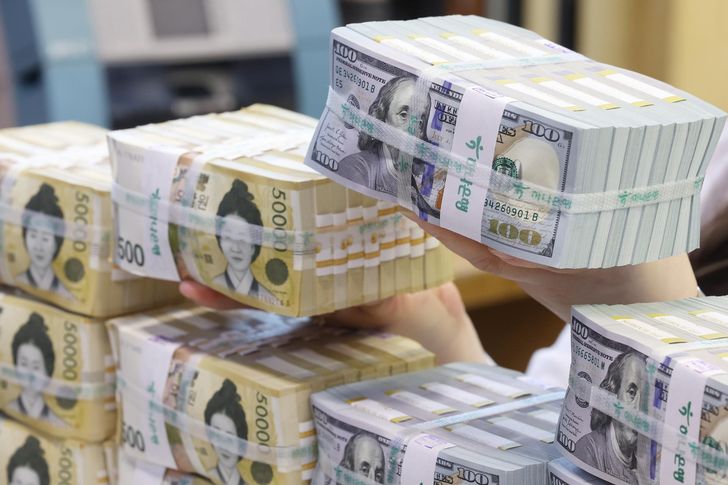

An employee arranges U.S. dollar bills and 50,000 won notes at a branch of Hana Bank in central Seoul, April 3. Yonhap
Korea’s move to make the won-dollar foreign exchange market a virtually 24-hour trading schedule starting in July is raising concerns that it could leave the won more vulnerable to overnight swings when trading volumes are thin, according to industry analysts Sunday.
As part of a broader push to improve access for global investors across time zones, the Seoul Foreign Exchange Market Committee approved the change, Friday, extending trading hours from the current 9 a.m.-2 a.m. schedule on Seoul time to near round-the-clock trading beginning July 6.
The market will operate continuously throughout the workweek, closing only on weekends and New Year’s Day. Aligned with New York trading hours, it will run from 6 a.m. Monday to 6 a.m. Saturday during U.S. daylight saving time and from 7 a.m. Monday to 7 a.m. Saturday during the rest of the year.
The market is also set to begin publishing hourly Time-Weighted Average Prices, or TWAPs, for the won-dollar rate, based on quotes from foreign-exchange brokers collected around the top of each hour.
Settlement arrangements, however, remain unchanged, meaning actual transactions will be settled only on banking business days.
The longer trading hours form part of the government’s efforts to open Korea’s financial markets wider to overseas players. Officials expect the move to improve liquidity and reduce trading frictions by making it easier for global investors, exporters and importers, as well as Koreans investing abroad, to access the won-dollar market across time zones.
The reform also dovetails with Seoul’s long-running campaign to secure developed-market status from MSCI, whose benchmarks help guide trillions of dollars in global investment flows. For years, investors and index providers have pointed to restrictions in the country’s foreign exchange market, including the won’s limited trading hours, as a barrier to broader international participation.
But not everyone is convinced the change will be entirely beneficial. Some economists caution that extending trading into overnight hours could leave the won more vulnerable to sharper swings as liquidity thins naturally outside Asia’s regular trading session.
The risk may be magnified by the structure of Korea’s foreign-exchange market, which has historically been relatively small compared with the size of the economy, according to Yang Jun-sok, an economics professor at the Catholic University of Korea.
“Because the market itself is relatively small, shifts in cross-border investment and capital flows tend to exert more of an outsized influence on the won than they would in larger currency markets,” he said.
That concern is particularly relevant because many of the global events that drive global currency markets — from U.S. consumer price index and employment data to Federal Reserve policy decisions — are released while Korea is asleep.
With fewer importers, exporters and domestic institutions active at those hours, offshore investors and speculative traders could exert a greater influence on the won-dollar rate, potentially amplifying short-term volatility.