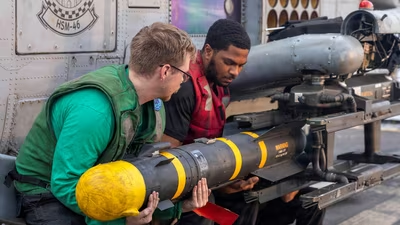
The United States military said it fired a Hellfire missile at a commercial cargo vessel after it allegedly ignored repeated warnings and attempted to enter an Iranian port despite an ongoing US naval blockade.

According to the US Central Command (CENTCOM), the Gambia-flagged cargo ship Lian Star was struck in its engine room while “transiting international waters toward an Iranian port on the Gulf of Oman.”
The incident comes as tensions remain high despite a fragile ceasefire between Washington and Tehran, with US secretary of war Pete Hegseth warning on Saturday that American forces are prepared to resume strikes on Iran if diplomatic efforts fail. Track US-Iran war live.
Ship ignored more than 20 warnings, says US military
In a statement issued Saturday, CENTCOM said US forces repeatedly attempted to stop the vessel before taking military action, claiming that the Lian Star ignored “more than 20 warnings” overnight informing it that it was violating the US blockade on Iranian ports.
US forces then launched a Hellfire missile into the ship’s engine room, effectively disabling the vessel. CENTCOM later said the ship was “no longer transiting to Iran” but did not provide further details on its status.
A US official familiar with the operation told the Associated Press that the vessel remained adrift in the Gulf of Oman and had not been boarded by American forces.
Sixth vessel stopped under US blockade
The interception marks the latest enforcement action under the US blockade, which Washington launched in April.
According to an AP report citing the US military, six ships have been stopped so far while attempting to breach the blockade. One vessel was eventually allowed to continue its voyage, while more than 116 others have been redirected.
On Friday, CENTCOM said it had “redirected” at least 115 ships since the blockade began.
The United States imposed the blockade after Iran effectively shut down access through the Strait of Hormuz following the outbreak of the current conflict, which began with US and Israeli strikes on February 28.
Ceasefire hangs in balance
The military action comes as uncertainty surrounds efforts to extend the current ceasefire between the United States and Iran.
A ceasefire has largely held since early April, but negotiations are underway over a possible 60-day extension that would allow talks to continue on Iran’s disputed nuclear programme.
US President Donald Trump met advisers on Friday in a Situation Room meeting, but has not yet decided whether to move ahead with a deal to prolong the truce and reopen maritime traffic through the Strait of Hormuz, news agency AFP reported, citing sources.
Iran, meanwhile, has said no final agreement has been reached.
On Saturday, Defence Secretary Pete Hegseth said the US military remains prepared to resume military operations against Iran if diplomatic efforts collapse.
Strait of Hormuz remains flashpoint
The Strait of Hormuz, one of the world’s most important energy chokepoints, remains at the centre of the standoff.
Disruptions to shipping through the narrow waterway between Iran and Oman have rattled global markets, with oil, natural gas and fertiliser shipments facing significant delays.
While some commercial traffic continues to move through the strait, volumes remain well below pre-war levels.
Iran has maintained that vessels require its approval to transit through the waterway and has reportedly imposed transit fees that have reached as high as $2 million, reported AP.
In a statement carried by Iranian state television on Saturday, Iran’s joint military command warned against foreign interference in the passage of ships through the region.
“Any violation of these regulations will place the security of their passage at serious risk,” Iran’s joint military command said Saturday in a statement carried by state TV, warning that any military vessels trying to interfere with that would be targeted.