The U.S. stock market is red hot despite economic uncertainty created by tariffs and the Iran war. In the past year, the S&P 500 (SNPINDEX: ^GSPC) has advanced 30% and the Nasdaq Composite (NASDAQINDEX: ^IXIC) has added 42%. But investors have reason to be nervous.
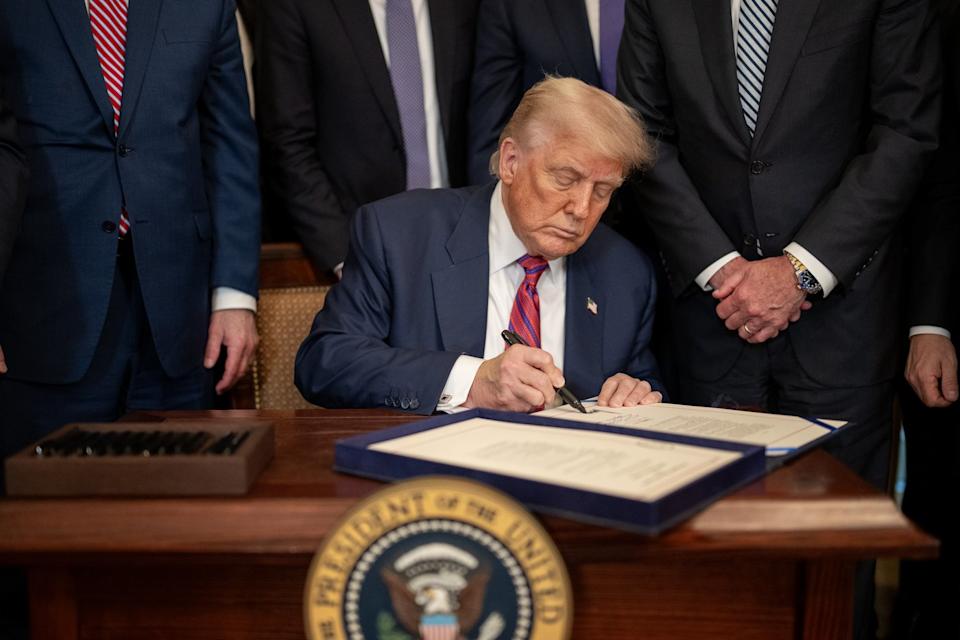
Kevin Warsh recently replaced Jerome Powell as Federal Reserve chair. Trump appointed Warsh, who has experience setting monetary policy in difficult economic climates — he previously served on the Fed Board of Governors during the Great Recession — but he finds himself in a particularly tough spot this time around.
Will AI create the world’s first trillionaire? Our team just released a report on the one little-known company, called an “Indispensable Monopoly” providing the critical technology Nvidia and Intel both need. Continue »
Trump has frequently chided the Fed for keeping its benchmark interest rate too high, so it stands to reason that he views Warsh as a solution. But Trump’s attempts to influence the Fed’s monetary policy, coupled with his decision to wage war in Iran, have made rate cuts essentially impossible.
In fact, elevated energy prices could force the Warsh-led Fed to raise rates, and the S&P 500 and Nasdaq Composite have historically declined when the central bank has started a new rate-increase cycle.
The Federal Reserve may have to raise interest rates
The Iran conflict has closed the Strait of Hormuz, a waterway that serves as a transit route for about 20 million barrels of oil per day, or about 20% of global consumption. The International Energy Agency says the strait’s closure has led to the largest oil supply disruption in history.
U.S. consumers are already paying the price. Consumer Price Index (CPI) inflation increased to 3.8% in April, the highest level in three years. But that situation is still getting worse. The Federal Reserve Bank of Cleveland’s forecasting tool shows CPI inflation accelerating to 6.5% in the second quarter.
Earlier this year, investors considered interest-rate cuts a sure thing. But the outlook has shifted. Traders now expect at least one quarter-point rate increase in the remaining months of 2026, according to CME Group‘s FedWatch tool. That’s bad news for the stock market. Since 1999, the Fed has initiated four rate-increase cycles, and the S&P 500 and Nasdaq Composite have always fallen over the next three months, with average declines of 7% and 8%, respectively.
Kevin Warsh could justify rate cuts by shrinking the Fed’s balance sheet
Warsh wants to shrink the Fed’s $6.7 trillion balance sheet, but doing so could drag the stock market down by draining liquidity from the financial system. If the Fed stops buying new Treasury bonds, banks and institutional investors would absorb the excess capacity, leaving them with less cash for stocks.