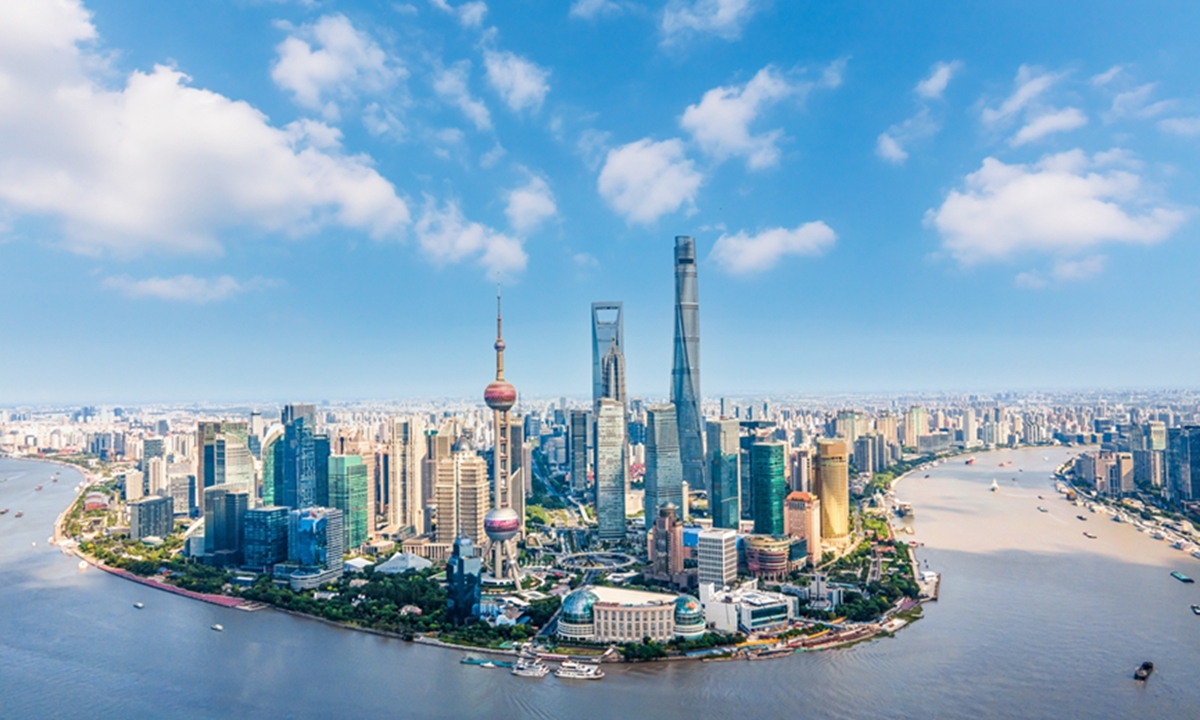
A view of the Lujiazui area in Shanghai Photo: VCG
Foreign capital has steadily flowed into Chinese stocks this year through various channels, and investors hold more than 4 trillion yuan ($590 billion) worth of the free float of A shares, becoming important participants in China’s capital market, an official from the China Securities Regulatory Commission (CSRC) said on Thursday, the Xinhua News Agency reported.
As China’s economy continues to improves and corporate vitality improves, these factors have become important drivers in attracting foreign capital, a Chinese expert said, adding that the country’s industrial upgrading creates many opportunities for foreign investors.
On Thursday, the 2026 Global Investors Conference held by the Shenzhen Stock Exchange opened in Shenzhen, the financial hub in South China’s Guangdong Province, Xinhua reported. Under the theme “Capital Markets and Innovation Driven Growth China Opportunities under the 15th Five Year Plan (2026-30),” the event attracted representatives from overseas regulatory agencies, exchanges, asset management institutions, venture capital firms, industry organizations, and listed companies from 24 countries and regions.
Speaking at the event, CSRC Vice Chairperson Liu Haoling said that comprehensive reforms of China’s capital market in terms of investment and financing are progressing steadily and taking effect continuously, with overall market valuations remaining in a reasonable range and foreign investors showing increasing willingness to allocate funds to high-quality Chinese assets.
Also at the event, Michael Heldmann, CIO Equity at AllianzGI, expressed his optimism about China’s A-share market. As Chinese companies continue to go public, the market capitalization of A shares is steadily expanding, and China’s share of global GDP and A-share trading volume are also continuously increasing, Heldmann said, according to media reports.
Commenting on the growing attractiveness of China’s capital market to global investors, Li Chang’an, an economist at the University of International Business and Economics, told the Global Times on Thursday that the capital market is an important reflection of the macroeconomy and also acts as an indicator.
“As China’s domestic macroeconomic conditions continue to improve and corporate vitality increases, this has become a key factor in attracting foreign capital,” Li said.
Li noted the country’s strong and complete industrial chain advantages in areas such as high-end manufacturing, green energy, and the digital economy, saying that these sectors “have offered investors opportunities from the industrial upgrading.”
China’s stock market continues to expand in scale and strength. The number of listed companies across the Shanghai, Shenzhen, and Beijing exchanges has exceeded 5,500, with the total A-share market capitalization reaching about 120 trillion yuan, including more than 200 leading companies with market values above 100 billion yuan, the Securities Times reported.
The performance of listed companies continues to improve. In 2025, cash dividends distributed by listed companies reached about 2.55 trillion yuan, a new record, the report said.
Compared with global peers, A shares offer more attractive risk premiums at current levels, Fang Dongming, head of China Global Markets at UBS, told the Global Times in a recent interview.
Corporate earnings in the A-share market are entering an upward cycle. In addition, the rise of yuan-denominated assets, gains in the consumer price index and producer price index, and consumption potential will be the core drivers of sustained growth in China’s equity market, according to Fang.
Amid rising global uncertainty and increasing geopolitical tensions and financial market volatility, China’s capital market, supported by a relatively stable macroeconomic environment, steadily advancing institutional opening-up, continuously improving market mechanisms, and an increasingly optimized asset structure, is providing global capital with more diversified and sustainable allocation options as well as enhanced risk diversification functions, Hu Qimu, a professor at the Maritime Silk Road Institute of Huaqiao University, told the Global Times on Thursday.
Opening-up measures have yielded tangible results, significantly boosting the confidence of long-term institutional investors. In 2020, China removed foreign ownership caps in the securities, futures, and fund management sectors. So far, 27 well-known international financial institutions have established majority-owned or wholly owned securities, futures, and fund management firms in China, the Securities Times reported.
Marking further opening-up of China’s capital market, Standard Chartered Bank (China) Ltd on Thursday announced the successful completion of its client’s inaugural Qualified Foreign Investor investment in China Government Bond (CGB) Futures. This marks the first participation of overseas institutions in China’s onshore treasury bond futures market.
The CSRC, together with the People’s Bank of China, the country’s central bank, and the State Administration of Foreign Exchange, officially permitted QFIs to trade CGB futures for hedging purposes as of April 24.
Hu said that when external shocks intensify, the Chinese market demonstrates relatively strong policy coordination and risk management capabilities, giving it a certain “buffering” role in a highly volatile global environment.
“This further enhances the attractiveness and resilience of China’s capital market within the global asset allocation framework,” Hu said.