Taiwan is watching the aftermath of US President Donald Trump’s summit with Chinese President Xi Jinping with a mixture of caution and realism. The island nation, which has long-standing security ties with the US, remains at the forefront of global geopolitics, with tensions with mainland China constantly simmering beneath the surface.
“We think it’s a good thing for the leaders of big powers to maintain constructive and open dialogue,” Taiwan’s Representative to Israel Abby Ya-Ping Lee told The Jerusalem Post, warning that Taipei must be ready to defend itself even as Washington and Beijing keep talking.
The Trump-Xi meeting left Taiwan facing renewed uncertainty. Trump said he had discussed Taiwan arms sales with Xi and later suggested he may speak directly with Taiwan President Lai Ching-te before deciding whether to approve a reported $14 billion arms package.
Global media, however, reported that no concrete plans for such a call currently exist, and that a direct call between sitting US and Taiwanese presidents would be unprecedented since Washington switched diplomatic recognition from Taipei to Beijing in 1979.

Lee stressed that Taiwan welcomed repeated US assurances that Washington’s Taiwan policy “remains unchanged.”
US alliance is crucial, main source of defensive weaponry for Taiwan
“We would like to express our appreciation for the US administration reaffirming that the policy on Taiwan remains unchanged,” she told the Post. “Taiwan Strait peace and stability is a shared interest. We continue to commit to maintaining the status quo that is peaceful, stable, and prosperous.”
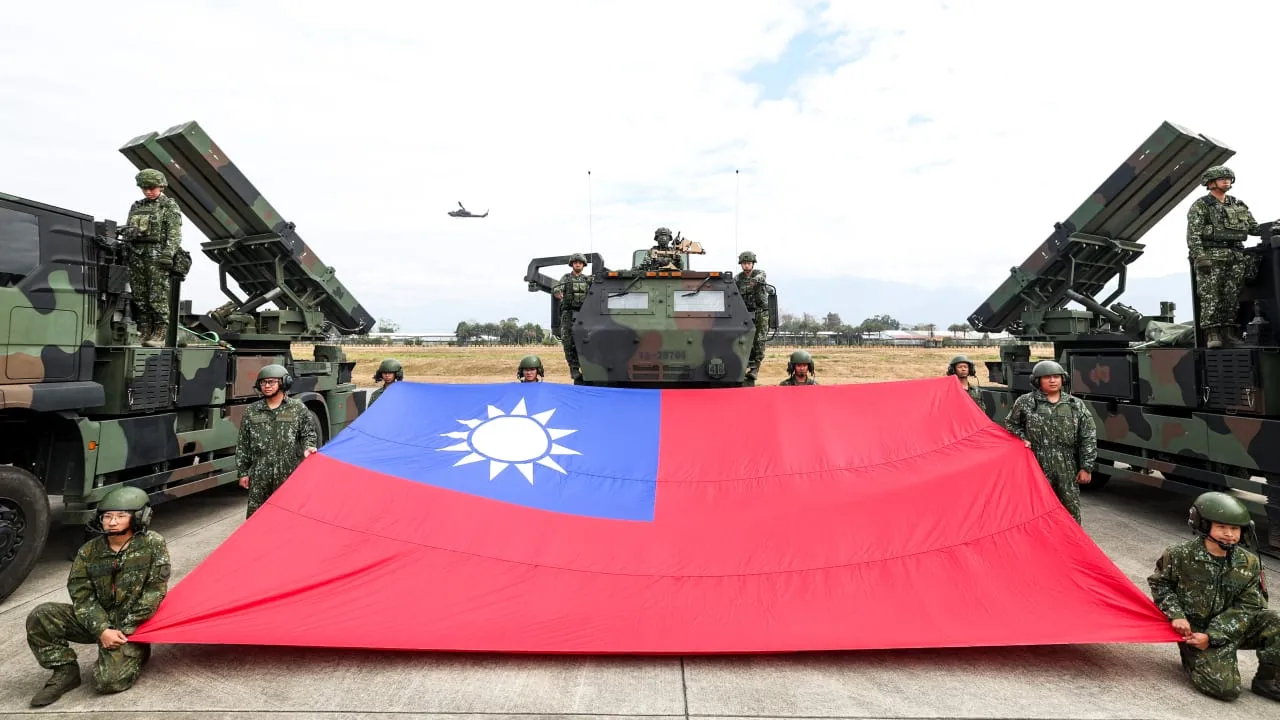
The status quo, however, does not leave Taiwan unguarded against keeping itself protected.
“We will continue to increase our national defense as a means of deterrence,” Lee said. “Chinese increasing military build-up in peacetime is the cause of the problem and the cause of regional instability.”
Taiwan has been pressing Washington to move ahead with arms sales. The Trump administration approved an $11 billion package in December, while a second package worth around $14 billion is still awaiting approval, according to Reuters. The Taiwan Relations Act commits the United States to make available defensive arms and services to Taiwan.
“The US is our major source of defensive weaponry,” Lee said. “The security relationship with the US is extremely vital for Taiwan’s survival.” She said the pending package was “very crucial,” particularly for air defense, anti-missile systems, and Patriot missiles.
“We will continue to work with the United States to make sure the weapons we need will be delivered,” she said.
Lee said Taiwan still enjoys strong bipartisan support in Congress.
“We are very, very grateful that both aisles in the Congress support Taiwan’s survival and Taiwan’s prosperity,” she said. “Our friends in Congress clearly know that the stability and prosperity of Taiwan is a shared interest.”
The summit also revived a familiar anxiety for Taipei: two great powers discussing Taiwan while Taiwan itself is not in the room, something the island is used to in international forums.
“We are not sitting in the same conference room, apparently,” Lee said. “But we keep very good communication before the summit and after the summit with the officials.”
Beijing has increased pressure around Taiwan in recent weeks. Reuters reported that Taiwan tracked a second Chinese “combat” patrol in a week, sending ships and jets to monitor Chinese activity. Lee argued that the world should understand Taiwan not merely as a regional flashpoint, but as a linchpin of global security and trade.
“We are at the center of the first island chain to stop the expansion of Chinese military aggression,” she said. “We have been telling the whole world the linchpin of continuing global peace is Taiwan’s continuous peace and stability.”
That role is also economic. Taiwan remains central to the semiconductor supply chain, accounting for more than 60% of global foundry revenue and more than 90% of leading-edge chip manufacturing, according to the US International Trade Administration. Lee rightly recognized that “If this ecosystem gets disrupted, the global economy has to suffer.”
‘Taiwan is taking actions – we have to fight on our own’
According to her, Taiwan’s increased investment in the US should not be mistaken for a weakening of Taiwan’s own industrial base.
“We will keep the most critical and most advanced technology in Taiwan,” she said. “It is really hard to replicate Taiwan’s ecosystem. It’s not only the Taiwan Semiconductor Manufacturing Company (TSMC). Actually, it’s hundreds of thousands of small and medium-sized Enterprises inside this cluster.”
TSMC is the world’s largest dedicated independent semiconductor foundry, headquartered in Hsinchu Science Park, Taiwan, and produces over 90% of the world’s most advanced semiconductor chips.
Lee also tied Taiwan’s concerns to the Middle East. She said Taipei has closely watched the war involving Israel, the US, and Iran, particularly the question of freedom of navigation.
“Most countries learned the importance of freedom of navigation,” she said. “Taiwan Strait is also a choke point for maritime trade, like the Strait of Hormuz,” and that any conflict in the Taiwan Strait would impose costs far beyond Asia.
“If there is a war, you’ve seen what happens to prices. Everybody needs to pay a really high cost,” she said. “We are very pleased and grateful to see many countries join the US-led freedom of navigation along the Taiwan Strait, to make sure it is an open and free international water.”
For Taiwan, she said, the lesson from Israel’s war with Iran is not that every country must fight the same way, but that deterrence and resilience are essential. The island’s representative also invoked Golda Meir, Israel’s only female prime minister, as a symbol of admiration amongst the Taiwanese.
“If Taiwan puts down the weapon, there will be no Taiwan,” Lee stated, paraphrasing Meir’s famous quote about the Arabs and Israelis. “The weapon is not for provocation, it’s not for inviting a war, but it’s for self-defense. It’s a means of deterrence.
“Taiwan is not only taking notes,” she added. “We’re also taking actions. We are improving our civil defense to increase our community-based resilience in times of emergency.”
For Lee, Taiwan’s strategy is clear. To maintain the status quo, strengthen its defenses, deepen ties with the US and other democracies, and ensure that Beijing cannot decide Taiwan’s future by force.
“We have to be very committed to our self-defense,” she said. “We have to fight on our own.”