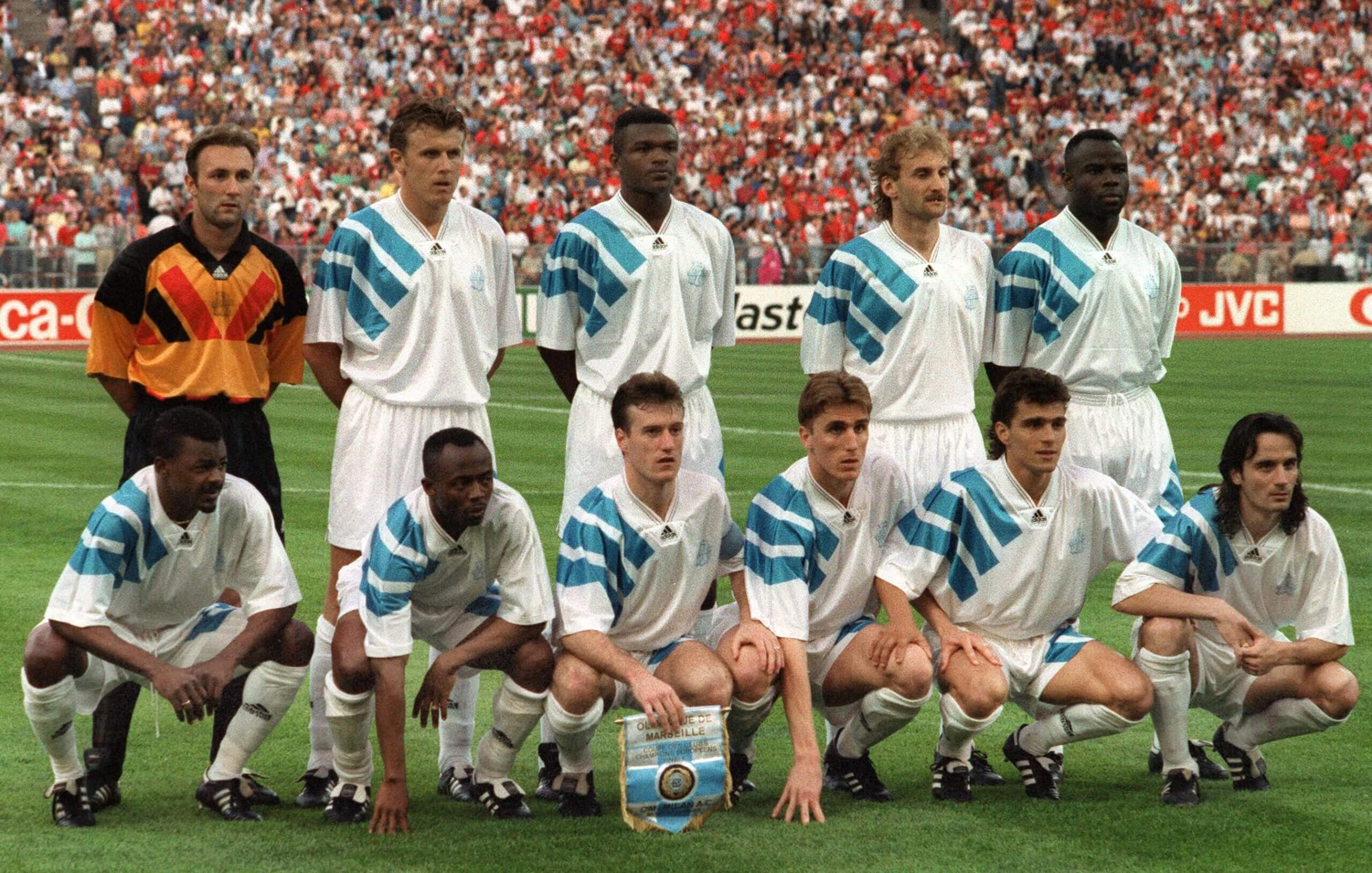
With the Champions League final just two days away, Eric Di Meco is one of a select band of players who have won the competition.
The former France international is, however, surely in a class of his own when it comes to life after football. He now plays in an Oasis tribute band, called Osiris.
Di Meco, who plays bass, won the European Cup with Olympique de Marseille in 1993, in a tightly fought 1-0 victory over Milan. Until Paris Saint-Germain’s success in the Champions League last year, Marseille were the only French side to have won the competition.
Their 1993 triumph followed heartbreak two years earlier, when they lost in the final to Red Star Belgrade in a penalty shootout.
“We thought we might never reach another European final again after that,” Di Meco, speaking over video call, tells The Athletic. “So when we got the chance to play another final in 1993, it felt unexpected.
“It was an incredible moment, especially because we were facing the great AC Milan side, the best team in Europe at the time. It was a huge moment in the lives of Marseille supporters.”
Di Meco, who spent 14 years with Marseille, was at the club as they rose from Ligue 2 to dominate French football, winning four consecutive Ligue 1 titles between 1989 and 1992, and the Coupe de France in 1989.
The Marseille team before the 1993 Champions League final. Di Meco is on the front row, furthest right (GEORGES GOBET/AFP via Getty Images)
During that illustrious time in Marseille’s history, Di Meco played in an exceptional team packed with starry names, including Fabien Barthez, Marcel Desailly, Dragan Stojkovic, Rudi Voller, Didier Deschamps, Chris Waddle and Jean-Pierre Papin.
“Every year we saw great players arriving,” he recalled. “Even Maradona nearly signed for Marseille. It was a unique period because the club had huge financial resources to build a top side. Football wasn’t like it is today, back then it was a bit easier for a French club to attract world-class players. Today, apart from PSG with their financial power, it’s very difficult for French clubs.”
Among that glittering assortment of players, who was his standout?
“I played with many extraordinary players, but I always had huge admiration for Enzo Francescoli,” he says. “He was an incredible player — classy, technically gifted — and I loved playing with him.
“And then with France, there was Zidane. I saw him start out with the national team, so I was lucky to play with him too. Eric Cantona as well, both at Marseille and with France. Eric has always been a friend.”
For all Marseille’s success during that era — which culminated in that European Cup win — it was overshadowed by the scandal involving their president Bernard Tapie.
Marseille also won Ligue 1 in 1993, which would have been a fifth consecutive league triumph, but were later stripped of their title after it emerged that players from Valenciennes, their opponents the Wednesday before the European Cup final, had been bribed to go easy on the Marseille players.
That led to Marseille losing their league title, while Tapie was found guilty of match-fixing. He served five months in prison, according to The New York Times, and was later declared bankrupt. Tapie, once a majority shareholder in Adidas, whose sale of his stake triggered years of legal battles, died in 2021.
Marseille’s bitter rivals PSG, who came second, said they didn’t want to accept the title, so there was no French champion that year. PSG were, at the time, owned by French media company Canal+, which feared their subscribers in Provence might boycott them in response if they were designated champions by default. As a result of the fallout, Marseille were not allowed to play in Europe in the 1993-94 season and were then demoted to Ligue 2 in 1994.
Did the scandal tarnish that golden period for the players?
“It’s true that the affair damaged the image of the club, and the repercussions were so huge that people still talk about it today,” Di Meco says. “It remains a dark chapter in the history of the club, that generation, and the Bernard Tapie era.
“It was something that marked French football and people still discuss it now. That’s a shame, especially because I’m sure there have been many stories like that in football. The problem for us was that it happened in the same year we became European champions. It spoiled the celebrations a little bit, yes.”

Di Meco features on a statue of Bernard Tapie outside the Stade Velodrome (CHRISTOPHE SIMON/AFP via Getty Images)
After leaving Marseille following their relegation, Di Meco joined Monaco, where he won another Ligue 1 title, in 1996-97 under Jean Tigana, and played alongside a young Thierry Henry.
“When I arrived at Monaco, he was only 17 and had just started playing,” he says. “I have huge admiration for both his career and the man himself. He was already powerful, incredibly fast, and above all, he listened to the older players. I was one of the older players at the time. He was very respectful and eager to learn.
“Maybe that’s why he improved so quickly and became such a great player. You could sense it straight away — just like David Trezeguet, who arrived slightly later when he was still very young. We immediately saw they had something extra and were destined to go very far.”
It was while he was at Monaco that Di Meco, a left-back, started to feature more regularly for France, and he was part of the squad at Euro 96 in England — although he featured only in the first game of the tournament.
That time in England — at the height of Britpop — was extra special for music lover Di Meco and cemented his love of British culture and music.
“It’s funny because in August 1996, Oasis played at Knebworth. I was in England for Euro 96 a couple of months earlier and I couldn’t go, but those shows became legendary in British music history. The demand for tickets was unbelievable even back then.

Oasis at Knebworth in 1996, the same summer Di Meco played at Euro 96 with France (CHRISTOPHE SIMON/AFP via Getty Images)
“For me, Oasis represent England in the 1990s. There was also the rivalry with Blur: Oasis represented the working-class northern city, while Blur were the London band. I loved that side of it.
“England has always had great rivalries in music — The Beatles and The Stones, for example. What I also loved about Oasis was that they were always huge football fans, huge Manchester City fans, even when City were in the Second Division (the third tier of English football).”
As well as Oasis, Di Meco also counts the Red Hot Chili Peppers, Rage Against the Machine, The Police and Pearl Jam as his favourite bands — while he’s got tickets to see The Cure play in Nimes this summer.
After retiring in 1998, Di Meco, who started learning to play bass as a youngster in Marseille’s academy, formed his first band and they began playing around the city.
However, he stopped for a while because he was working as a football pundit in France and he was required to travel regularly.
Before that, he also worked as deputy mayor of Marseille, looking after youth programmes in the city, with a focus on sport and music, after entering local politics in 1995, while still playing for Monaco.

Di Meco pictured in Marseille in January 2026 (MIGUEL MEDINA / AFP via Getty Images)
After stepping back from politics and with fewer commentary commitments, Di Meco set up his Oasis tribute band with his friends six years ago.
How did that come about?
“It’s thanks to our singer (Axel Rancurel), who grew up listening to Oasis,” he explains. “When he sang Oasis, we immediately realised he had Liam Gallagher’s voice and knew every Oasis song. He was a massive Oasis fan, so naturally we became an Oasis tribute band.”
The band try to play once a month, although in summer they often perform two or three times a month. They have six gigs lined up over the next three months.
What’s his favourite Oasis song to play?
“I really love playing Rock ’n’ Roll Star and Some Might Say,” he says.
As for his preferred album, he picks Definitely Maybe, Oasis’s debut album, released in 1994. It’s a close call over their second, (What’s the Story) Morning Glory?
“Those first two albums are masterpieces, there are only classics on them,” he smiles.
Di Meco also explains how he met Noel Gallagher, thanks to his friendship with Ali Benarbia, with whom he played at Monaco. Benarbia later joined Manchester City.

Noel Gallagher pictured at Manchester City’s 1-1 draw at Bournemouth earlier this month (Alex Pantling/Getty Images)
“Noel is a huge fan of Ali,” he says. “When I started the band, we played wearing old Manchester City shirts, so I asked Ali if he still had one. He gave me one of his old shirts and said: ‘One day, when you come to commentate at City, I’ll introduce you to Noel.’
“So about four or five years ago, I was commentating on a Manchester City match. After the match, I went to Noel’s box and met him. I gave him an Oasis T-shirt and some Marseille shirts, and we talked about the game. City had won and played well, so he was in a great mood. So, I was lucky enough to meet Noel. I’ve never met Liam, though.”
Di Meco’s band normally play in France, but they have performed in Scotland and that experience has left them itching for more — with Manchester and London high on their bucket list of cities to tick off.
“When we went to Scotland to play, I was fascinated by the musical culture among young people there,” he says. “At our concert, there were 18-year-olds who knew every guitar solo and every lyric by heart.
“The United Kingdom is the place of football and music. So, for people like us, it felt like paradise.”