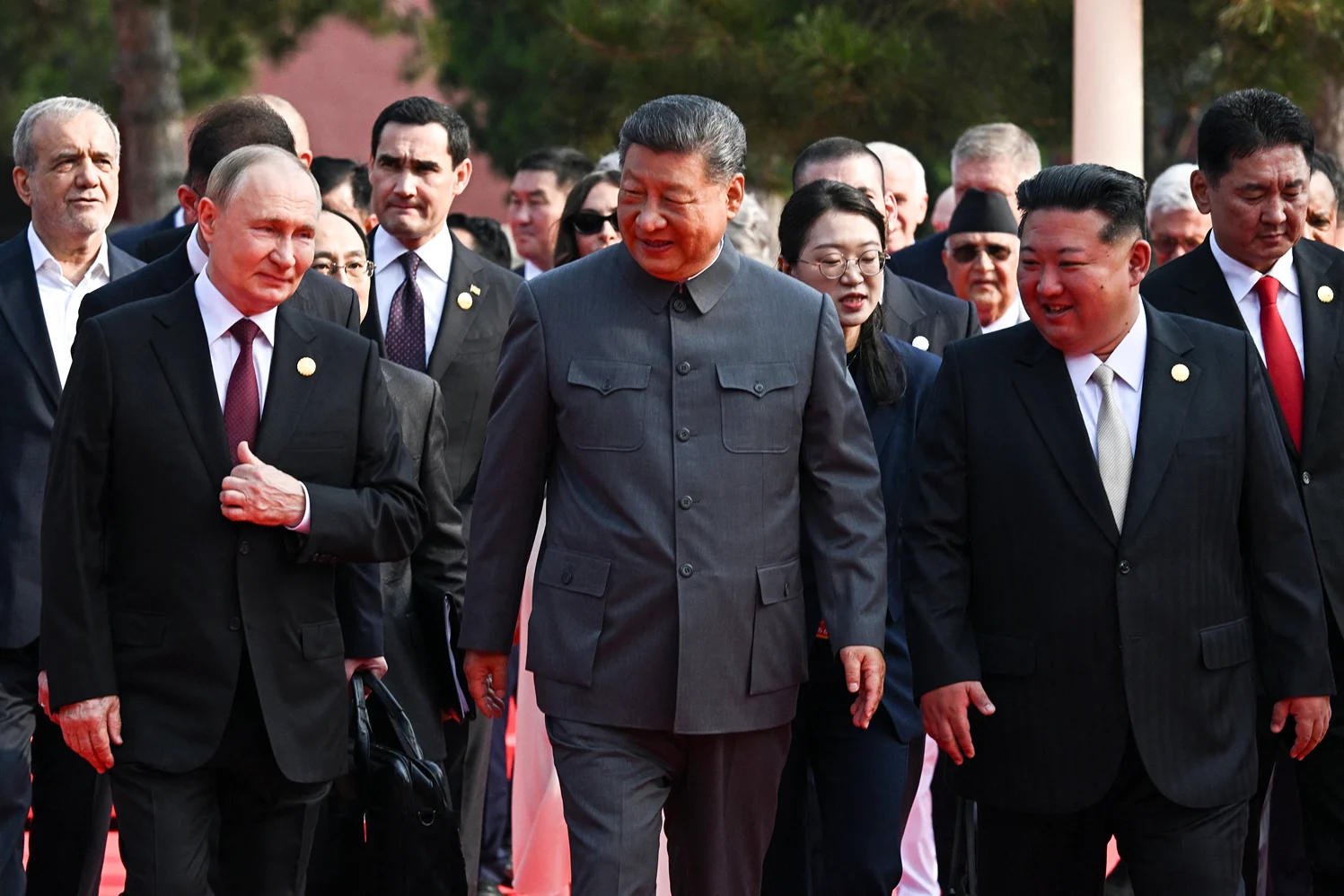
South Korean media recently reported that Chinese security and protocol personnel have already arrived in Pyongyang to make preparations, and that Chinese President Xi Jinping may visit North Korea in late May or early June.
China hasn’t yet confirmed the trip, but a visit is both overdue and, from Xi’s perspective, necessary. As close as Beijing and Pyongyang are on paper, relations between the two behind the scenes are often tense; China has never quite accepted North Korea’s status as a nuclear power and worries about losing influence in the country to Russia.
South Korean media recently reported that Chinese security and protocol personnel have already arrived in Pyongyang to make preparations, and that Chinese President Xi Jinping may visit North Korea in late May or early June.
China hasn’t yet confirmed the trip, but a visit is both overdue and, from Xi’s perspective, necessary. As close as Beijing and Pyongyang are on paper, relations between the two behind the scenes are often tense; China has never quite accepted North Korea’s status as a nuclear power and worries about losing influence in the country to Russia.
Xi last paid a state visit to Pyongyang in June 2019, nearly seven years ago. Even after deducting the three years of the pandemic, that’s a long delay, and in that time Xi has visited many countries—including South Korea. Even more foreign leaders have come to China, ranging from Cuban and Venezuelan leaders to, in the last few weeks, U.S. President Donald Trump and Russian President Vladimir Putin. There have been a fair number of visitors to Pyongyang, too, from Putin to Vietnam’s To Lam.
A gap in diplomatic protocol is itself a political signal. And because North Korea is so closed off from the world, China-North Korea diplomacy is inherently out of the ordinary. While the two are both communist states with a history of mutual support, and North Korea is China’s only formal treaty ally, the friendship “forged in blood” is more fragile than it seems.
Xi’s long delay in visiting reflects that Beijing has never fully digested the reality that North Korea is now a de facto nuclear-armed state, and this has become a major obstacle to the development of deeper relations between the two countries.
North Korea already possesses nuclear weapons, while China’s long-standing external policy has been the denuclearization of the Korean Peninsula. For North Korean leader Kim Jong Un, nuclear weapons are the ultimate guarantee of regime security and North Korea’s only bargaining chip to escape the fate of a small state and negotiate with the United States. Asking him to give up nuclear weapons is tantamount to asking him to give up regime security. For Beijing, openly recognizing North Korea as a nuclear-armed state would undermine China’s long-held nonproliferation position and potentially trigger a chain reaction from South Korea, Japan, and others.
Beijing once cooperated with the United States in pressuring Pyongyang to abandon its nuclear program, which alienated the two sides. China-North Korea relations were very poor for years as a result. In the end, Beijing had no choice but to tacitly accept North Korea’s possession of nuclear weapons—continuing in principle to emphasize denuclearization of the Korean Peninsula, while in reality accepting that North Korea is a nuclear state.
“Denuclearization of the Korean Peninsula” still appears in China’s diplomatic language, but it is no longer the central term in China-North Korea relations. Beijing more often emphasizes peace and stability on the peninsula, political settlement, opposition to U.S. military deterrence, and respect for North Korea’s legitimate security concerns. This change is significant. It shows that Beijing values the relationship with Pyongyang, and countering the U.S.-Japan-South Korea security alliances is already being placed ahead of the goal of denuclearization.
A Xi visit gives the chance for new discussions. Beijing may have realized that it can no longer allow the North Korean nuclear issue to block top-level exchanges between China and North Korea. Relations between the two countries need to be rearranged on the basis of North Korea’s de facto nuclear status.
Xi’s trip would also mean China bringing North Korea back into its own surrounding strategic buffer system. Now that U.S.-Japan-South Korea security cooperation is deepening and China-Japan relations are very poor, North Korea’s strategic value to China has risen. A nuclear-armed North Korea is, of course, also a potential threat to China—but a much more pressing one to Japan, and a useful card for Beijing.
Xi also has Putin in mind. Kim has moved closer to Moscow not because he truly wants to replace China with Russia, but because he needs a patron willing to underwrite North Korea’s security. Putin is willing to offer him that. But Russia can only give North Korea its military and security backing, not a complete path to development of the kind that China pursued in the 1980s and 1990s and that Chinese officials have long pressed North Koreans to accept.
If China continues to keep its distance, it will push North Korea further and further toward Russia and may eventually lose its dominant position on the peninsula. Taking this reality into account, China would use Xi’s visit to pull North Korea back onto a track dominated by Beijing, offering both economic and security incentives.
In addition, Xi’s visit would also seek to open up access through the Tumen River outlet and the Rajin-Sonbong economic zone, thereby revitalizing northeast China’s economy. The revitalization of northeast China, once the industrial heartland of the country but long fallen into stagnation, has been discussed for many years but has never truly taken off.
There are plenty of reasons for this, from a shrinking population to stagnant institutions, but the region’s neighbors also matter. Northeast China borders North Korea, and North Korea’s long-term closure has blocked the chance for real cross-border exchanges and trade. If China-North Korea relations improve, North Korea opens up in a limited way, the Tumen River outlet is opened, and North Korea’s Rajin Port and Rason Special Economic Zone become active again, then Northeast China could find a new future providing fresh connections between the Korean Peninsula, the Russian Far East, and the Sea of Japan. During Putin’s recent visit to China, the joint statement with Xi again mentioned the Tumen River and the need to consult with North Korea, showing that this issue has still not been fully resolved.
Kim has his own reasons for welcoming a Xi visit. While he has long since consolidated his dynastic authority internally, he needs external recognition as well. Putin’s visit to North Korea already gave him a major security endorsement. But China’s significance is different. Russia today is a major power mired in war and sanctions, with its national strength in decline. China, by contrast, is the world’s second-strongest power.
If North Korea truly wants development, and if the regime is to remain stable, it still has to rely on the aid and assistance of its Chinese big brother. If Xi keeps delaying his visit, it means China-North Korea relations are not that solid, and Kim’s personal authority has not received Xi’s full endorsement. He therefore needs to use a grand welcome for Xi to add another layer of legitimacy to his own authority.
And if North Korea wants in the future to open its doors and return to the international community, it needs Beijing, not Moscow, which hovers on the edge of being a pariah state itself. In particular, if Kim wants to open a channel to the United States, hold another Kim-Trump summit, and secure partial U.S. sanctions relief, he will need Beijing to mediate and provide a security guarantee.
Some argue that Xi’s visit to North Korea reflects Beijing’s fear that Kim will bypass China and establish direct contact with Trump, and that a future Kim-Trump summit would exclude China. If Xi visits North Korea, it is indeed possible that he may carry a message for Trump. But to say that Beijing fears future U.S.-North Korea negotiations will exclude China is an exaggeration; Pyongyang will not do this, nor can it do this. In the previous two meetings between Kim and Trump, China was not cast aside; on the contrary, Kim first went to Beijing to meet Xi before heading to Singapore to see Trump.
Today, it is even less possible for him to act alone while bypassing Beijing. North Korea does not trust the United States, and Kim does not trust Trump. The failed Hanoi summit in 2019 was a wound and a lesson for Kim. He has already experienced Trump’s last-minute demands and sudden reversals. Now, with the experiences of Venezuela and Iran before him, and perhaps Cuba next, he will inevitably become even more convinced that small countries need great-power backing, nuclear weapons, or both. How could he still trust the United States and Trump?
A Xi visit won’t mean contradictions between the two sides over the nuclear issue have completely disappeared. But they will build a more pragmatic bilateral relationship based on reality. The two sides will continue to emphasize traditional friendship. Pyongyang will continue to need China’s protection and assistance, while Beijing will continue to need North Korea as its own bargaining chip. Each takes what it needs—and a relationship of mutual pragmatism can last a long time.