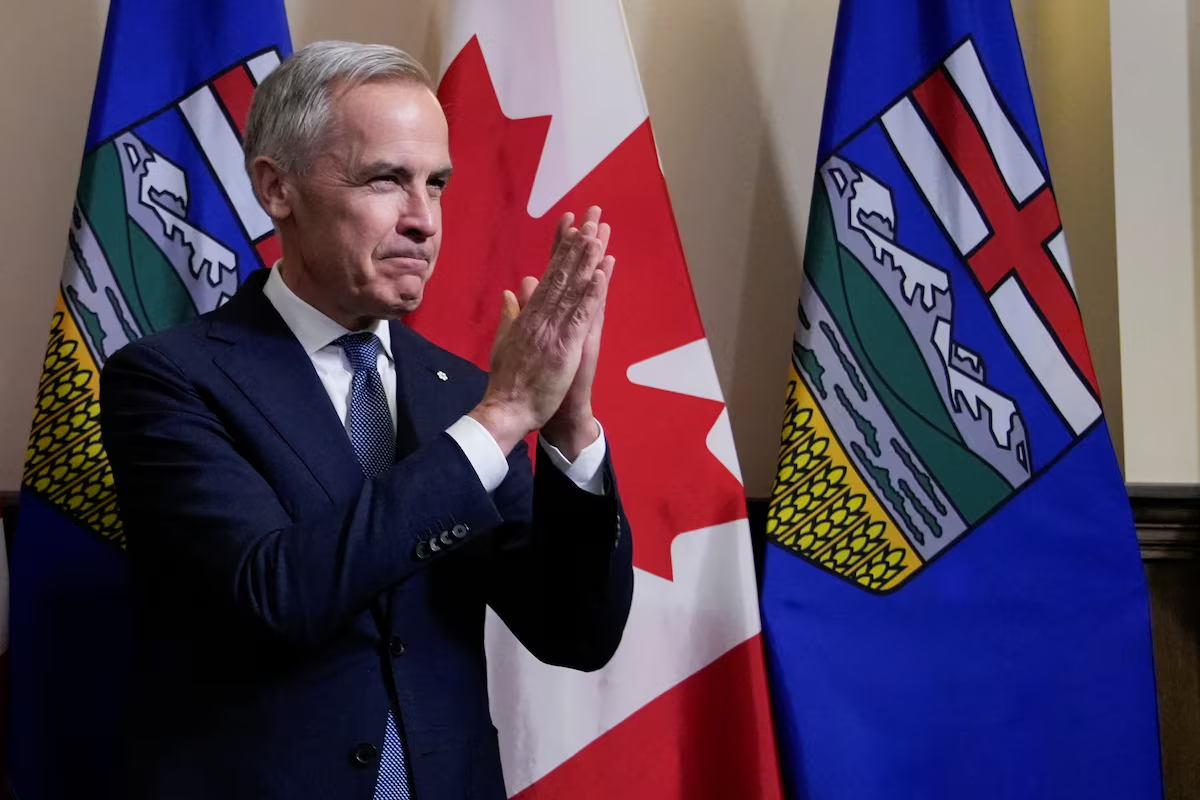
Prime Minister Mark Carney in Calgary on May 15.Todd Korol/Reuters
Kevin Yin is a contributing columnist for The Globe and Mail and an economics doctoral student at the University of California, Berkeley.
Most leaders across advanced economy democracies are struggling. British Prime Minister Keir Starmer, for example, whose party lost badly in recent local elections, has faced fresh calls within his own party to resign. But here in Canada, we seem to be in Carneymania.
Is our own Prime Minister is simply a more capable politician than his counterparts?
It is often said in the British press that Mr. Starmer’s problem is a lack of vision – that he has failed to communicate a clear path forward for Britain, in part because he does not know what he wants and in part because he lacks the backbone to see it through. In this sense, he seems to be Mark Carney’s opposite. Mr. Carney has harped repeatedly about building grand infrastructure projects and diversifying away from the United States to the point there is little doubt what he has in mind.
But there is more in common between these two leaders than often admitted. Both were essentially pro-growth centrists who made concessions to the right in order to get elected. Mr. Carney cut the carbon tax and is in the process of cutting the number of temporary foreign workers, just as Mr. Starmer promised not to raise taxes and ended recruitment of overseas care workers. Yes, Mr. Starmer has made embarrassing U-turns, but Mr. Carney has faced no pressure to do so. Why does Mark Carney get a pass while Keir Starmer might get the boot?
Carney dismisses environmental detractors, defends government’s climate plan
In some part, it is because Mr. Carney’s job is simply easier. What is understated is just how much luckier he is than his counterparts.
Canada’s fiscal capacity makes the growth problem more straightforward. Our government has managed to cut both corporate and income taxes, promised significantly more spending on infrastructure, all while maintaining Trudeau-era social programs such as dental care and child care benefits. We are having our cake and eating it. The Liberals did not have to raise taxes or cut social services and take on the image of the heartless austerity government. Buoyed too by the Liberal Party’s flexible ideological identity and a wave of anti-Trump sentiment, Mr. Carney inherited a strong political hand.
Mr. Starmer has had no such luxuries. Britain faces a net-debt to GDP ratio at over 90 per cent, well above its advanced economy peers (Canada’s is around 45 per cent). This has forced the Labour government to scrap growth initiatives such as its proposed £28-billion green investment package. At the same time, the Conservative Party cornered Mr. Starmer by claiming his government would raise taxes, against which he then had to promise otherwise. The British Prime Minister has tried to cut social services such as a winter fuel subsidy along with disability benefits instead, which resulted in a mutiny from within his own party.
One should not make promises one cannot keep. But it is hard not to feel that the man is between a rock and a hard place. As such, Nigel Farage’s far-right Reform party is on the rise even as progressives abandon Mr. Starmer.
His poor judgment and indecisiveness have hurt him, but they alone cannot account for Mr. Starmer’s radical lack of popularity. It is telling that French President Emmanuel Macron, who is generally credited with more vision than Mr. Starmer, is also struggling against far-right and populist pushback. Germany’s Friedrich Merz, who has tried to be a “hard-truths” chancellor, was booed for stating that pensions needed reform.
The tough job of modern governance seems to reward neither Mr. Starmer’s brand of spinelessness nor his peers’ blunt honesty. The only G7 leader who seems to be doing well under these constraints is Japanese Prime Minister Sanae Takaichi – however, she seems to have threaded the needle simply by embracing larger deficits.
This is not to say that Mr. Starmer has not made serious missteps, or that Mr. Carney has not been deft. It is hard to imagine, for example, that Mr. Carney would appoint someone affiliated with Jeffrey Epstein to a critical ambassadorship as Mr. Starmer did. The Labour party’s decision to go after disability benefits instead of, say, fixing Britain’s triple-lock pension system, looked extremely cruel and would have saved less money than the alternatives.
There is also something to the fact that Canada’s Liberals have chosen their overtures to the right on far more winnable territory – support for the energy sector and deregulation for example, as opposed to fear mongering about becoming an “island of strangers.”
But as Davos-goers and business leaders heap praise on Mr. Carney, it is worth remembering that Canada’s situation is simply different. Mr. Starmer, and many of his peers in the G7, face the twin-crisis of stagnant growth and inherited fiscal mismanagement. It will take more than just vision to correct that course.