The 2025-26 Premier League season was a strange one — the bottom-half clubs were good, the top-half clubs were inconsistent, and there was a major focus on intensity and set pieces at the expense of interplay and creativity.
Three hundred and eighty games is a lot to digest. But what if the whole Premier League season could be boiled down into 10 matches, with each side featuring once? Well, it would look something like this…
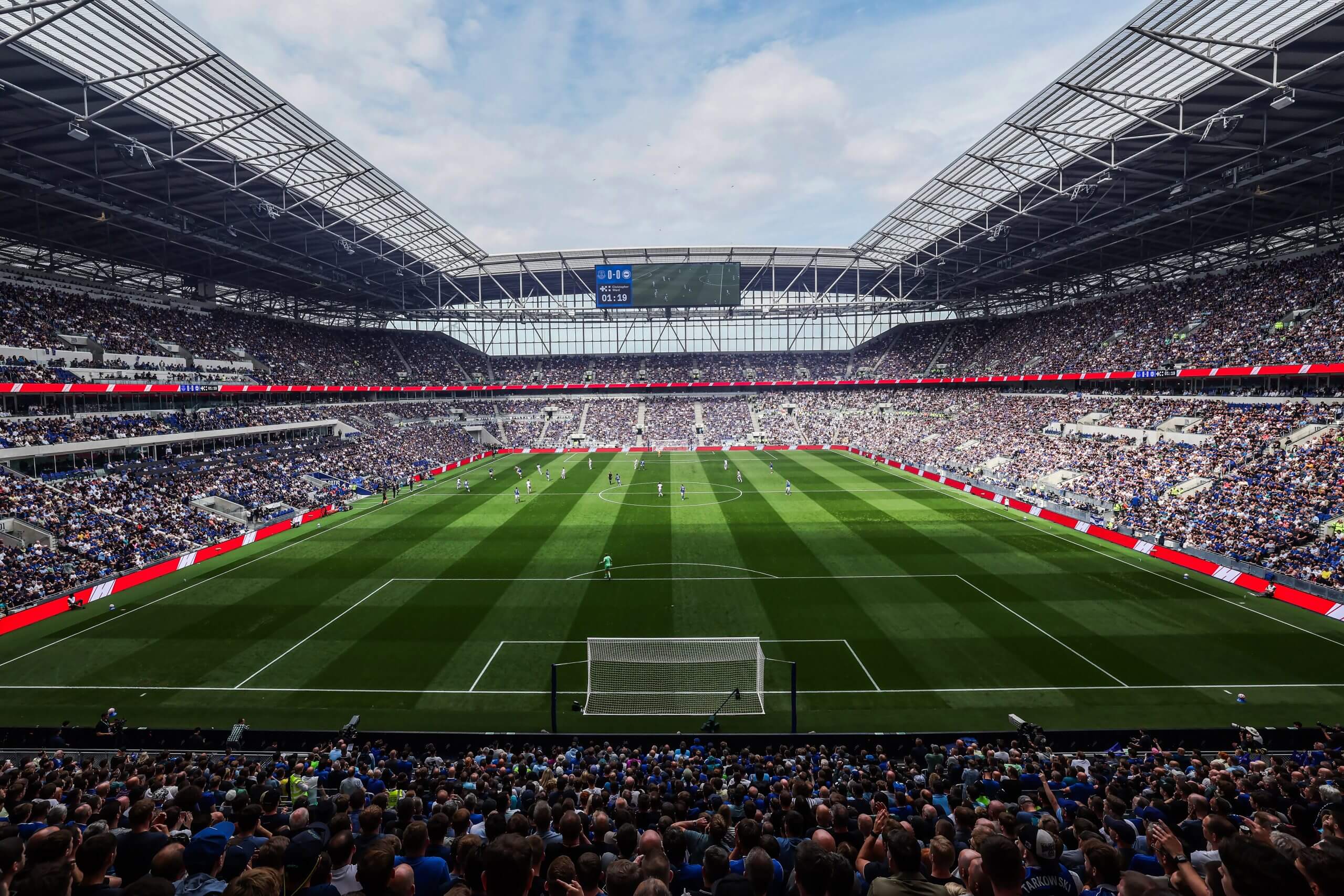
Week 2: Everton 2-0 Brighton. Another new stadium.
Despite concerns about ticket prices, poor atmospheres and attritional football, the demand to watch Premier League football is remarkable. Twenty years ago, only Manchester United and Newcastle United averaged over 50,000 at home. They’ve now been joined by West Ham United, Tottenham, Liverpool, Arsenal, Manchester City and now Everton, with four of those sides having built new stadiums. This is maybe the defining feature of this era of football.
Everton’s move was on the more jarring end of the spectrum: leaving the legendary Goodison Park, the first purpose-built football stadium in the world, for a different part of the city. But while once new stadiums felt generic and soulless, the Hill Dickinson is a genuinely daring, visually spectacular construction. Comparable clubs in Serie A, for example, cannot dream of the infrastructure Premier League supporters take for granted.
First impressions count for a lot. And Everton got their new era off to a wonderful start with a win that ticked all the boxes. Jack Grealish was exciting and got two assists. Iliman Ndiaye and James Garner both scored great goals. Jordan Pickford saved a penalty. The sun was shining. The whole spectacle looked fantastic on television. It made you want to visit.
Everton host Brighton in the first Premier League game at their new stadium (Michael Regan/Getty Images)
Week 3: Tottenham 0-1 Bournemouth. Which managers scale up?
There’s a basic pattern when it comes to the Premier League’s big boys appointing a manager who has performed well with underdogs in the same division. Essentially, those who already coached ‘big club’ football — high pressing, possession-heavy — tend to perform quite well. Those who have relied more on direct football struggle.
Last summer, Tottenham went for Brentford’s Thomas Frank when they might have opted for Bournemouth’s Andoni Iraola. Even when Tottenham made a positive start to the campaign, their fans were far from convinced, and this home defeat was a good example of why.
Tottenham were completely outplayed on home soil, barely creating a chance. Bournemouth were superior at pressing, at combination play, at getting runners in behind and should have won by a greater margin. It is hard for managers to change their identity when making the leap up the league, and managers like Iraola fare better than those like Frank.
Week 10: Crystal Palace 2-0 Brentford. Set pieces.
You probably don’t remember this game, but I was there and I’m still not quite over it. The Premier League’s sudden obsession with dead-ball situations is best demonstrated by Brentford deciding to replace Frank with Keith Andrews, who previously was the club’s set-piece coach. Andrews has, by all accounts, performed extremely well in his job. But going from set pieces to the main job, it seems, isn’t considered an enormous leap these days.
This game showed why. After his side’s victory, Palace manager Oliver Glasner said that, with limited time on the training ground after their midweek European match, the only thing he worked on was set pieces. And my god, did it show.
The first goal arrived after a long free kick into the box, Jefferson Lerma nodded it on, and Jean-Philippe Mateta headed home. The second came from a Lerma long throw, and Nathan Collins diverted the ball into his own net. Almost nothing else happened: the xG was just 1.2. No exciting passing moves, no good combination play, no great counter-attacks. Just set pieces.

Palace’s game with Brentford in November: not a classic (Eddie Keogh/Getty Images)
Week 16: Arsenal 2-1 Wolves. First narrowly beats 20th.
Unlike their previous three titles in the Premier League era, Arsenal have not won the league with beautiful, exciting, attack-minded football. None of their attackers is in the conversation for the best XI of the season. They’ve had an excellent defence, and they’ve scored lots of goals from set pieces.
And therefore, this match was an extreme microcosm of Arsenal. They didn’t play well. They seemed to have thrown away two points by conceding a late equaliser. But they eventually won the match in entirely scrappy fashion, thanks to two own goals, which were forced by Bukayo Saka knocking the ball into the danger zone and hoping for the best. Several months later, their 1-0 win over Burnley, thanks to another goal from a Saka corner, put them on the brink of becoming champions.
This match also summed up Wolves, who somehow both threatened to record the lowest-ever points tally in the Premier League and also battled well against strong opponents. They managed a draw with Arsenal in the reverse fixture. But a heartbreaking defeat thanks to two own goals? That was very Wolves.
Week 18: Sunderland 1-1 Leeds. The promoted sides are hard to beat.
After two seasons where all three promoted sides went straight back down, it was somewhat refreshing that two of this season’s trio thrived.
Sunderland and Leeds have sometimes played well. But more crucially, they’ve always been difficult to beat. They were well organised, they were able to compete physically, they didn’t try to play beyond their capabilities, and they offered intimidating home atmospheres.
Simon Adingra opened the scoring for Sunderland here, after a lovely through ball from their best player this season, Granit Xhaka. The equaliser came from Dominic Calvert-Lewin, whose move to Leeds rejuvenated his career. These sides have basically thrived by drawing lots: between them, they managed 25 wins, 26 draws and 25 defeats.
Week 24: Chelsea 3-2 West Ham. The five-substitutes era.
One of the fundamental recent changes to football has been the switch from three substitutes to five. Initially planned as a temporary measure during Covid, eventually the rule stuck. It’s difficult to find any positives from the switch. It has not reduced injury rates. It further breaks up the game. It means matches are played at a higher intensity, which means technical quality is increasingly being overrun by pressing.
Equally, you have to acknowledge that a manager having five substitutions can play a major role. Here, Nuno Espirito Santo had a well-crafted tactical plan to exploit Chelsea’s left flank, and West Ham went 2-0 up by breaking down that wing.
Chelsea head coach Liam Rosenior had to make a first-half substitution due to injury — Pedro Neto on for Jamie Gittens down the right. In the old days, he would only have had two further changes to make, and wouldn’t have made them both at half-time.
But in the five-subs era, Rosenior could make three half-time switches and still have one in reserve. He was clearly so appalled by his side’s left flank that he substituted left-back Jarell Hato, left-sided centre-back Benoit Badiashile and left winger Alejandro Garnacho.
On came Joao Pedro, Wesley Fofana and Marc Cucurella. Pedro scored Chelsea’s first, Cucurella scored the second, then Pedro teed up Enzo Fernandez for the winner. West Ham were able to compete 11-vs-11. But they couldn’t cope with Chelsea’s depth.

The five-substitute era favours big teams with deep squads (Shaun Botterill/Getty Images)
Week 32: Burnley 0-1 Manchester City. Competitiveness.
For years, the Premier League has marketed itself as a division where anyone can beat anyone. It’s never really been true. But this season, more than for many years, it felt realistic — evidenced by the aforementioned Arsenal vs Wolves matches.
But this match was even more instructive. With Burnley only one defeat away from their relegation being confirmed, and City having just beaten Arsenal and the title set to be decided on goal difference, this match was billed as a question of how many goals City could smash past Scott Parker’s side. For context, they’d scored five or more against Burnley six times in the previous eight seasons.
But no. Instead, it was a nervy 1-0 win. Erling Haaland scored, of course, but it wasn’t a case of City squandering a succession of chances — more about them being unable to consistently break down a well-organised side.
Late on, Burnley even had a decent spell of pressure. They couldn’t find an equaliser, and their relegation was sealed. But, like in many games this season, the relegation certs caused one of the big boys problems.
Week 35: Manchester United 3-2 Liverpool. Roaming No 6s.
Not long ago, top Premier League clubs would field holding midfielders such as Jon Obi Mikel, Lucas Leiva and Claude Makelele, who would play hundreds of games without scoring a single goal. But now, in the era of high pressing and sudden forward bursts, Casemiro, Martin Zubimendi, Moises Caicedo and Ryan Gravenberch all offer a genuine goal threat in open play. Equally, sometimes they forget the basics of protecting the defence.
This match was a good example. The story of the game can be told almost exclusively by looking at the way both teams were able to find oceans of space between the lines. Liverpool’s first goal, for example, came when Manchester United winger Amad received the ball, and both holding midfielders Casemiro and Kobbie Mainoo went flying forward in advance of him, which left Amad with no passing option. He sloppily gave the ball away, allowing Liverpool’s Dominik Szoboszlai to waltz through to score, under no pressure whatsoever.
But it’s about risk and reward. When United went forward in search of a winner, Amad was at the far post to receive a cross, tried to nod it down to the waiting Casemiro to fire home, only for the ball to be half-cleared… to the other central midfielder Mainoo, who steered the ball home for the winner.
We used to talk about ‘holding’ midfielders and ‘sitting’ midfielders, but even the deep midfielders these days are playing all-action roles.

Mainoo celebrates scoring what turned out to be his side’s winning goal against Liverpool (Shaun Botterill/Getty Images)
Europa League semi-final second leg: Aston Villa 4-0 Nottingham Forest.
Yes, we’re cheating a bit here because this is a Europa League game. But a clear theme was another season of English clubs dominating the second and third-tier European competitions. At Champions League level, other leagues can compete. But England’s sixth and seventh-best sides routinely beat the equivalents from other leagues.
After a 1-0 Forest win in the first leg, Villa were comfortable here. But whatever the result, the simple nature of the tie showed what’s going on at the moment. One statistic sums it up. In the last two seasons, Premier League sides have contested 20 knockout ties in the Europa and Conference Leagues against teams from other leagues, and have won all 20. Crystal Palace can make it 21 with a win over Rayo Vallecano this week.
Last season, Manchester United were only toppled in the Europa League when they encountered Tottenham. Here, Nottingham Forest only lost once they had to face Aston Villa. Had the draw worked out differently, there would probably have been another all-English Europa League final this time around.
Week 38: Fulham 2-0 Newcastle. Nothing at stake?
Broadcasters have to insist that every match of the Premier League season is the most important sporting event of the year. Which, when each campaign consists of 380 games, simply isn’t true. In fairness, 18 of the 20 Premier League sides had, in some way, eventful seasons. They were battling relegation, challenging for the title or the Champions League places, or they were newly promoted, or they reached a European final, or they had a new stadium.
Take all those away, and you get Fulham and Newcastle. Never properly in danger of going down, never the favourites to finish in the European places, not bad enough to dismiss their manager (but flat enough that many supporters would probably be keen on a change this summer).
They met on the final day, and therefore this was the deadest rubber of the season. Yet the closeness of the midtable teams this season meant that both could have finished in six different positions: anywhere from 9th to 14th, depending on other results. The difference between those positions was worth £19m. In that light, maybe every match is important.