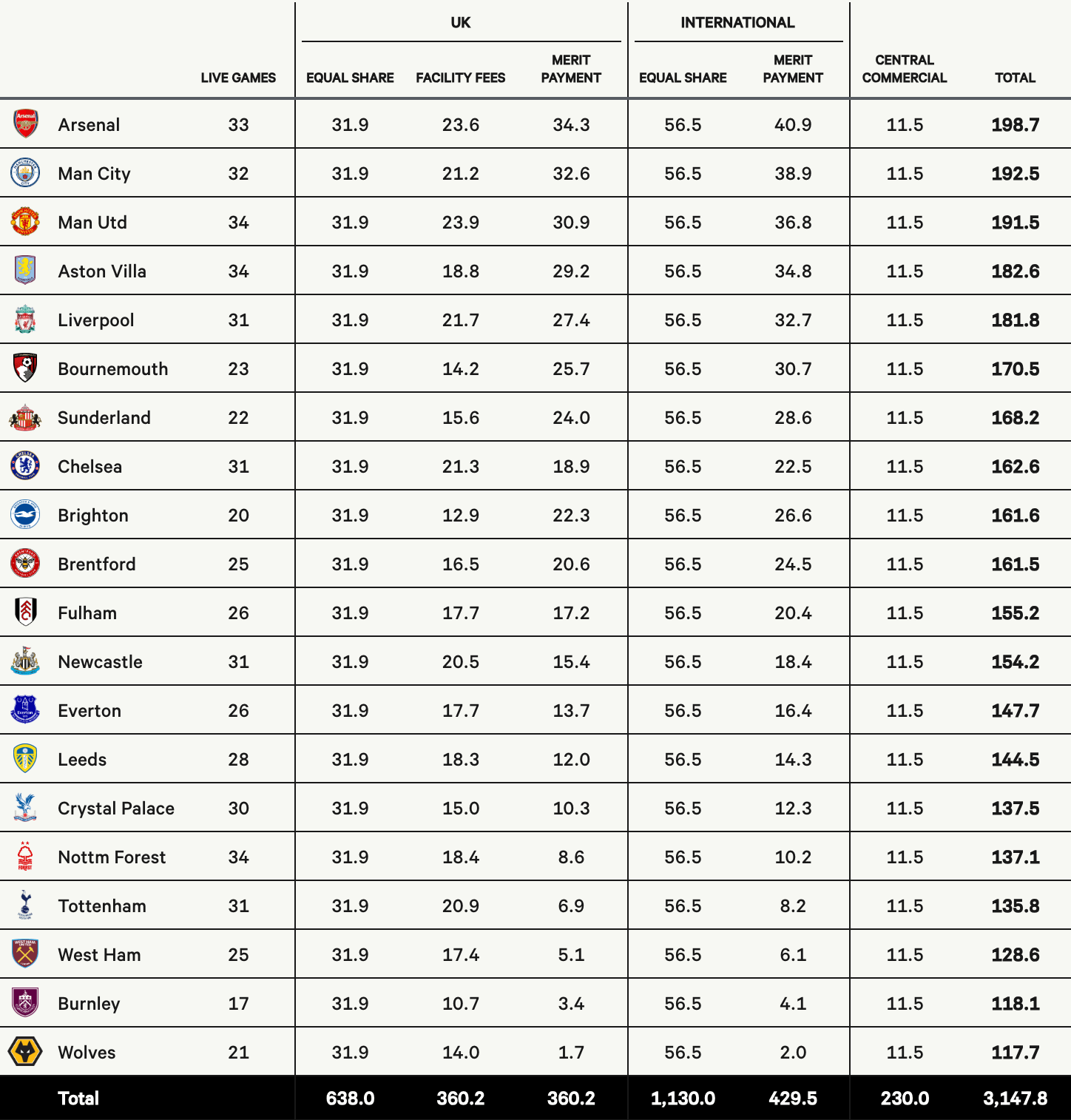
Arsenal’s first Premier League title for over two decades is expected to generate almost £200million ($269m) in domestic prize money as payouts to England’s top clubs hit new heights this season.
Calculations undertaken by The Athletic, based upon information provided by various club sources across the division, project that the Premier League will distribute over £3billion to its 20 member clubs for the first time, up from £2.8bn in each of the past three seasons.
The newly crowned champions, naturally, lead the way. Arsenal are expected to earn £198.7million in broadcast revenues from the Premier League this season, a £27.2m increase on 2024-25 and £23.8m more than Liverpool received for winning the competition a year ago.
Arsenal’s takings are expected to be over £20million higher than the previous single-season record: Manchester City’s £176.2m in 2022-23. We project five clubs — Arsenal, City, Manchester United, Aston Villa and Liverpool — have all cleared that mark in 2025-26.
That big jump in earnings at the top of the division is driven by a large increase in ‘merit’ payments, where clubs receive more money the higher they finish in the table.
Such payments have been a staple of the Premier League since its inception in 1992 but have jumped markedly this year. Each league position in 2025-26 was worth an extra £3.76million to clubs, up from £2.65m a year ago and a new high, surpassing the £3.11m-per-spot on offer in 2022-23. Arsenal are therefore understood to have earned £75.2m in merit payments this season, 42 per cent more than Liverpool’s £53.1m in 2024-25.
The lucre on offer meant today’s final raft of games bore real financial consequence, even beyond those sides battling relegation or chasing Champions League qualification. Six clubs — Chelsea, Brentford, Sunderland, Newcastle United, Everton and Fulham — could each have finished in any of six different positions leading into Sunday’s matches, a range of possibilities that equated to an £18.8million difference in prize money.
Sunderland’s 2-1 win over Chelsea elevated them both into the Europa League and a seventh-place spot, which upped their Premier League prize money to an estimated £168.2m, £11.3m higher than if they had remained 10th.
At the foot of the table, where fates have been known a long while, Burnley’s second-half equaliser ensured they finished higher than visitors Wolves and banked an extra £3.8m into the coffers, which will come in handy for next season in the Championship. Their extra money earned today is equivalent to more than a third of the TV money most Championship clubs earn, albeit both Burnley and Wolves — and West Ham — will receive parachute payments in 2026-27.
Those parachute payments are dictated by the size of the ‘equal share’ pot doled out to clubs, which The Athletic understands remains largely unchanged at £88.4million this season (2024-25: £89m). Improved league-wide commercial deals meant clubs each received an improved £11.5m (2024-25: £7.9m) from that pot, which is also shared equally.
Behind the non-commercial equal share payments stagnating while the merit pot swelled is the continued growth in the Premier League’s overseas TV rights. Distributions from the international pots — £1.13billion in equal share payments and £430m in merit payments — now comprise 50 per cent of the total expected payouts to clubs in the top tier.
The Premier League has inked ever-improving broadcast deals abroad, and those increased earnings are shared equally up to the rate of inflation, but growth above that level (which is assessed each season) goes into the merit pot. It means that, per our projections, Arsenal earned £81million more than bottom-placed Wolves’ £117.7m, even as that represented an £8.5m increase over table-propping Southampton’s takings in 2024-25.
In an attempt to retain some parity and promote competitive balance, the Premier League limits the maximum earnings of a club in a single season to 1.8 times that of the lowest earner. That gulf between Arsenal and Wolves equates to a ratio of 1.688:1, a notable jump on last year’s 1.602:1 but lower than both the 1.8:1 maximum and the 1.701:1 of 2022-23.
This season marked the commencement of a new domestic TV rights cycle, running for four years to the end of the 2028-29 season. A large uptick in games televised in the UK was expected, with the number of live broadcasts growing from 200 games in each of the past three seasons to around 270 this year.
In fact, the figure was even higher still. Just 103 Premier League games kicked off at 3pm on a Saturday this season, with the remaining 277 all screened live in the UK. The three most televised clubs — Aston Villa, Manchester United and Nottingham Forest — played just four games at 3pm on a Saturday.
For Villa and Forest, having 34 games screened live was a consequence of their participation (and going deep) in the Europa League, where games are played on Thursday evenings and thus bump domestic fixtures to a Sunday.

Aston Villa rarely played at 3pm on a Saturday this season (Darren Staples / AFP via Getty Images)
The Athletic has learned that not all televised fixtures generate the same payment to clubs, with a distinction made between those games selected for ‘live’ broadcast and those ‘displaced’ by other events. Over 40 per cent of Villa and Forest’s broadcast fixtures fell into the latter pot; at Crystal Palace, who have reached this week’s Conference League final, 16 of their 30 broadcast games this season are understood to be part of the ‘displaced’ category. Displaced fixtures attract less than half the sum paid out for the other selections.
In all, 226 games were selected as ‘live’ by either Sky Sports or TNT Sports, with 51 displaced. The biggest beneficiaries of televised games were Manchester United, whom we estimate earned £23.9million from 34 televised games. All of the Premier League’s ‘Big Six’ — United, Arsenal, Chelsea, Liverpool, Manchester City and Tottenham Hotspur — are expected to have earned over £20m from the ‘facility fees’ pot, which pays out according to televised games. Newcastle United, screened 31 times this season, are expected to have topped that figure too.
Per our projections, United’s third-place finish this season generated £191.5million in domestic prize money, just £1m behind local rivals City. United have improved 12 spots on last season’s 15th-placed finish and, as a result, have shown the greatest improvement in earnings of any non-promoted club, generating £55.3m more than their 2024-25 Premier League earnings.
A rising tide lifts all boats, or almost all of them. Based on our calculations, 15 of the league’s 20 clubs improved their TV money take in 2025-26 and, of the five others, three only saw a drop of £5million or less.
The promoted clubs enjoyed the broadest increase, a fact inherent to English football and at least one reason why Hull City’s play-off final victory on Saturday was so cherished, but that more than £3billion bounty means improvements almost everywhere. Bournemouth, Brighton and Brentford, all three of whom finished in the top 10, each improved their domestic prize money by £17m or more. Even at Spurs, a plainly miserable season (save for their final-day survival act) is expected to have generated £8m more than a year ago despite no improvement in league position.
None of the numbers mentioned here is yet certain, save for the number of televised games, even as they have been widely sourced. The Premier League has not yet released official figures and usually does so during the summer break.
When contacted by The Athletic to corroborate monetary amounts, the Premier League declined to comment.
What is clear is that English clubs continue to earn more than ever before from a competition which keeps growing even as the forces driving that growth change. Domestic TV rights have largely stalled and require clubs to give up ever more games for broadcast; overseas is where the Premier League’s money is increasingly made.
The latest payouts also come amid the backdrop of ongoing stasis surrounding how such monies are distributed throughout the English game, with no end in sight to the current impasse between the Premier League and the EFL.
While The Athletic has projected over £3.1billion in payments to this season’s top-tier clubs, those beneath it have seen none of the benefit. Indeed, if, as told to us by several sources, those equal share payments have slightly dipped, it means solidarity payments to non-Premier League clubs will have fallen too.
Based on our calculations, £362.5million of Premier League distributions went to EFL clubs in 2025-26, or 12 per cent of the amount presented to the 20 teams above them. Of that, £225.4m went to five clubs in receipt of parachute payments: Ipswich Town, Leicester City, Luton Town, Sheffield United and Southampton.
That left just £137.1m in solidarity payments to the remaining 67 clubs in England’s top four divisions, a mark we project 16 Premier League clubs hit or cleared on their own.