Manchester United have two years to meet their ambitious goal of winning the Premier League title by 2028. Chief executive Omar Berrarda stood by the commitment a year ago after Ruben Amorim’s self-proclaimed “disaster season”.
“We’ve just finished 15th and it seems an impossible task. But why not aim for it? Why not do everything in our power?” Berrada told fanzine United We Stand.
Michael Carrick was probably not the head coach INEOS had in mind when they set out Project 150, a plan which sought to propel the men’s and women’s teams to the top of English football in time for the 150th anniversary of the club being founded as Newton Heath.
However, by handing Carrick a two-year contract, which includes an option to extend until 2029, United’s decision-makers have certainly given the impression they believe he will fulfil that target and lift the title for the first time since 2012/13.
Few people have argued against the decision to give Carrick the job. Yet there is not a great deal of confidence that he can bring United back to the top. Six have tried and failed since Sir Alex Ferguson. Does Carrick stand a chance, and what does he need to address?
Is Carrick capable of winning the title at Man Utd?
United spoke to other candidates before hiring Carrick but there was little doubt he would get the job after the results he has picked up. He clinched a third-placed finish with a game to spare and a return to the Champions League. What else were United to do?
Logistically, the World Cup may have aided Carrick’s chances by narrowing the field and eliminating a few elite managers that could have made United rethink their plans. Someone like Germany’s Julian Nagelsmann would not have been able to start work until mid-July.
Carrick, meanwhile, has already been involved in talks about the summer and has the overwhelming support of the dressing room. He makes sense. That might not have been the case in a different year.
This was framed as a summer when world-class managers would be available, yet it has not worked out like that. Instead, United have hired the man Middlesbrough sacked last summer for missing out on Championship promotion.
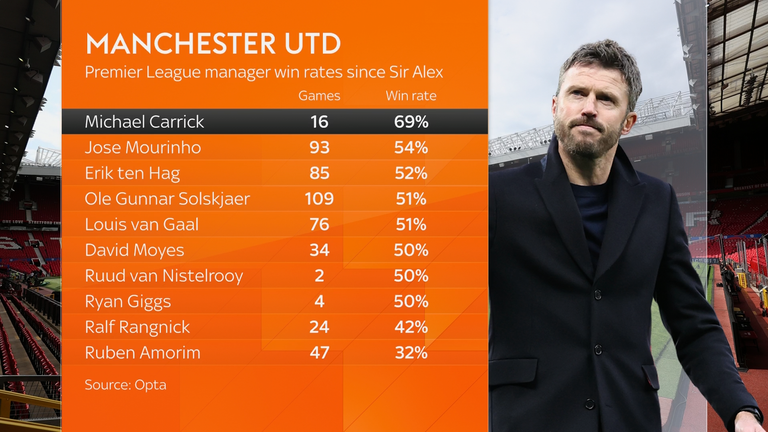
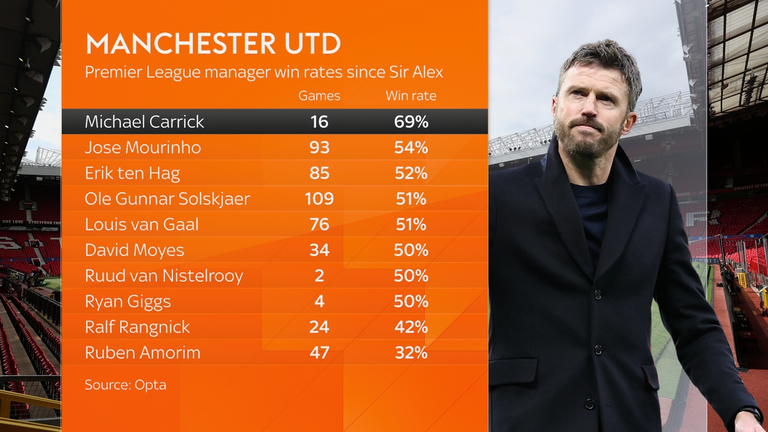
There is, of course, much more to Carrick than that. He has a better win rate than any other United manager since Ferguson, albeit over a smaller sample size. But his lack of Premier League experience is important to factor in to this consideration.
The form that earned Carrick the Man Utd job (correct as of May 23, 2026)
Mikel Arteta is the first manager to win the Premier League who had never won major silverware before his appointment. You can spin that both ways for Carrick, whose journey from midfielder and club captain to the dugout bears some resemblance to Arteta’s.
Describing Carrick as a ‘stop-gap’, or the coach before the coach, may prove foolish if he does one day replicate the remarkable success of Arteta, but it does seem to be a case of ‘Mr Right Now’ rather than ‘Mr Right’.
After all, he has more than enough on his plate to ensure United qualify for the Champions League again, let alone begin challenging for the title.
Coping with Champions League schedule
Carrick’s record at United is remarkable. When he was handed his two-year contract, United had been the best team in the Premier League after winning 12 of Carrick’s 17 games. Amorim had won 15 league games over the entirety of his 18 months in charge.
The big challenge for Carrick will be replicating that form when United are balancing Champions League commitments because this season it has been a relatively easy ride.
Through no fault of his own, Carrick inherited a squad playing a 40-game campaign, the fewest in a single season at United since 1914/15, after being eliminated at the first time of asking in both cup competitions and failing to qualify for Europe.
So, while United outperformed Arsenal and Manchester City, they also enjoyed an average of eight days between games, which is more than double that of Arteta’s side across all competitions. Arsenal (29) played 13 games more than United (16) over that time.
Everyone wants to be in the Champions League, but few can cope with the schedule. Chelsea, Newcastle and Tottenham massively underperformed as a result. Their plight should serve as a warning.
United will have a minimum of eight additional games on top of the 40 they played this season and hope to progress further in the Carabao Cup and FA Cup next time around. For what is currently such a thin squad, that poses a big headache for the head coach.
Reshaping the midfield
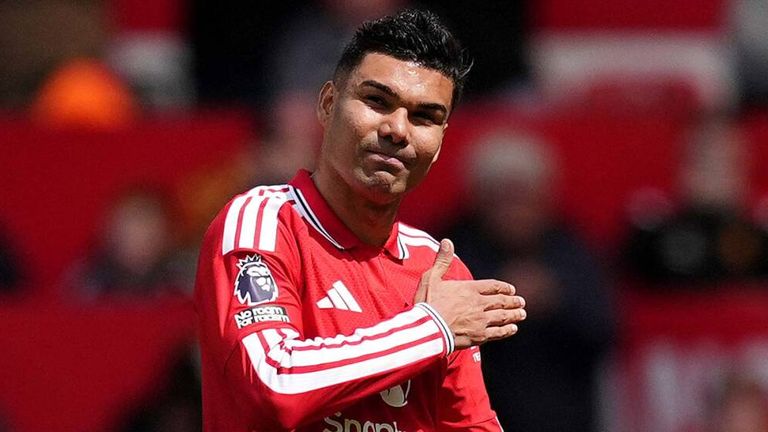
Casemiro is substituted on his final Manchester United appearance at Old Trafford
Almost every area of the squad is in need of reinforcements – but central midfield is the clear priority. It is a position United have never adequately addressed post-Ferguson. But it is tough to think of a time when United’s midfield has required such urgent attention.
Casemiro is leaving, and Manuel Ugarte is likely to join him, with United hoping he can feature in a summer clear-out of up to eight first-team players. That leaves Kobbie Mainoo, 21, as the only recognised central midfielder in the first team.
Sky Sports News understands at least two midfielders will be signed this summer. Elliot Anderson, Carlos Baleba, Mateus Fernandes and Ederson are among their targets. It is hard to see how United cope with anything less than three given the scarcity of their options.
Finding a player to replace Casemiro will be particularly troublesome because of the value he offers in both boxes. He was initially signed as a No 6 – or “the cement between the stones” as Erik ten Hag put it – but became a fan favourite as a goalscoring midfielder.
United need a player for each of those profiles – and another for cover – to feel comfortable with their options. Signing a defensive midfielder will not be enough to replace Casemiro, whose six goal contributions have been worth five points under Carrick.
Shifting the dead wood
Amorim has understandably taken a lot of flak for his decision-making at United. What has gone under the radar somewhat has been his good work in identifying the players that needed to move on.
Alejandro Garnacho and Antony left on permanent deals. Rasmus Hojlund’s loan move to Napoli from last summer will become permanent in June after the Italian club secured Champions League qualification.
Victor Lindelof departed upon the expiry of his contract last summer. This summer, Jadon Sancho, Casemiro and Tyrell Malacia are set to do the same.
Marcus Rashford and Andre Onana, as things stand, will return from their loans at Barcelona and Trabzonspor. Their futures will need to be resolved along with Ugarte and Joshua Zirkzee, who have been on the periphery this season.
If United get their way, there could be eight first-team exits, including those players set to depart as free agents, with the club hoping to recoup £100m from sales.
United, under the minority ownership of INEOS, no longer operate solely taking direction from whichever head coach is in charge but there is no doubt that Carrick’s input will feature in the decision-making about squad building.
In his role as head coach until the end of the season, Carrick has been a firm favourite in the dressing room. Difficult decisions that require him to be ruthless lie ahead. How he handles that could define his tenure as United boss.
What’s next?
Already thinking about the 2026/27 Premier League season?
There’s a World Cup to fit in first – follow live blogs of every game on the Sky Sports App – but the key dates are locked in for next term, when Sky Sports will once again show at least 215 live Premier League games.
Here’s your summer diary:
June 11: World Cup starts – day-by-day fixture list
June 14: Scotland’s opener vs Haiti (2am)
June 15: Summer transfer window opens
June 17: England’s opener vs Croatia (9pm)
June 19: Premier League fixtures released (10am)
July 19: World Cup final
June 25: Championship fixtures released
August 22-23: Premier League opening weekend
August 27: Champions League league phase draw
August 31: Transfer Deadline Day
September 8-10: Champions League matchday 1
May 30, 2027: Premier League final day