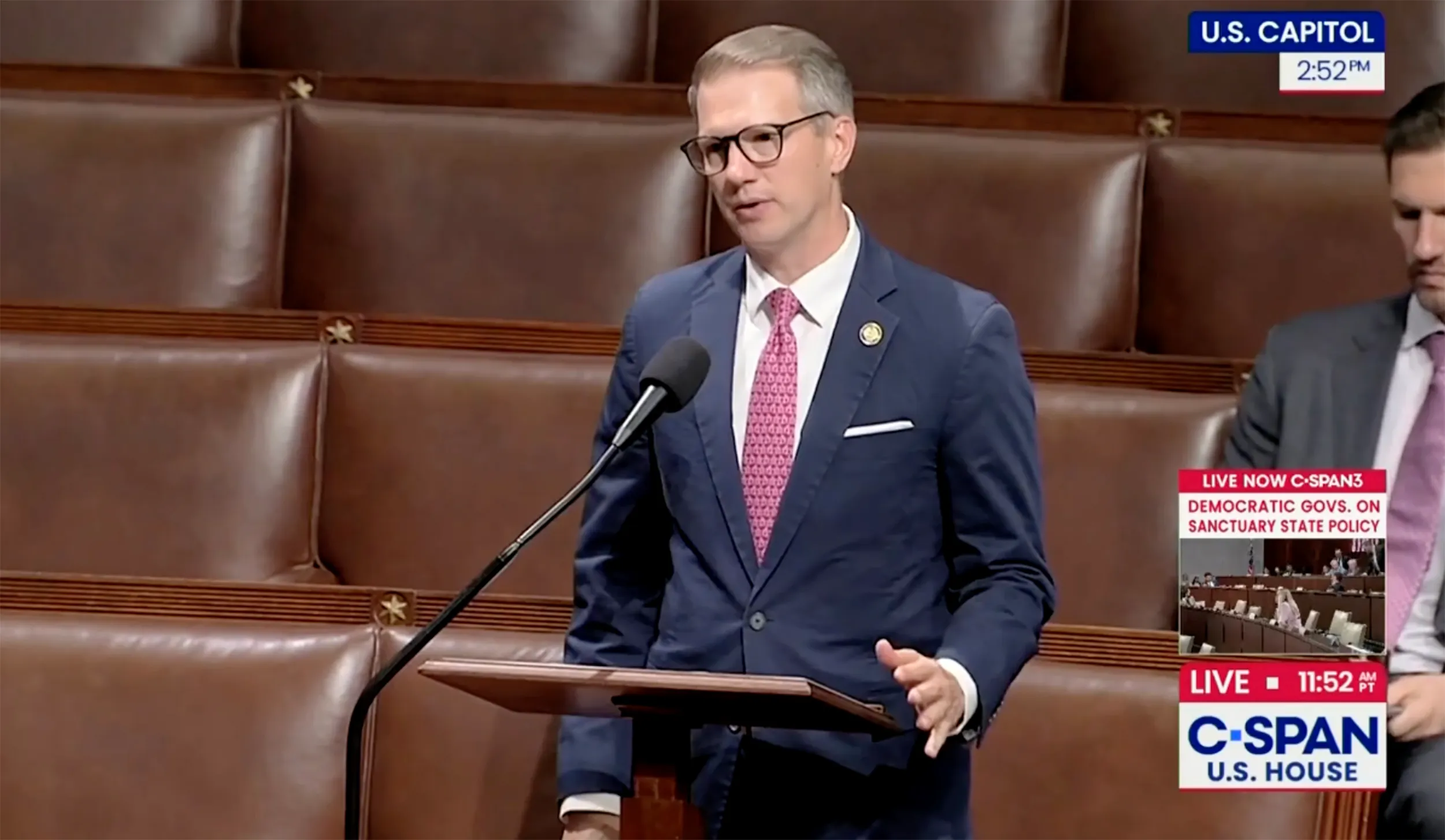
Last week, Rep. Riley Moore rose from his chair in a budget committee meeting to ask for help with West Virginia’s drinking water.
He told his colleagues, “Between 2016 and 2024, nearly one million West Virginians, about half of the state’s population, were served by systems violating federal standards.”
The following day, lawmakers did not agree to fund a $250 million request for water projects both he and fellow West Virginia Rep. Carol Miller submitted earlier this spring.
Moore’s unsuccessful bid for money for clean drinking water is one more chapter in an uphill battle for the state. Just this year, lawmakers in Charleston spent little to fix the state’s $16-20 billion water and sewer problem.
Community advocates turned to their federal representatives for help.
Moore and Miller, like most Republicans, have supported President Donald Trump’s agenda to slash federal spending through their votes, public statements and photo opportunities.
In the U.S. Senate, Sen. Jim Justice, a man who invited Trump to attend a rally where he announced he’d switched parties, expressed support for Moore and Miller’s request for water aid.
“I hope to see some big wins for our state when the next appropriations bills are released this year,” Justice said in a statement.
But so far, the wins for water funding aren’t there.
And if the Trump administration had its way, West Virginia probably wouldn’t win at all. The president’s proposed budget calls for cuts to the major fund that pays for water and sewer projects nationwide, the same one West Virginia’s congressional representatives are now trying to get money from.
Last year, Moore took over a working group dedicated to passing Trump’s legislation to eliminate funding for public broadcasting and foreign aid, stalling water projects in at least 21 countries.
But for Washington Republicans, Moore and Miller included, the domestic grant program for water and sewer projects, mostly in rural and impoverished areas, is not to be touched. Since 2021, West Virginia’s mostly-Republican congressional delegation has brought back $258.8 million in water project funding to the state from that program.
The program, administered by the Environmental Protection Agency, has helped communities nationwide with water and sewer projects.
However, over the last two budget cycles, the Trump Administration has recommended cutting the program’s budget to about one-fifth of its current level.
Since taking office, the Trump administration has stressed that states should take on more responsibilities, whether it be for food assistance, disaster response or education.
But some communities and lawmakers in West Virginia tried earlier this year to get $250 million for water in the Southern Coalfields. Lawmakers slow-walked introducing any legislation that would help, and when they did, the amount shrank to about $20 million. Republicans still killed it while passing tax cuts that benefit the wealthiest West Virginians.
The Rev. Caitlin Ware, an activist involved in trying to get clean water to the coalfields, said her group, From Below: Rising Together for Coalfield Justice and others had visited Washington, D.C. in the past to get funding. But the failure in Charleston renewed their efforts.
Her group and 40 others signed a letter and sent it to federal lawmakers earlier this month.
“Now we see the state has zero interest in doing it, so let’s move to the federal,” she said.
Ware noted Moore’s office has shown an interest in securing funding and resources for the water crisis.
So far this year, Moore successfully garnered support for an amendment that encourages the Army Corps of Engineers to offer technical advice to water districts in southern West Virginia. The amendment did not include a budget amount for the technical advice.
Before Moore, who did not respond to multiple requests for comment, took office in January 2025, he declared himself both a fan of cutting budgets and getting pork projects back to West Virginia.
“We have a long history of appropriators in West Virginia, and I’m happy to carry on that tradition. At the same time, while trying to right-size our federal budget and expenditures and everything else going on, it’s a real honor,” Moore said in a MetroNews Talkline interview.
Miller opposed two Biden-era spending bills that helped expedite water projects in the state. She doesn’t see a problem with spending money on water now.
“Congresswoman Miller is committed to being a good steward of taxpayer dollars and believes that spending an efficient amount of tax dollars to build infrastructure projects that deliver clean water to our communities is a good use of money,” her office replied in an email statement.
Last year, lawmakers in D.C. rejected the president’s proposal to cut water funding and funded the EPA’s program at a little more than $3 billion. At an April 27 subcommittee hearing, Rep. Mike Simpson, R-Idaho, told EPA Administrator Lee Zeldin that cutting it was a nonstarter.
Early versions of the budget show the grant funding remains largely intact, at $3.8 billion this year.
Moore, who sits on the appropriations committee, will have another shot at getting the money for West Virginia water projects on June 3, when the full committee meets about the appropriations bill. At that time, he could introduce an amendment for $250 million. Moore’s office did not respond to a question asking what he plans to do to secure the money.