Key Points
Most promising artificial intelligence (AI) stocks are already priced at a premium. So while growth rates are high, so are the valuations.
There’s one AI stock, however, that remains a bargain. That’s because most investors don’t yet classify the company as an artificial intelligence business. That’s the case even though the company’s closest competitor is arguably one of the biggest AI stocks on the planet.
Will AI create the world’s first trillionaire? Our team just released a report on the one little-known company, called an “Indispensable Monopoly” providing the critical technology Nvidia and Intel both need. Continue »
If this emerging AI stock falls below $10, I’m going all in for the long haul.
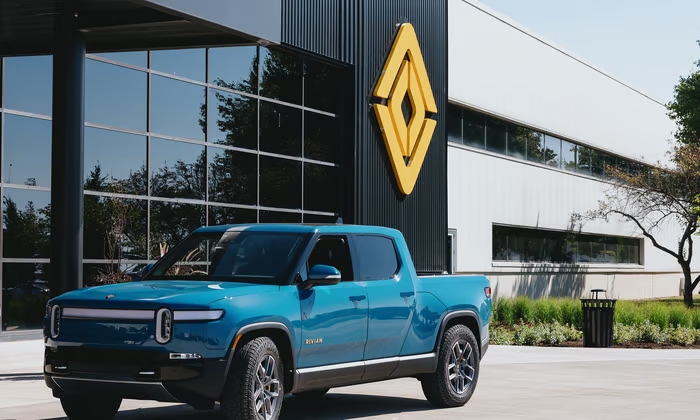
Image source: Rivian.
This Tesla competitor is my favorite AI stock in 2026
Most analysts have come to appreciate the AI potential of Tesla (NASDAQ: TSLA). Autonomous driving technologies increasingly rely on AI, leading to rapid advancements that could make self-driving cars a reality within the next few years.
Tesla has made direct AI investments, including its $2 billion investment in xAI, Elon Musk‘s AI start-up. But it’s really the robotaxi market that is driving Tesla’s $1.3 trillion valuation. Major Tesla investor Cathie Wood, CEO of Ark Invest, believes robotaxis could be Tesla’s biggest growth opportunity in its history.
“We think US$8 [trillion] to US$10 trillion for the entire autonomous taxi opportunity throughout the world, from almost nothing,” Wood told investors last year. “That’s how quickly AI is going to cause these things to happen.” Five years from now, Wood thinks that robotaxis will account for 90% of Tesla’s valuation.
But Tesla isn’t the only EV stock betting big on AI and autonomous driving. Rivian (NASDAQ: RIVN) is also going all in on AI and autonomy, so much so that it recently pushed out its profit timeline to invest more aggressively. And here’s the thing: Rivian’s market cap is just $17 billion — 98.7% smaller than Tesla’s market cap.
Rivian does have some structural disadvantages versus the likes of Tesla. The company’s smaller size limits its ability to fund large-scale research and development in AI and autonomy.
It’s also taking a different approach to robotaxis. While Tesla is both building its own vehicles and operating its own robotaxi service, Rivian seems content to be an industry supplier. In March, the company announced a deal with Uber Technologies to supply 50,000 Rivian vehicles to power that company’s robotaxi arm.
It will take years until the robotaxi market begins to mature. But investors are clearly bought into Tesla’s vision. Rivian has a similar vision, yet its stock garners a much smaller valuation both in terms of market cap and key valuation metrics like price-to-sales ratio.
Rivian stock doesn’t break below the $10 mark often. But if a market correction brings shares sharply lower, I’m prepared to load up on Rivian stock for the long haul.
Should you buy stock in Rivian Automotive right now?
Before you buy stock in Rivian Automotive, consider this:
The Motley Fool Stock Advisor analyst team just identified what they believe are the 10 best stocks for investors to buy now… and Rivian Automotive wasn’t one of them. The 10 stocks that made the cut could produce monster returns in the coming years.
Consider when Netflix made this list on December 17, 2004… if you invested $1,000 at the time of our recommendation, you’d have $477,813!* Or when Nvidia made this list on April 15, 2005… if you invested $1,000 at the time of our recommendation, you’d have $1,320,088!*
Now, it’s worth noting Stock Advisor’s total average return is 986% — a market-crushing outperformance compared to 208% for the S&P 500. Don’t miss the latest top 10 list, available with Stock Advisor, and join an investing community built by individual investors for individual investors.
*Stock Advisor returns as of May 23, 2026.
Ryan Vanzo has no position in any of the stocks mentioned. The Motley Fool has positions in and recommends Tesla and Uber Technologies. The Motley Fool has a disclosure policy.
The views and opinions expressed herein are the views and opinions of the author and do not necessarily reflect those of Nasdaq, Inc.