Few statesmen have reflected as deeply on the unpredictable nature of war as Winston Churchill. In his autobiography, “My Early Life: A Roving Commission,” written in the aftermath of the Boer War, he wrote:
“Never, never, never believe any war will be smooth and easy, or that anyone who embarks on that strange voyage can measure the tides and hurricanes he will encounter. The Statesman who yields to war fever must realise that once the signal is given, he is no longer the master of policy but the slave of unforeseeable and uncontrollable events.”
President Donald Trump has never believed that wars are smooth and easy. Indeed, in an August 2004 interview with Esquire magazine, he staked his ground as an opponent of costly and catastrophic wars, taking the Bush administration to task for launching the Iraq War on the premise that Saddam was pursuing weapons of mass destruction, later failing to discover any weapons.
Now, decades later, the United States finds itself on the brink of two regional wars that could spin out of control: the conflict in the Persian Gulf that could sink the world economy and, beyond Gaza and the West Bank, a calamity in Lebanon that could become Netanyahu’s Vietnam.
In this light, Trump’s summit with Chinese leader Xi Jinping is as pivotal as Nixon and Kissinger’s 1972 visit, dubbed “the week that changed the world.”
There would be no war in Iran without the specter of China’s neocolonialism. As Iran’s strategic partner, China plays a double game. China uses Iran as a battering ram against America and its partners in the Middle East while pretending to act as mediator. As Operation Epic Fury unfolded, China provided Iran with satellite imagery to facilitate the targeting of troops and bases, hardly a neutral act. Remarkably, during the summit Trump and Rubio seem to have secured Xi’s assurance that he would not provide arms to Iran, an important diplomatic win.
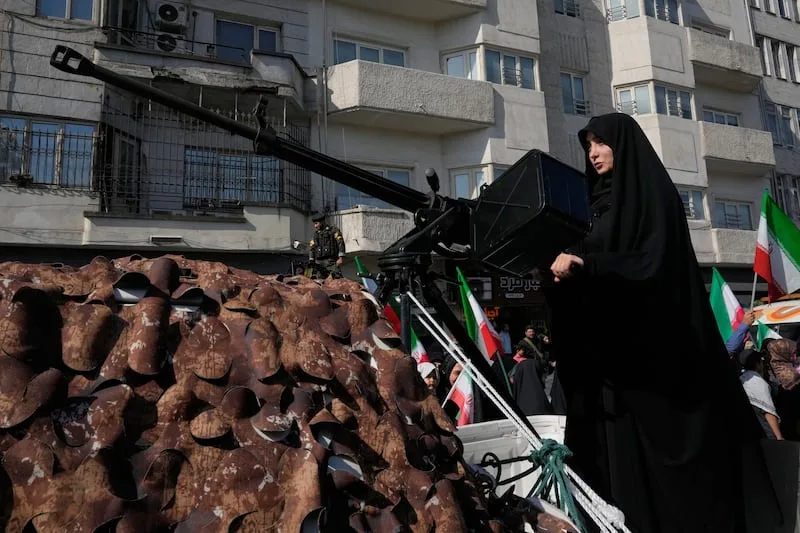
A women member of the Basij paramilitary, affiliated with Iran’s Revolutionary Guard, holds a machine gun on a pickup truck during a state-organized rally in support of the supreme leader marking National Girl’s Day in Tehran, Iran, Friday, April 17, 2026. | Vahid Salemi
But it may prove short-lived, as China has repeatedly provided the Islamic Republic with military and diplomatic cover, most recently by shielding Iran’s leaders at the U.N. for the January massacre of Iranian protesters and condemning the subsequent US-Israel war.
Yet far from protecting Iran’s sovereignty, China’s diplomacy reveals a darker reality. China has for all practical purposes converted Iran’s Revolutionary Guards Corps into its proxy — a militia that sells Iran’s oil to China at a discount, massacres the Iranian people at home, and targets American bases, interests and partners in the Middle East.
Herein lies the undeniable problem: China uses the cover of sanctions to siphon billions of dollars’ worth of Iranian oil — at severely discounted prices. China finances the IRGC and supplies Iran with components and fuel for its missiles. China sells the IRGC surveillance systems to track and silence dissidents. China enables the IRGC to plunge Iran into darkness by providing the technology to pull the plug on the internet, now for over 70 days.
A container ship sits at anchor as a small motorboat passes in the foreground in the Strait of Hormuz off Bandar Abbas, Iran, Saturday, May 2, 2026. | Amirhosein Khorgooi, ISNA via the Associated Press
Without China’s support, the IRGC would collapse and the Islamic Republic would fall within months — without a shot being fired. What’s more, a win in Iran, the arrival of an Iranian Spring would usher in the end of a Chinese winter — the shadow cast by Xi Jinping and the Communist Party over China, the Middle East, Asia and even America.
The president knows this, and so do the Iranian people.
While Trump’s patience with the war is wearing thin, this is not the moment to strike a deal with China that protects the regime. Nor is it the moment to antagonize the Iranian people with threats of destruction, to impoverish them by targeting Iran’s economic and oil infrastructure, or to bleed them with plans for partition — a Jerusalem Post proposal for a Kurdish state premised on dismembering Iraq, Turkey and Iran, a failed Syrian model.
Rather, this is the moment for the President to honor his promise — and place his faith — in the Iranian people. In his Feb. 28, 2026, address to the Iranian people on Truth Social, Trump said:
“[Finally], to the great proud people of Iran, I say tonight that the hour of your freedom is at hand.”
A woman holds up pictures of the Iranian Supreme Leader Ayatollah Mojtaba Khamenei, left, and his father, the slain Ayatollah Ali Khamenei in a state-organised rally celebrating the birthday of Imam Reza, the 8th Shiite Muslims’ Imam, and supporting the supreme leader, in Tehran, Iran, Wednesday, April 29, 2026. | Vahid Salemi
Thousands of Iranians placed their faith in the President’s word — and paid the ultimate price for freedom with their lives. What we owe them — and our friends in the Persian Gulf — is Iran’s resurrection. That begins with diplomacy that cuts off China’s support for the IRGC. And it ends with exploding a lie — refusing to recognize the IRGC’s puppet, Mojtaba, as Iran’s supreme leader.
It is time for the United States and China to recognize that everyone’s interests are best served by ending the reign of Iran’s militant ayatollahs and placing Iran’s sovereignty back where it has always belonged. A new, secular Iran open to the world will be a better friend to the United States, to China and its neighbors without sacrificing the Iranian people or destabilizing the region and world economy.